This classification of soleares styles is based on the research of Luis Soler Guevara and Ramón Soler Díaz in their book, "Antonio Mairena en el Mundo de la Siguiriya y la Soleá," published by the Fundación Antonio Mairena and the Junta de Andalucía. The book contains an analysis of 1,269 soleás (examples of sung verse) recorded by 130 singers born up to 1920 and of some 250 non-commercial recordings, as well as a wealth of data obtained from abundant primary sources. The recordings range from late 19th-century cylinders to CDs released shortly before the publication of the book in 1992.
Cante means flamenco singing in a broad sense or any specific example of a singing style. Verse (stanza) refers to a predetermined arrangement of lines, syllables and rhyme. The cambio is a standard ending in the last few lines of sung verse. Por arriba is guitar accompaniment based on the chords E major and F major; por medio is accompaniment based on A major and B-flat major.
Soleás are lyric poems sung with three or four eight-syllable lines and perfect (vowels and consonants coincide) or assonant (vowels coincide) rhymes in the first and third lines of three-line verse and in the second and fourth lines of four-line verse:
The lines of verse are sung one after another or repeated, with or without pauses between the lines, although in all styles the last lines are sung without pause or repetition, forming a compact unit known as the cambio. This means that there is always a core of successive lines starting just before the cambio: ABC in three-line verse and BCD in four-line verse. Because of the fixed nature of the endings of the different styles, variations on form are determined by the first line or lines:
Five of these patterns can be identified in nearly 80 percent of all styles and can be related to four stages of singing soleás:
The cantes de inicio use only four-line verse, but others can be sung with three- or four-line verse. Four-line verse can be made to fit three-line structures by starting with the second line of verse because lines BCD of four-line verse contain the same rhyme scheme as lines ABC of three-line verse. The first line can be used in the repetition of the conclusion or omitted if the meaning of the words remains clear. Here are two examples of the style Enrique el Mellizo 2, which is usually arranged AAA-BC-BC, as seen in the version of Mairena:
Regarding the accompaniment, most styles start with melodies that involve the chords II-I (F-E por arriba) or the chords I7-iv (E7-Am). In a few styles, the implied chords are III-II (G-F), VI7-II (C7-F) or V7-I (B7-E). In nearly all styles, the conclusion (cambio) is III-VI-II-I (G-C-F-E).
The following patterns are found among the recordings of the nearly 100 styles that make up this study. Obviously, singing in real life is not always going to coincide with these models. Due to artistic endeavor or waning faculties, singers are free at all times to interpret the cantes as they wish.
Pattern 1: AB-BB-CD-CD or AB-AB-CD-CD (starting cantes)
These cantes start with the repetition of a compound phrase (two lines of verse with differing melodies, normally the rise and fall of an arc) that resolves to the tonic at the end of the second and fourth lines. The first lines may be AB-AB or AB-BB and the last lines CD without repetition, CD-CD or CD-AB (in nearly all styles, singers are completely free to repeat the conclusion). Notice that in the middle of the pattern AB-AB-CD-CD the lines are arranged ABCD.
Other ways of singing four-line verse:
ABCD: Matrona 1, Fillo 1, Joselero and Yllanda 3. The four lines are sung one after another or linked.
ABCDAB: Silverio 1-2 and Enrique Ortega. Three soleás apolás the melodies of which involve the chord progression VI-III-VI-II-I. In both styles of Silverio, because of this progression, there must be at least six sung lines of verse.
A-AB-CD-CD: Serneta 1, Fillo 2 and Onofre 1. The first sung line is sung separately and then the first two lines are sung together. Notice that in the middle of this pattern the four lines are arranged ABCD.
ABB-CD-CD: Paquirri 1 and Ribalta. The second line is repeated, forming a unit of three sung lines.
Pattern 2: A-A-BC-BC (transitional)
With three-line verse, the first line is repeated (not linked) with the same simple phrase (one line of verse and one melody). This is the pattern that appears most often among the different styles. Among the I7-iv cantes, a number of melodic patterns are common to several styles (see the description of each style for more information). If we use four-line verse for this pattern, the result is the analogous pattern B-B-CD-AB. Notice that in the middle of pattern 2 the lines are arranged ABC.
The following styles use pattern 2 with different harmonic implications: Carapiera (V7-I), Serneta 4 (VI7-II), and Caracol and Jerez (II-III).
Pattern 3: ABC-BC (transitional/ending)
Sung with three linked lines of verse. If we use four-line verse for this pattern, the result is the analogous pattern BCD-AB. Notice that pattern 2 becomes pattern 3 when the first line is not repeated.
The following styles use pattern 3 with different harmonic implications: Juaniquí 4 (VI7-II), Yllanda 1 and R. Moreno 1 (II-III).
Pattern 4: AAA-BC-BC (ending cantes)
Sung with three linked and/or fragmented lines of verse. Sometimes the first line is repeated twice instead of three times. If we use four-line verse for this pattern, the result is the analogous pattern BBB-CD-AB. The styles in this group are Joaquín 3, Mellizo 2 and Paquirri 3. Very often the style of Joaquín is sung at the end of a series of soleares.
Other ways of singing three-line verse:
AAA-BC-BC: Morcilla, Frijones 4, Mairena 4 and Pepe Torre. The lines are arranged as in pattern 4, but without the extreme linking. The style el Morcilla repeats the music of the second line in the third, at least in the version of Manolo Vargas, which makes it more similar to the styles Paquirri 1 and Ribalta. The styles Frijones 4, Pepe Torre and Mairena 4 start with two lines that lead into the style Frijones 2.
AABC(BC): Francisco Amaya and el Portugués 2. As in the preceding pattern, three-line verse is adapted to cantes that start with a compound phrase (two lines).
The remaining styles have been recorded using different patterns, and no specific pattern has been assigned: Chozas 1-2, José de Paula, Portugués 1, Sordillo 1. Recordings of the styles R. Moreno 2 and E. Abadía 1-2 remain unavailable for this study.
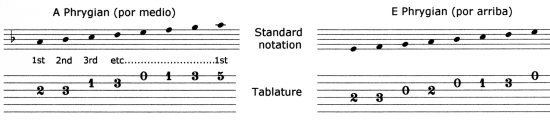
Flamenco guitarists use capos to adjust the key of the music to the singer's preference. This makes it difficult to compare different recordings of a single style because the recordings are likely to be in different keys. For purposes of analysis, we can use the Phrygian mode to represent the melodies of soleá styles in order to generically refer to each note of the melody as a degree, regardless of the corresponding key. The diagram below represents standard notation and guitar tablature for A and E Phrygian scales. The first note (also called tonic) would be the first degree, the second note would be the second degree, etc. The eighth note would be the first degree once again because it is the same note in a higher register (this is why they are called octaves). Using this same system, Roman numerals are used in reference to chords. For example, playing por medio, in the key of A, a D minor chord would be written "iv" because D is the fourth scale tone (A-B-C-D) and in lower case because it's a minor chord (D major would be IV).
The styles are attributed to the artists with whom they are most closely associated, but it does not necessarily mean that they created them. In many cases, they either sang styles that were popular within their family or social group or sang a personal version of another attributed song form. Therefore, this classification is not designed to determine the authorship of styles. Its greatest value is the compilation of different versions of styles and the establishment of a series of names for their identification.
All the styles included here are associated with Alcalá de Guadaíra, except for the two styles attributed to la Jilica from the neighboring town of Marchena.
Verse/accompaniment: A-A-BC-BC / II-I. Popularity: known. Agustín Fernández Franco was born in Alcalá de Guadaíra in 1853 and died in Dos Hermanas in 1919. He was the brother of Joaquín el de la Paula, the father of Juan Talega and uncle of Manolito de María. The first sung line is the descending leg of the melodic arc heard in the style attributed to Juan Talega.
Juan Talega (1959). With Paco Aguilera. Capo at third fret por arriba (G).
Se meneaban cuando yo paso
se menean cuando paso
yo te quiero a ti solita
y a nadie hacía yo caso
Juan Talega (1966). With Melchor. Capo at third fret por arriba (G). Without the repetition of the first line, the lines of verse are arranged ABC.
Yo voy a perder la razón
que cuando hablo contigo
y a mí me engaña mi corazón
Verse/accompaniment: ABC-BC / I7-iv. Popularity: known. This cante contains a simplified version of the melody of Joaquín el de la Paula 3 without the repetition and fragmentation of the first line. Between the end of the first line and the beginning of the second, the melody reaches the seventh degree in a flourish that links the two lines. The linking flourish is one of the characteristics that distinguish this style from Joaquín el de la Paula 2 and la Roezna 2, another being the pause and thrust heard in the last line, as detailed below.
Juan Talega (196?). With Diego de El Gastor. Capo at fourth fret por arriba (G sharp). He starts singing on beats 7-8. The linking flourish is heard in the words "mío por." Notice how he breaks his voice in the second sung line in the word "que." The pause and thrust are heard in "bo-rrara de mi" on beats 7-8-9-10.
Pidiendo a Jesús mío
por lo que pasó en el huerto
te borrara de mi sentido
Juan Talega (1962). With Paco Acosta. Capo at fourth fret por arriba (G sharp). He starts singing on beats 1-2-3. The linking flourish is heard in the words "ver y a." The pause and thrust are heard in "fa-alta de mi" on beats 12-1-2-3.
Que no me puedes ver y
a la cara te ha salido
la falta de mi querer
Juan Talega (1966). With Melchor. Capo at third fret por arriba (G). He starts singing on beats 7-8. The linking flourish is heard in the words "bueno por(que)." The pause and thrust are heard in "ve-ez de sangre" on beats 7-8-9-10.
No puedes hacer nada bueno
porque tienes en tus venas
y en vez de sangre veneno
Verse/accompaniment: A-A-BC-BC / II-I. Popularity: known. The birth certificate of la Jilica was recently brought to light by her descendant Paqui Reyes Torres in the July-September 2011 edition of the magazine La nueva Alboreá. According to the published information, María del Carmen Reyes Torres was born in Écija in 1867, she subsequently moved with her family to Marchena and was the aunt-in-law of Melchor de Marchena. Click here for information on Paqui's book about flamenco in Écija. Luis and Ramón Soler point out the similarity between this style and la Andonda 2 in the first line and in the pauses between lines, although the melodies are not the same. In all versions except Pastora's, the first sung lines end with one or more syllables of the next line and a pause. In the versions of Chaqueta and Mairena, the pause at the beginning of the third line of verse is very similar to what Juan Talega sang in the style la Roezna 2. The versions of Antonio Mairena and Joselero are sung with characteristics of Alcalá and Triana, respectively.
Pastora (1947). With Melchor. Capo at fifth fret
por medio (D). Pastora's version does not feature the characteristic ending of the first lines of verse and the melody in the third sung line is different. The title of the recording is "Soleares marcheneras."
(Cuan)do paso por tu puerta
cuando paso por tu puerta
cojo un puñado de papeles
que todos se me volvieron mosquetas
cogí un puñado de papeles
que todos se me volvieron mosquetas
Chaqueta (1950). With Paco Aguilera. Capo at third fret por arriba (G). The same cante is set to bulerías rhythm. Notice the abrupt pause at the beginning of the third line of verse (after "que cuando"), also heard in two of Antonio Mairena's versions.
(A) mí me daba me daba y a mí
me daba me daba tenta-
-aciones de locura
que cuando de ti me acordaba
Chaqueta (1950). With Paco Aguilera. Capo at third fret por arriba (G). From the same recording. Another example of the pause at the beginning of the third line of verse (after "de hier-").
(Le)vántate tempranito levan-
-tate tempranito y ve-
-erás como te traigo
que de hierbabuena un ramito
Antonio Mairena (1965). With Melchor. Capo at sixth fret por arriba (A sharp).
Levanta y no duermas más leva-
-anta y no duermas más que vie-
-enen los pajaritos
cantando la madrugada
que vienen los pajaritos
y cantando la madrugada
Antonio Mairena (1966). With Melchor. Capo at sixth fret por arriba (A sharp). The ending is reminiscent of Alcalá styles.
Pasas de largo y no miras pasa-
-as de largo y no miras como-
-o sabes que yo te quiero
tú me hacías pasar fatigas
Antonio Mairena (1969). With Melchor. Capo at sixth fret por arriba (A sharp). Another example of the pause at the beginning of the third line of verse (after "que se"). Carmen Linares sings this cante with some of the features heard here.
(Cuan)do pasas y no me miras cuando
pasas y no me miras y el co-
-orazón por la boca
que se me sale de fatiga
corazón por la boca
que se me sale de fatiga
Antonio Mairena (1969). With Melchor. Capo at sixth fret por arriba (A sharp). Another example of the pause at the beginning of the third line of verse (after "y el mal").
(Mal) fin tenga esta gitana mal fin
tenga esta gitana sabie-
-endo que la camelo
y el mal paguito que a mí me daba
(sa)biendo que la camelo
y el mal paguito que a mí me daba
Joselero (1976). With Diego de Morón. Capo at first fret por arriba (F). Echoes of Triana styles in the endings of the next two versions.
Merecía esta serrana mere-
-ecía esta serrana que la-
-a fundieron de nuevo
que como funden las campanas
Joselero (1978). With Diego de Morón. Capo at third fret por arriba (G).
(¿Que yo) contigo no igualo que yo-
-o contigo no igualo? eso-
-o será en los dineros
que a vergüenza yo te gano
Verse/accompaniment: ABC-BC / I7-iv. Popularity: not popular. In the beginnings of the following versions, Pastora's is similar to Joaquín el de la Paula 3 and Mairena's is closer to la Roezna 2.
Pastora (1947). With Melchor. Capo at fifth fret por medio (D). Includes the "juguetillo" ending, seen below.
Llévame a una huerta
por Dios llévame a una huerta
y dame unos paseítos
que cayéndome estaba muerta
y dame unos paseítos
que me estaba cayendo muerta
Vente conmigo
dile a tu madre
que soy tu primo
Antonio Mairena (1969). With Melchor. Capo at sixth fret por arriba (A sharp).
Primita llévame al huerto
y dame unos paseítos
que cayéndome estaba muerto
y dame unos paseítos
que cayéndome estaba muerto
Verse/accompaniment: AB-BB-CD-CD / I7-iv. Popularity: popular. Joaquín Fernández Franco was born in Alcalá de Guadaíra in 1875 and died in 1933. He was the brother of Agustín Talega and the uncle of Juan Talega and Manolito de María. This classic four-line starting style has long been one of the most popular soleás, although none of the styles attributed to Joaquín were recorded before the mid-1920s. It is interesting to compare the melody and structure of this style to those of la Serneta 1 and Enrique el Mellizo 1.
Manuel Torre (1929). With Borrull hijo. Capo at third fret por medio (C). Manuel's personal version seems to have inspired Tomás Pavón and many other artists. The lines of verse are arranged A-AB-CD.
Por ti abandoné a mis niños
por ti abandoné a mis niños
y mi madrecita de penita murió
ahora te vas y me abandonas
no tienes perdón de Dios
Tomás Pavón (1947). With Melchor. Capo at second fret por medio (B). This cante is considered by some aficionados to be a separate soleá of Alcalá, although it seems to be based on Manuel Torre's version of this style. Nonetheless, Tomás' version includes some important contributions to the style of Joaquín and the version of Manuel. As in said version, Tomás isolates and repeats the first sung line, but his outstanding musicianship is apparent in the stretching of certain syllables, his linking of lines of verse and the absence of long pauses.
Válgame Dios no le temes
válgame Dios y no le temes
ni a la ira de Undebel
ni a la ira de Undebel
ni a la ira de Undebel
y sin embargo te asustas
gitana de mi querer
Juan Talega (1962). With Eduardo el de la Malena. Capo at third fret por arriba (G). Verse 5398 from the collection "Cantos populares españoles" by Francisco Rodríguez Marín: "¿A quién le contaré yo / Lo que á mí me está pasando? / Se lo contaré á la tierra, / Cuando me estén enterrando."
¿A quién le contaré yo
la fatiguillita que estoy pasando
fatiga que estoy pasando
la fatiguillita que estoy pasando?
se la voy a contar a la tierra
cuando me estén enterrando
se lo voy a contar a la tierra
cuando me estén enterrando
Verse/accompaniment: ABC-BC / I7-iv. Popularity: popular. This style is normally sung immediately after Joaquín el de la Paula 1 in transition to more dramatic styles. However, several different ways of singing this cante have been developed over time, and it can even be used to conclude a series of soleás. This style is very similar to la Roezna 2, but the second line of verse includes the fifth or even sixth degree, while la Roezna 2 goes no higher than the fourth degree. The melody of the first line is in Manuel Cagancho 1, Juaniquí 3, Santamaría, Manolo Oliver and, with differences, la Serneta 2. In studio recordings, Juan Talega sings what appears to be his version of this style (see below), and the versions of Manolito de María also seem to be the artist's personal approach to the style. In Antonio Mairena's versions of the style la Roezna 2, the first line is identical to that of Juan Talega's versions of this second style of his uncle Joaquín.
Tomás Pavón (1927). With Niño Ricardo. Capo at sixth fret por arriba (A sharp).
Me voy por la otra acera
porque le temo a tu madre
que tiene muy mala lengua
y que yo a tu madre le temo
que tiene muy mala lengua
Tomás Pavón (1927). With Niño Ricardo. Capo at sixth fret por arriba (A sharp). Tomás' personal vision of this style.
(Tú) te tienes que quedar
con el dedito señalando
como se quedó san Juan
y con el dedo señalando
como se quedó san Juan
Manuel Torre (1929). With Borrull hijo. Capo at third fret por medio (C). An incredible reworking of this cante by Torre. Notice the difference between the third and fourth sung lines.
Veo que te vas a quedar
con el dedo señalando
como se quedó san Juan
señalando con el dedo
como se quedó san Juan
Tomás Pavón (1947). With Melchor. Capo at second fret por medio (B). Another monumental reworking of this style. In a rather unusual move, Tomás starts the first line on beat four. Like Juan Talega, he ends the first line of verse on the fourth degree. He lengthens the second line, reaching the seventh degree (as in Agustín Talega 2) and eventually zeroing in on a note heard at the end of the line. Melchor follows him perfectly, waiting until beat 12 for the change to the VI chord (F without capo por medio). Compare this to Tomás' versions from 1928 to see the great versatility of this style.
(No) encuentro otro remedio
que agachar la cabecita
creer que lo blanco es negro
Juan Talega (1959). With Paco Aguilera. Capo at third fret por arriba (G). In studio recordings, the second line of verse is sung in what appears to be Juan's version of the style, consisting of a descent from the sixth degree (or upturn from fifth to sixth) and the juxtaposition of the third and major second degrees (heard in this version in the word "loco."). The juxtaposition contrasts wonderfully with the minor second degree heard in the third line of verse.
(Qui)se mucho a una mujer
tuve un momento de loco
y esa mi ruina fue
Juan Talega (1959). With Paco Aguilera. Capo at third fret por arriba (G). The juxtaposition of the third and major second degrees is heard in the word "intención."
(Dices) que no me querías
pero hice la intención
de no mirarte en mi vida
Juan Talega (1962). With Eduardo el de la Malena. Capo at third fret por arriba (G). The juxtaposition is heard in the word "tienes."
(Dices) que no me querías
cuando adelante tú me tienes
el sentido te varía
Juan Talega (196?). With Diego de El Gastor. Capo at fourth fret por arriba (G sharp). This is one example of a more classic version of the style that Talega sang outside of recording studios. The second line of verse starts with an upturn from the fourth to the fifth degree and the ending does not involve the aforementioned juxtaposition.
Pasé un día por tu puerta
tiré un puñado de papeles
y me se volvieron mosquetas
Verse/accompaniment: AAA-BC-BC / I7-iv. Popularity: popular. Nearly always, this style is sung with three-line verse as the last of a series of soleás. The first line is fragmented into several sung lines, each starting with the last vowel of the end of the preceding line. The tension climaxes at the start of the second line of verse and the rest of the cante is sung straight through. Singers sometimes add characteristics of other styles to the conclusion. There are similarities between this style and Enrique el Mellizo 2 as both make use of the seventh degree in the first half of the verse, but the first sung line of the soleá of Joaquín only reaches the sixth scale degree before going on to the seventh degree in the following sung lines (reaching a melodic climax before going on to the second and third lines of verse), and the cante of Enrique el Mellizo goes straight to the seventh scale degree from the first sung line. Sometimes the first line is repeated twice instead of three times, as in the cante of el Mellizo. Click here to listen to several cantes related to this style.
El Gloria (1929). With Niño Ricardo. Capo at fourth fret por medio (C sharp). In this excellent version with echoes of Cádiz styles, the lines are arranged BB-CD-AB. Verse 2222 Rodríguez Marín: "Quitarme de que te quiera / Es quitarme la salú, / Porque, á la chita callando, / Mi vida la tienes tú."
Me quita la salud
y es quitarme la salud
pero a la calla callando
la culpa la tienes tú
quitarme de que te quiera
y es quitarme la salud
Manolito de María (1962). With Fernández el Negro. Capo at sixth fret por arriba (G). In the next two versions, the lines are arranged AAAA-BC.
(Por) dinero no lo-
-o hagas por di-
-inero no lo-
-o hagas lléva-
-ame a las herrerías
y échame un hierro en la cara
Manolito de María (1962). With Fernando de Alcalá. Capo at third fret por arriba (G).
(Des)de que murió mi-
-i madre desde-
-e que murió mi-
-i madre la ca-
-amisa de mi cuerpo
no tengo quien me la lave
Perrate (1962). With Eduardo el de la Malena. Capo at third fret por arriba (G). In this version the first sung line is a bit longer than usual and the lines are arranged AA-BC-BC. The inspired letra was recorded by Pastora Pavón por tientos in 1917 with Currito el de la Jeroma: "Al rezarle al Cristo un credo / por decir: ‘Creo en Dios padre’ / dije ‘Serrano te quiero’ / yo me fui a la capillita / a rezarle al Cristo un credo."
Al rezarle al Cristo un credo y a re-
-ezar al Cristo un credo
por decir, ‘Creo en Dios padre’,
dije, ‘Gitana te quiero’
y por decir, ‘Creo en Dios padre’,
dije, ‘Gitana te quiero’
Antonio Mairena (1974). With Paco de Lucía. Capo at sixth fret por arriba (A sharp).
(¿Qué) motivos te he dado-
-o yo qué mo-
-otivos te he dado yo
para que me tires la ropa
como un pícaro ladrón
para que la ropa tú me la tires
como un pícaro ladrón?
Verse/accompaniment: A-A-BC-BC / II-I. Popularity: known. The only artists born up to 1920 to sing this style in commercial recordings were Antonio Mairena and Joselero. Mairena's versions start with a melodic arc that is reminiscent of the style la Serneta 5, whereas the versions of Talega (who attributed this style to la Serneta) start with a descent from the sixth degree heard in the styles Manuel Cagancho 2, Enrique el Mellizo 3, Frijones 1, Aurelio Sellés, Antonio Ballesteros, Antonio Mairena 2 and Pepe el de la Matrona 2. The versiones coincide in the end with the upturn to the sixth degree and extended descent.
Antonio Mairena (1952?). With Melchor. Capo at seventh fret por arriba (B).
Quise cambiarle y no quiso
quise cambiarle y no quiso
el pañuelo de lunares
por otro de fondo liso
el pañuelo de lunares
por otro de fondo liso
Antonio Mairena (1954). With Manuel Morao. Capo at seventh fret por arriba (B).
Yo tengo un marimoñero
yo tengo un marimoñero
y se lo voy a poner a mi prima
y esta noche en el sombrero
se lo voy a poner a mi prima
y esta noche en el sombrero
Juan Talega (196?). With Diego de El Gastor(?). Capo at third fret por arriba (G). The lines of verse are arranged B-CD-AB.
Que echó mi marimoñero
se lo tengo yo que poner
a mi Vicente en el sombrero
la primera marimoña
que echó mi marimoñero
Joselero (1975). With Diego de Morón. Capo at third fret por arriba (G). The lines are arranged ABCD. Joselero sings the conclusion in the style of el Machango.
Las fatigas de la muerte
mira qué fatigas son
las de mi compañerita
no tuvo comparación
Antonio Mairena (1976). With Melchor. Capo at sixth fret por arriba (A sharp).
(Es)tán sentados en la plazuela
(es)tán sentados en la plazuela
la Roezna y tío Frasco
y Paco el de la Malena
la Roezna y tío Frasco
y Paco el de la Malena
Verse/accompaniment: AB-BB-CD-CD / II-I. Popularity: not popular. It is believed that Dolores Tinoco Fernández was born in Alcalá de Guadaíra in the 1870s or 1880s and that she sang the styles attributed to la Jilica. Antonio Mairena recorded two styles in four cantes that he attributed to la Roezna. Luis and Ramón Soler point out that the first half of this cante is related to la Andonda 1 and the rest to Alcalá styles. The first two lines are a rise and fall involving the fourth and seventh scale degrees, and la Andonda 1 starts at the seventh scale degree.
Antonio Mairena (1965). With Melchor. Capo at sixth fret por arriba (A sharp).
Los pajaritos y yo
nos levantamos a un tiempo
nos levantamos a un tiempo
nos levantamos a un tiempo
ellos le cantan al alba
y yo alegro mis sentimientos
ellos le cantan al alba
y yo alegro mis sentimientos
Antonio Mairena (1966). With Melchor. Capo at sixth fret por arriba (A sharp).
Y hasta los árboles sienten
que se le caigan sus hojas
que se le caigan sus hojas
que se le caigan sus hojas
y esta gitana no siente
la perdición de su honra
y esta gitana no siente
la perdición de su honra
Verse/accompaniment: ABC-BC / I7-iv. Popularity: known. This style is very similar to Joaquín el de la Paula 2, but from the second line onward, the melody falls from the fourth degree to the tonic. At parties and festivals, Juan Talega sang this style with a pause at the beginning of the third third line of verse, as heard in the versions of Chaqueta and Mairena of the style la Jilica 1.
Antonio Mairena (1965). With Melchor. Capo at sixth fret por arriba (A sharp).
Te se caigan las carnes
desprendidas de tu cuerpo
si es que vienes a buscarme
ay desprendidas de tu cuerpo
si es que vienes a buscarme
Antonio Mairena (1966). With Melchor. Capo at sixth fret por arriba (A sharp). With the repetition of the first line, the verse is arranged A-A-BC-B-C
Quisiera verte y no hablarte
quisiera verte y no hablarte
quisiera cogerte sola
y satisfacciones darte
quisiera cogerte sola
y satisfacciones darte
Juan Talega (196?). With Diego de El Gastor. Capo at fourth fret por arriba (G sharp). Notice the pause at the beginning of the third line of verse after "que atrás."
(Tu) querer y mi querer
es como el agua de río
que atrás no se puede volver
Juan Talega (196?). With Diego de El Gastor. Capo at fourth fret (G sharp). Notice the pause at the beginning of the third line of verse.
Perder la razón
y cuando hablo contigo
me engaña mi corazón
Juan Talega (1966). With Chico Melchor. Capo at third fret por arriba (G). Notice the pause at the beginning of the third line of verse.
Quiero que a nadie quieras
yo te tengo destinada
para que seas mi compañera
Bernarda de Utrera (1970). With Juan Maya "Marote". Capo at eighth fret por arriba (C).
En una maceta
la semilla del encanto
me salió la violeta
Dios mío de mi alma
me salió la violeta
Verse/accompaniment: AB-BB-CD-CD / I7-iv. Popularity: popular. Juan Fernández Vargas was born in Dos Hermanas in 1891 and died in 1971. He was the son of Agustín Talega, the nephew of Joaquín el de la Paula, and the cousin of Manolito de María. This cante seems to be based on la Serneta 1. In the versions of Talega and others, the melody goes no higher than the fifth degree, although el Sevillano and other singers push up to the sixth degree, which is a characteristic detail of la Serneta 1. The melody of the first line is in Joselero and Noriega. The descending leg of the melodic arc (second line of verse) is heard in the first sung line of the style Agustín Talega 1.
El Sevillano (1940). With Niño Ricardo. Capo at seventh fret por arriba (B). The melody reaches the sixth degree in the first and second sung lines.
Válgame Dios serrana
que voy a dotar yo a ti diez mil reales
dotarte diez mil reales
que voy a dotar yo a ti diez mil reales
porque no alcanzaba mi fuerza
y a pagar lo que tú vales
que mi fuerza no alcanzaba
y a pagar lo que tú vales
Perla de Triana (1959). With Manuel Morao. Capo at third fret por medio (C).
El árbol que está en un cerro
que adonde el agüita no le llega
que el agua no le llega
que adonde el agüita no le llega
si no riegan a mano
ay que está propenso y se pierda
si no riegan a mano
que está propenso y se pierda
Juan Talega (1962). With Eduardo el de la Malena. Capo at third fret por arriba (G). The pattern is ABCD.
(Cuando) a ti nadie te quiera
ven que yo a ti te querré
que (el) daño que me hiciste
que yo te lo recompensaré
Juan Talega (196?). Con Diego de El Gastor. Capo at fourth fret por arriba (G sharp).
Quieres ponerte buena
de ese mal que Dios te ha mandado
a que Dios te ha mandado
de ese mal que Dios a ti te ha mandado
anda vete a la capilla
y confiesas tus pecados
Verse/accompaniment: AB-BB-CD-CD / I7-iv. Popularity: not popular. Style 2 attributed to this singer is based on Triana styles, and styles 3 and 4 on Jerez. Antonio Cruz García was born in Mairena del Alcor in 1909 and died in 1983. This variation on the style Joaquín el de la Paula 1 features a shortened first line, as heard in the versions of Manuel Torre, and the second line reaches the fifth and sixth degrees.
Antonio Mairena (1966). With Melchor. Capo at sixth fret por arriba (A sharp).
Lo que tú haces conmigo
no tiene punto en comparación
punto de comparación
no tiene punto en comparación
te tienen que ver mis ojos
metida en la Inquisición
merecía esta gitana
meterla en la Inquisición
Verse/accompaniment: ABCD / I7-iv. Popularity: not popular. Luis Torres Cádiz was born in La Puebla de Cazalla in 1910 and died in 1985 and was the brother-in-law of Diego de El Gastor and the father of Diego de Morón and el Andorrano. The melody in the first line is in Juan Talega and Noriega. The rest of the cante echoes Triana styles, with a peculiar melodic rise in the third sung line, similar to the styles attributed to Juaniquí. In studio recordings, festivals and parties, Luis Torres sang this style along with the soleá of Francisco Amaya. In the samples seen below, the comments of Diego de El Gastor may indicate that his father sang both styles.
Joselero (1962). With Diego de El Gastor. Capo at
third fret por arriba (G). Notice that Diego comments "¡Sigue, sigue! El cante de mi padre; sigue." Verse 5598 Rodríguez Marín: "Sale la cruz de la iglesia, / Vestida de negro luto; / ¡Harto trabajito tiene / El que no logra su gusto!"
(De)trás de la cruz de la iglesia
vestidita de un negrito luto
y hartas fatiguitas tiene
y el que no logra su gusto
Joselero (1962). With Diego de El Gastor. Capo at third fret por arriba (G). The lines of verse are arranged A-AB-CD-CD. In this recording and the next, he says "consurta." Notice Diego's comment "de mi padre." and, at the end of the cante, "Dale el aire de mi padre." Joselero goes on to sing the style Francisco Amaya.
La retama y la consuelda
la retama y la consuelda
que yo en un vasito las metí
todos me saben a azúcar
cuando me acuerdo de ti
compañera de mi alma
cuando me acuerdo de ti
Joselero (1975). With Diego de Morón. Capo at third fret por arriba (key of G). The second line of verse is similar to Juaniquí 2.
La retama y la consuelda
y en un vaso yo las metí
todos me saben a gloria
que cuando me acuerdo de ti
These styles are normally very rhythmical and feature a characteristic cadence in the final sung lines.
Verse/accompaniment: ABB-CD-CD / II-I. Popularity: known. Very little is known about this singer, although according to the researcher Faustino Núñez his name was Francisco Guanter and he was born in 1834 in El Puerto de Santa María. Like Ribalta, the repetition of the second line creates a three-line unit. Aurelio repeats the three lines for a total of 10.
Aurelio de Cádiz (1959). With Manuel Morao. Capo at sixth fret por arriba (A sharp). In his biography of Aurelio, José Blas Vega identifies the following recordings as two of the cantes that Aurelio sang when asked about the soleás of Paquirri.
Esquinas me pones que
ya sé que no me quieres
que ya sé que no me quieres
pones por las esquinas que
ya sé que no me quieres
que ya sé que no me quieres
andas loquita perdida
malas puñaladas te peguen
y loquita perdida tú andabas
malas puñaladas te peguen
Aurelio de Cádiz (1962). With Andrés Heredia. Capo at seventh fret por arriba (B).
(A) rebato toquen
que las campanas del olvido
que las campanas del olvido
que toquen a rebato
que las campanas del olvido
que las campanas del olvido
(que ven)gan y tocan a fuego
que esta gitana ha encendido
(que ven)gan a fuego y le toquen
que esta gitana ha encendido
Antonio Mairena (1969). With Melchor. Capo at seventh fret por arriba (B).
A la orillita de un río
que me pongo a considerar
que me pongo a considerar
mis penas son como el agua
que no acaban de pasar
y a la orillita de un río
me pongo a considerar
Verse/accompaniment: A-A-BC-BC / II-I. Popularity: known. The melody of the first line of verse falls from the first or second degree to the fifth. In the second line of verse there is a melodic arc that rises to the same high note and another arc in the third line that rises to the seventh degree and falls back to the tonic. Similar melodic descents from tonic to tonic are heard in Paquirri 3, el Portugués 1, el Quino and Triana anonymous 3.
Revuelta (1908). With Román García. Capo at fifth fret por arriba (A).
Señor del mayor dolor
Señor del mayor dolor
como la morita negra
tengo yo mi corazón
y como la morita negra
tengo yo mi corazón
Aurelio de Cádiz (1929). With Ramón Montoya. Capo at fifth fret por arriba (A).
Remedio tú no tengas
remedio tú no tengas
que te corte a ti un cirujano
que la campanilla y la lengua
un cirujano a ti te corta
que la campanilla y la lengua
Aurelio de Cádiz (1962). With Andrés Heredia. Capo at fourth fret por arriba (G sharp).
Pregúntale tú a tu madre
pregúntale tú a tu madre
si es que te dice que no
que mi palabra es la que vale
si es que te dice que no
que mi palabra es la que vale
Verse/accompaniment: AAA-BC-BC / II-I. Popularity: known. Unlike the preceding style, in this cante the high notes are held in the first sung line, which is repeated several times as in Enrique el Mellizo 2. The next line features two melodic descents from these same high notes and the last line falls to the tonic. The repetition of the conclusion involves a peculiar melodic arc that rises to the seventh degree (the same note is heard in the conclusion of Paquirri 2) and falls back to the tonic, although some singers repeat the conclusion with the same melody. Echoes of this soleá are heard in the first line of Onofre 3. Similar melodic descents from tonic to tonic are heard in Paquirri 2, el Portugués 1, el Quino and Triana anonymous 3.
Aurelio de Cádiz (1929). With Ramón Montoya. Capo at third fret por arriba (G). The lines of verse are arranged BBB-CD-AB. Verse 5665 Rodríguez Marín: "M' han dicho qu' estás malita / Y á Dios le pío yorando / Que me quite la salú / Y á tí te la baya dando."
A Dios llorando yo le pido
le pido a Dios llorando
yo le pido a Dios llorando
que me quite la salud
y a ti te la vaya dando
en mis cortas oraciones
que yo le pido a Dios llorando
Pepe el de la Matrona (1969). With Manolo el Sevillano. Without capo por arriba (E). Notice Pepe's personal touch in the third sung line in the high notes heard in "remedio."
Remedio no tengas y que tú
remedio no tengas y que tú
remedio no tengas
que un cirujano te corte
la campanillita a la lengua
que te corte un cirujano
la campanillita a la lengua
Fernanda de Utrera (1970). With Juan Maya "Marote." Capo at ninth fret por arriba (C sharp). Fernanda's extraordinary version is a testimony to her ability as an artist and to the depth of her art.
(No) vivían las cria-
-turas no vi-
vivían (las) cria-
-turas con lo que yo te camelo
y mi mal no tiene cura
(con) lo que yo te camelo
y mi mal no tiene cura
Antonio Mairena (1972). With Melchor. Capo at fourth fret por arriba (G sharp). In the next two recordings, the pattern is AA-BC-BC.
Por Dios que esto es matarme ay po-
-or Dios que esto es matarme
y esto es quitarme la vida
y esto es comer de mis carnes
esto es quitarme la vida
y esto es comer de mis carnes
Antonio Mairena (1972). With Melchor. Capo at fourth fret por arriba (G sharp).
Que estaban queriendo perso-
-onas que están queriendo
y hasta de noche en la cama
y el querer les quita el sueño
hasta de noche en la cama
y el querer les quita el sueño
Verse/accompaniment: AB-BB-CD-CD / II-I. Popularity: popular. Francisco Antonio Enrique Jiménez Fernández was born in Cádiz in 1848 and died in 1906. This differs from other opening styles like Joaquín el de la Paula 1 and la Serneta 1 in the high notes in the melody in the first half of the verse. In the second half, the ending is very similar to that of la Serneta 1 and 2 in the melody and in the "ay" that links the lines of verse. Enrique's son "el Morcilla" adapted the melody of this style to three-line verse.
Pastora (1913). With Luis Molina. Capo at fifth fret por medio (D). The pattern is AB-AB-CD-CD. Notice Pastora's personal touch in the high note she adds to the third sung line (the "i" of bayetita). Luis and Ramón Soler consider this to be a creation of Enrique's son Antonio el Mellizo. Verse 5317 Rodríguez Marín: "De pura bayeta negra / Mi cuerpo se ha de vestir; / Esa es la mejor librea / De aquel que sabe sentir."
Bayetita de la negra
que en mi cuerpo quiero vestir
bayetita de la negra
que mi cuerpo quiero vestir
porque es la propia librea
para todo el que sabe distinguir
bayetita de la negra
yo mi cuerpo quiero vestir
Manuel Torre (1929). With Borrull hijo. Capo at third fret por medio (C).
La fe mía del bautismo
yo la había empeñadito por tu querer
por tu querer la he empeñado
yo la he empeñado por tu querer
ahora te vas y me abandonas
que te castigue Undebel
Tomás Pavón (1947). With Melchor. Capo at sixth por arriba (A sharp). Tomás stretches out this cante at several points, especially in the seventh line ("alma").
A mi madre de mi alma
lo que la camelo yo
lo que yo quiero a mi madre
lo que la camelo yo
porque la tengo presente
metida en el corazón
a mi madre de mi alma
y lo que la camelo yo
Antonio Mairena (1952?). With Melchor. Capo at fourth fret por medio (C sharp). Luis and Ramón Soler point out that in this recording Antonio Mairena is following a version of Tomás Pavón. Despite the poor audio quality of the medium (asbestos disk), this is one of the best recordings of the style. Mairena's inspired performance is enhanced by the high key (even if the capo were at the third fret, it would still be the highest pitched of his recorded soleás).
Como no puedo vengarme
de lo que has hecho conmigo
de lo que has hecho conmigo
de lo que has hecho conmigo
hablaré con Undebé
para que te mande un castigo
como no puedo vengarme
de lo que has hecho conmigo
Verse/accompaniment: AAA-BC-BC / II-I. Popularity: popular. There are similarities between this style and Joaquín el de la Paula 3, as both make use of the seventh scale degree in the first half of the verse, but the first sung line of the soleá of Joaquín reaches only the sixth scale degree before going on to the seventh in the following sung lines, and this soleá of Enrique el Mellizo goes straight to the seventh scale degree from the first sung line. As in the soleá of Joaquín, the first line is sometimes repeated twice instead of three times. In the versions of Torre, Tomás and Mairena, the sixth line of verse is a "zero" line (not originally included in the verse).
Manuel Torre (1922). With el Hijo de Salvador. Capo at sixth fret por arriba (A sharp). The verse makes more sense if we place "tan pobre era mi pena" at the beginning, rather than consider it a zero line (pattern BBB-CD-AB). Verse 5284 Rodríguez Marín: "Son tan grandes mis fatigas, / Que me tiran á ajogá; / Se siguen unas á otras, / Como las olas der má." According to the author, also like this: "Mis penas y mis fatigas / Ya no se pueden contar; / Unas se van y otras vienen, / Como las olas del mar."
No lo aguanto
más no ag(u)a(nto)
(no) puedo aguantar más
se unen unas con otras
como las olas del mar
tan pobre era mi pena
que no la puedo aguantar
Manuel Torre (1931). With Javier Molina. Capo at sixth fret por arriba (A sharp).
Que le ruegues
a Dios quiero
que tú le ruegues a Dios
para que me alivie las penas
que tengo en mi corazón
mamaíta de mi alma
quiero que le ruegues a Dios
Tomás Pavón (1947). With Melchor. Capo at sixth fret por arriba (A sharp). Tomás starts this excellent version on beat 11.
Le pido yo
a Dios yo le estoy
rogando a Dios
para que me aliviara las fatigas
que tengo en el corazón
compañerita de mi alma
que tengo en mi corazón
Aurelio de Cádiz (1959). With Melchor. Capo at third fret por arriba (G).
Sólo por tu querer
-erer tan só-
-ólo por tu querer
la pájara aburrió el nido
y no ha vuelto (a) entrar en él
y la pájara aburrió el nido
y ya no ha vuelto (a) entrar en él
Antonio Mairena (1952?). With Melchor. Capo at fourth fret por medio (C sharp).
Pasar fatigas
pasar fatigas dobles
y a pasar fatigas dobles
pero ha de llegar la horita
de que mi gusto se logre
compañera de mis entrañas
de que mi gusto se logre
Verse/accompaniment: A-A-BC-BC / I7-iv. Popularity: not popular. The melody in the first sung line is in Manuel Cagancho 2, Frijones 1, Aurelio Sellés, Antonio Ballesteros, Antonio Mairena 2 and Pepe el de la Matrona 2. Although this style was recorded on many occasions at the beginning of the 20th century, it is rarely sung today.
Niño de Cabra (1906). With Enrique López. Capo at fourth fret por medio (C sharp).
Ya sale la luna llena
ya sale la luna llena
ya salen los resplandores
de tu carita morena
ya salen los resplandores
de tu carita morena
Paca Aguilera (1910?). With Román García. Without capo por arriba (E).
Hombre ¿qué quieres de mí?
hombre ¿qué quieres de mí?
si a nadie en el mundo miro
cuando me acuerdo de ti
si a nadie en el mundo miro
cuando me acuerdo de ti
Pastora (1910). With Ramón Montoya. Without capo por arriba (between D sharp and E). The pattern is B-B-B-CD-AB.
Amarillo sale el sol
amarillo sale el sol
qué amarillo salía el sol
manifestando las penas
que tiene mi corazón
colorado se traspone
y amarillo sale el sol
Juan Mojama (1939). With Ramón Montoya. Capo at third fret por medio (C). The lines of verse are arranged B-B-CD-AB.
Las que en el silencio estén
las que en el silencio estén
que me quitan de la vera
de quien yo camelo bien
que redoblen las campanas
las que en el silencio estén
Verse/accompaniment: AAA-BC-BC o AA-BC-BC / II-I. Popularity: not popular. José Enrique Jiménez Espeleta was the son of Enrique el Mellizo. He was born in Cádiz in 1877 and died in the same city in 1929. The style is an abbreviated version of Enrique el Mellizo 1. Manolo Vargas and Pericón arrange three-line verse differently.
Manolo Vargas (1962). With Andrés Heredia. Capo at fourth fret por arriba (G sharp).
¿Dónde estabas metida?
dime dónde estás metida
que dime dónde estás metida
que yo te llamaba a voces
que tú no me respondías
mamaíta de mi alma
que dime dónde estás metida
Pericón (1971). With Félix de Utrera. Capo at third fret por arriba (G).
Te lo (he) dicho en una broma
te lo (he) dicho en una broma
tan de veras lo has tomado
que ni a la puerta te asomas
lo tomaste tan de veras
que ni a la puerta te asomas
Verse/accompaniment: AB-AB-CD-CD / I7-iv. Popularity: known. It is thought that he was born around 1880 in Jerez and was the brother of the dancer Ramirito. This style seems to combine the beginning of Paquirri 1 and the conclusion of Enrique el Mellizo 1. As Agujetas el Viejo was the only singer born up to 1920 to record this style, its development can not be analyzed. However, certain recordings of Antonio Chacón and el Mochuelo of the style attributed to Ribalta include details that may have been involved in the creation of this soleá (Ribalta and Paquirri 1 share certain characteristics). Luis and Ramón Soler state that Agujetas el Viejo sang on at least one occasion this style with the verse heard in the recording of Chacón. Other similarities are heard in some of Cojo de Málaga's recordings of Enrique el Mellizo 1.
Agujetas el Viejo (1971). With Félix de Utrera. Capo at third fret por arriba (G).
Si te publico me pierdo
y mal si te publicara
si te publico me pierdo
y mal si te publicara
yo le voy a escupir al cielo
me va a caer en la cara
yo le voy a escupir al cielo
me va a caer en la cara
Agujetas el Viejo (1971). With Félix de Utrera. Capo at third fret por arriba (G). Verse 5641 Rodríguez Marín: "¡Bien sabe Dios, compañera, / La lástima que te tengo! / Como sé lo que es querer, / Sé lo que estás padeciendo."
Si esta gitana supiera
la lástima que le tengo
si esta gitana supiera
la lástima que le tengo
como sé lo que es quererte
sé lo que está padeciendo
Verse/accompaniment: ABCD / II-I. Popularity: not popular. Style 2 of this singer corresponds to Triana. José Núñez Meléndez was born in 1887 and died in 1980. His friend and disciple Enrique Morente stated that Pepe learned this soleá from his mother Manolita la Matrona. The first sung lines reveal a certain amount of influence of la Serneta 3, such as the fourth scale degree.
Pepe el de la Matrona (1976). With Félix de Utrera. Capo at fourth fret por arriba (G sharp).
Ramito de azahar
pintado en un papel verde
una Antoñita me mata
y que una Manuela me pierde
Verse/accompaniment: A-A-BC-BC / I7-iv. Popularity: known. Aurelio Sellés Nondedeu was born in Cádiz in 1887 and died in 1974. In José Blas Vega's biography of Aurelio, the artist mentioned that he sang a hybrid soleá, explaining that he substituted part of the soleá of Paquirri with the soleá of Frijones, because he found it difficult to sing the lowest notes. The biography includes the verse sung by Aurelio to illustrate this hybrid cante, but it does not correspond to anything that Aurelio recorded. None of this is particularly clear in the biography, and, unfortunately, the recordings made during the interview are not available. Nonetheless, Blas Vega and Luis and Ramón Soler have stated that Aurelio recorded this hybrid cante in 1962 with Hispavox, seen in the sample below. However, this version is very similar to Frijones 1 and has little to do with the four styles attributed to Paquirri. The same verse can be heard in a Jerez style recorded by and attributed to Manolo Caracol. The melody in the first sung line is in Manuel Cagancho 2, Frijones 1, Enrique el Mellizo 3, Antonio Ballesteros, Antonio Mairena 2 and Pepe el de la Matrona 2.
Aurelio de Cádiz (1962). With Andrés Heredia. Capo at seventh fret por arriba (B).
No presumas más
anda y no presumas más
porque no tiene tu cara
nadita de particular
(com)pañerita de mi alma
nadita de particular
Verse/accompaniment: ABC-CD / I7-iv. Popularity: not popular. Although there are no clues to attribute this style to any one artist, Luis and Ramón Soler point out the Cadiz air of this cante, recorded only by Garrido de Jerez. It features certain characteristics of Frijones and even Juaniquí 2 in the repetition of the conclusion, although this may be because Garrido was from Jerez.
El Garrido (1908). With Román García. Without capo por medio (A).
Te lo he dicho en una broma
que lo has tomadito tan a pecho
que ni a la puerta te asomas
que compañera de mi alma
te lo he dicho en una broma
These styles are also known as "soleares de Onofre." The singer Manuel Moreno Madrid, known as Juanero el Feo, is the alleged creator of these styles which are based on the soleá of Ramón el Ollero and bear some similarities to the cantes of la Serneta and Paquirri. Juanero el Feo transmitted these cantes to his son Ricardo, who was known as Onofre or Media Oreja. The recordings below were made by the grandson of Juanero el Feo, also known as Onofre. These soleás have been recorded almost exclusively by artists from Córdoba.
Verse/accompaniment: A-AB-CD-CD / I7-iv. Popularity: not popular.
The melody in the first sung lines is similar to that of Ramón el Ollero, but the cante follows the pattern of la Serneta 1.
Onofre (1962). With José Morales. Capo at second fret por arriba (F sharp). The grandson of Juanero el Feo, José Moreno Rodríguez, made these recordings at 72 years of age.
No tengo padre ni madre
no tengo padre ni madre
qué triste empezó mi sino
tan sólo me encontré piedras
y zarzas en mi camino
tan sólo me encontré piedras
y zarzas en mi camino
Verse/accompaniment: A-A-BC-BC / II-I. Popularity: not popular. Echoes of la Serneta 3 can be heard in the first sung line.
Onofre (1962). With José Morales. Capo at second fret por arriba (F sharp).
Ahora que tengo dinero
ahora que tengo dinero
no encuentro piedras ni zarzas
qué mundo más embustero
Verse/accompaniment: AB-AB-CD-CD / II-I. Popularity: not popular. The first sung line is similar to that of Paquirri 3.
Onofre (1962). With José Morales. Capo at second fret por arriba (F sharp).
Hay dos cosas en el mundo
que te amargarán la vida
hay dos cosas en el mundo
que te amargarán la vida
un desprecio sin motivo
y un halago de mentira
un desprecio sin motivo
y un halago de mentira
The soleás of Jerez are the shortest, most dynamic and most rhythmic. Most of these styles end with a peculiar and characteristic melodic arc, although in some singers and styles only the descent of the arc is sung. The complete arc is heard in nearly all the versions of Frijones 1.
Verse/accompaniment: A-A-BC-BC / I7-iv. Popularity: known. Recent research indicates that he may have been Antonio Vicente Rafael María de Regla Vargas Fernández, born in 1846 in Jerez and the first cousin of la Serneta. This style was much more frequently recorded in the past. The melody of the first sung line is in Manuel Cagancho 2, Aurelio Sellés, Enrique el Mellizo 3, Antonio Ballesteros, Antonio Mairena 2 and Pepe el de la Matrona 2.
Manuel Torre (1909). With Juan Gandulla. Capo at second fret por medio (B).
(No) pegarle a mi padre
no pegarle a mi padre
que es un pobrecito viejo
que no se mete con nadie
que es un pobrecito viejo
que no se mete con nadie
Pastora (1914). With Luis Molina. Capo at fifth fret por medio (D).
(Mar)chemos para Pamplona
marchemos para Pamplona
y en la mitad del camino
me acordé de tu persona
que marchemos los dos solitos
marchemos para Pamplona
Pepe Torre (1959). With Melchor. Capo at third fret por medio (C).
Hermanita mía
no llores hermana mía
que en la casa de los pobres
nunca reina la alegría
en la casita de los pobres
nunca reina la alegría
Agujetas el Viejo (1975?). With Rafael Alarcón. Capo at fifth fret por arriba (A). He sings the second line with only the descent of the melodic arc, which seems to be more characteristic of Frijones 2.
Corre a llorar
corre a llorar
por no darle cuenta a nadie
de lo que me va a pa(sar)
por no darle yo cuenta a nadie
de lo que me va a pasar
Verse/accompaniment: A-A-BC-BC / I7-iv. Popularity: popular. This is the most popular of Jerez styles. The first line reaches a higher note than the preceding style. Luis and Ramón Soler describe the unique structure of this style, in which the third sung line is linked to the second, the fifth is linked to the fourth and the sixth line is sung separately. The second line of verse is the descent of the melodic arc.
Pastora (1914). With Luis Molina. Capo at fifth fret por medio (D). The lines of verse are arranged B-B-CD-AB. Although this soleá has been classified as Frijones 4, it very clearly appears to be Frijones 2.
Al pilarito por agua
al pilarito por agua
que puede ser que algún día
que en el pilarito caiga
mas, ¿cómo quieres que yo te vaya
al pilarito por agua?
Tomás Pavón (1947). With Melchor. Capo at sixth fret por arriba (A sharp). Excellent version by Tomás.
Acuérdate cuando entonces
acuérdate cuando entonces
bajabas descalza a abrirme
y ahora no me conoces
compañerita de mi alma
tú ahora no me conoces
Agujetas el Viejo (1975?). With Rafael Alarcón. Capo at second fret por arriba (F sharp).
A tu casa no voy más
a tu casa no voy más
para que no me eches tú en cara
lo poquito que me das
para que no me eches en cara
lo poquito que me das
Verse/accompaniment: A-A-BC-BC / II-I. Popularity: known. The descent from the seventh degree to the tonic, in different forms, is in la Andonda 2, José Yllanda 2, Juaniquí 1-2 and Triana anonymous 2. Luis and Ramón Soler state that Pastora Pavón, Antonio Mairena and Rafael Romero attributed this cante to José Yllanda.
Pastora (1933). With Antonio Moreno. Capo at sixth fret por arriba (A sharp).
Se lo pedí esta mañana
se lo pedí esta mañana
al Señor del Baratillo
que me quiera esta serrana
al Señor del Baratillo
que me quiera esta serrana
Antonio Mairena (1966). With Niño Ricardo. Capo at fifth fret por arriba (A).
Se lo pedí esta mañana
se lo pedí esta mañana
y al Señor del Baratillo
que me quiera esta gitana
y al Señor del Baratillo
que me quiera esta gitana
Verse/accompaniment: AAA-BC-BC / I7-iv. Popularity: known. This style consists of Frijones 2 preceded by two lines of verse that form a melodic arc. This is one of a series of styles that adapts three-line verse to four-line musical phrases.
Tía Anica (1962). With Parrilla de Jerez. Capo at third fret por medio (C).
Qué malina era tu madre
mira qué mala es tu madre
mira qué mala es tu madre
que ella es la que ha tenido la culpa
que nuestro querer se acabe
por malina que ella ha sido
que nuestro querer se acabe
Antonio Mairena (1974). With Paco de Lucía. Capo at sixth fret por arriba (A sharp). The second sung line is in the style of Juaniquí 2.
Yo nunca falté a mi ley
nunca de la ley falté
yo nunca a mi ley falté
la terelo tan presente
como la primera vez
que tan presente yo la tenía
como la primera vez
Verse/accompaniment: (variable) / I7-iv. Popularity: not popular. José María Sebastián Soto Vega was born in Jerez in 1871 and died in 1955. The two recordings of this style, made in 1927 and 1971, differ considerably. Elements of Joaquín el de la Paula 3 and Enrique el Mellizo 2 are heard, especially in the version of José Cepero.
Tía Anica (1971). With Pedro Peña. Capo at fourth fret por arriba (G sharp). The lines of verse are arranged ABCDCD and the repetition of the conclusion is in the style Frijones 2. It is interesting to compare la Periñaca's version to the Triana style el Fillo 1 sung by Paco el de Montilla in a cylinder recording.
(Tan im)posible yo hallo de darte
que yo a ti los buenos días
como se hacía padre un bautismo
en tierra de morería
como el que hacía un bautismo
en tierra de morería
José Cepero (1927). With Borrull hijo. Capo at third fret por arriba (G). The lines of verse are arranged AAA-BC. This version starts like the style Enrique el Mellizo 2, continues like Joaquín el de la Paula 3 and borrows from Paquirri 2 in the last sung line.
De pagarte he prome-
-etido yo pro-
-meto de pagarte
de no olvidarte en la vida
y aunque la puñalada me mate
Verse/accompaniment: A-A-BC-BC / V7-I. Popularity: known. It is thought that his name was José Monge Niño. According to tía Anica la Periñaca, he was a peer of Manuel Torre. This is perhaps the most unusual style of soleá, due to its major-key melody like that of cantiñas.
Agujetas el Viejo (1975?). With Rafael Alarcón. Capo at fifth fret por arriba (A).
De tus agravios yo me río
de tus agravios me río
por tus condiciones malas
y haces hablar a los mudos
Manuel Agujetas (1997). With Curro de Jerez. Capo at seventh fret por arriba (B).
Y por lo que tú quieras pase
por lo que tú quieras pase
mis libros los he repasado
y cuenta me tiene el dejarte
Verse/accompaniment: AB-AB-CD-CD / II-I. Popularity: not popular. It is thought that her name was Teresa Auseda, Oseda or Uceda, that she was the niece or daughter of the bullfighter Luis Mazzantini, and that she was born in El Puerto de Santa María around 1875. This cante may be her version of Frijones 1 with influences of Enrique el Mellizo 1 in the first sung lines. The melody heard in the fifth sung line is unusual.
Manuel Torre (1909). With Juan Gandulla. Capo at first fret por medio (A sharp-B).
Primita de mi alma
mira qué juntitos estamos
prima de mi alma
mira qué juntitos estamos
ay yo alcé los ojos para verte
los tuyos no me miraron
Pastora (1910). With Ramón Montoya. Without capo por arriba (D). The guitar is tuned down a whole step. Pastora sings a strong melodic upturn in the fifth and seventh sung lines.
(Mira) qué juntitos estamos
mira qué juntitos estamos
(her)manita de mi alma
mira qué juntitos estamos
alcé los ojos para verte
los tuyos no me miraron
alcé los ojos para verte
los tuyos no me miraron
Manuel Agujetas (197?). With Parrilla. Capo at second fret por medio (B). The audio file was taken from Spanish television. This version and that of the album Rutas del Cante Jondo (Ariola, 1973) differ from the proposed model.
En un llano primita
te vi en un llano
en un llano primita
te vi en un llano
y yo abrí los ojos para verte
pero los tuyos no me miraron
Verse/accompaniment: AAA-BC-BC / I7-iv. Popularity: not popular. José Soto Loreto was born in Jerez in 1887 and died in 1970 and was the younger brother of Manuel Torre. This is basically a version of Frijones 2 that Pepe developed with his sense of melody and dramatic contrast. Although the lines of verse are arranged as in Frijones 4, the first line is repeated with the same melody, similar to Enrique el Mellizo 3.
Pepe Torre (1959). With Melchor. Capo at third fret por medio (C).
(Tus) cositas me tienen loco
(tus) cositas me tienen loco
tus cosas me tienen loco
y por eso me estoy quitando
y la vida poquito a poco
que yo me he quitado la vida
serrana poquito a poco
Verse/accompaniment: A-A-BC-BC / II-III. Popularity: known. Manuel Ortega Juárez was born in Seville in 1909 and died in 1973. The same verse can be heard in a Cádiz style recorded by and attributed to Aurelio. The beginning of this cante is very similar to that of Jerez anonymous.
Caracol (1958). With Melchor. Capo at fourth fret por arriba (G sharp).
Y anda y no presumas más
anda y no presumas más
que tu carita no tiene
nadita de particular
Verse/accompaniment: A-A-BC-BC / II-I. Popularity: not popular. Styles 1 and 2 attributed to this singer correspond to Alcalá and Triana, respectively. Style 3 and, in particular, style 4 seen below bear great similarity to style 2 of the bulería por soleá attributed to María la Moreno. In the first sung lines, the melody consists of a series of melodic descents from the third and fourth degrees to the tonic. To a certain extent, this may be considered coincidence, as said tones, especially when they coincide with the aforementioned melodic descents, are important characteristics of many cantes (for example, the beginning of the siguiriya of Manuel Torre is melodically similar to these cantes). Nonetheless, the lively rhythm of styles 3 and 4 of Mairena and the manner in which the melodic descents are extended and repeated in style 4 are highly reminiscent of style 2 of María la Moreno. In this third style attributed to Mairena, the second line of verse is sung with the descent of the melodic arc of Frijones.
Antonio Mairena (1969). With Melchor. Capo at second fret por medio (B).
Ven y siéntate en mi puerta
ven y siéntate en mi puerta
que te voy a escribir mi nombre
con un ramo de mosquetas
que te voy a escribir mi nombre
con un ramo de mosquetas
Verse/accompaniment: AAA-BC-BC / II-I. Popularity: not popular. It is interesting that Mairena recorded styles 3 and 4 only once and that seven years passed between one recording and the other. In the first lines of style 4 of Mairena, the similarity to style 2 of la Moreno (see above) is easily observed. With the same notes sung in the preceding style, Mairena arranges the lines of verse ABB-CD-CD and draws out the series of melodic descents. As in the styles Frijones 4 and Pepe Torre, the cante consists of two lines of verse that lead into the style Frijones 2.
Antonio Mairena (1976). With Enrique de Melchor. Capo at sixth fret por arriba (A sharp).
Por esto que a mí me pasa
que nadie me tenga dolor
nadie me tenga dolor
que yo por mis propias manitas
me he buscadito mi perdición
que yo por mi propia mano
me he buscadito mi perdición
Verse/accompaniment: AB-AB-CD-CD (variable) / II-I. Popularity: not popular. Gregorio Manuel Fernández Vargas was born in Jerez in 1910 and died in 1983. Although this is clearly based on Enrique el Mellizo 1, the tortured delivery of tío Borrico creates important differences, such as the shortened first lines, the details in the conclusion and the overall interjection of pathos and suffering.
Borrico (1974). With Diego Carrasco. Capo at fifth fret por arriba (A).
Diez años después de muerto
y de gusanitos comido
diez años después de muerto
y de gusanitos comido
llevan mis huesos un letrero
señal de haberte querido
Borrico (1974). With Diego Carrasco. Capo at fifth fret por arriba (A). He sings three-line verse arranged AABC.
Hazme con los ojos señas
hazme con los ojos señas
porque en muchas ocasiones
sirven los ojos de lengua
Verse/accompaniment: A-A-BC-BC / II-III. Popularity: known. The melody of this soleá appears in several recordings from different periods. Luis and Ramón Soler base their classification of this cante on its rhythmic drive, suitable for dancing, as well as its Jerez-style conclusion and spoken delivery. Several different endings are heard in the following versions: Pastora sings several melodic arcs in a low register, Mojama's melodic descent and arc echo Alcalá and Cádiz styles and Rafael Romero sings jaleos extremeños. The melody of the first sung line is in the styles Manolo Caracol and Yllanda 1.
Pastora (1910). With Ramón Montoya. Without capo por arriba (D). The guitar is tuned down a whole step. This soleá of Pastora has been classified as Frijones 1, but the melody in the first line of verse takes a clear turn to III major (G major por arriba) and the conclusion is not in the style of Frijones. The cante in this recording is different from Pastora's eight versions of Frijones 1, two of which were made in 1910 and another six by 1922.
(No) pegarle a mi padre
(no) pegarle a mi padre
que es pobrecito viejo
y no se mete con nadie
que es un pobrecito viejo
que no se mete con nadie
Bernardo el de los Lobitos (1923). With Ramón Montoya. Capo at third fret por medio (C).
Yo no tengo más remedio
yo no tengo más remedio
que cuando te veo por la calle
atacarme de los nervios
que cuando te veo por la calle
atacarme de los nervios
Juan Mojama (1929). With Ramón Montoya. Capo at fourth fret por medio (C sharp).
Dios te mandará un castigo
y todas las personas que quieras
te se vuelvan tus enemigos
y ven acá mala gitana
te se vuelvan tus enemigos
Rafael Romero (1969). With Antonio Arenas. Capo at eighth fret por arriba (C). This recording is titled "Jaleos extremeños." In the conclusion of this and the following version, Rafael makes use of the minor fifth degree, also heard in la Serneta 4, Juaniquí 4 and José Yllanda 3.
No se lo digas a nadie
no se lo digas a nadie
que he vendido mi jaca torda
y en dos mil quinientos reales
que he vendido mi jaca torda
y en dos mil quinientos reales
Rafael Romero (1969). With Antonio Arenas. Capo at eighth fret por arriba (C). Taken from the same recording as the sample above.
Vengo de la Extremadura
vengo de la Extremadura
de poner a mis caballos
de plata las herraduras
de ponerle a mi caballo
de plata las herraduras
These styles are attributed to Juan Moreno Jiménez (1862-1946), known an Juaniquí, and Juan José Vargas Vargas (1903-1974), known as el Chozas. The styles attributed to el Chozas indicate a strong influence of Juaniquí. The first three styles of Juaniquí bear a characteristic upturn in the melody in the third sung line. Although the upturn is a bit different in each style, it is most clearly heard in style 2. No specific model is indicated for the styles attributed to el Chozas because each one arranges the lines of verse in diverse ways.
Verse/accompaniment: A-A-BC-BC / II-I. Popularity: known. The descent from the seventh degree to the tonic, in different forms, is in la Andonda 2, José Yllanda 2, Frijones 3 and Triana anonymous 2. The third sung line contains the upturn that characterizes the soleás of Juaniquí.
Tía Anica (1959). With Juan Moreno. Capo at third fret por medio (C). The ascending melody in the first lines is very strong; the upturn in the third sung line reaches the seventh degree.
Tengo un hijo perdido yo tengo
tengo un hijo perdido
si Dios no me lo remedia
yo voy a perder mi sentido
si Dios no me lo remedia
yo perderé mi sentido
Joselero (1962). With Diego de El Gastor. Capo at fourth fret por arriba (G sharp). Compared to the preceding version, the ascending melody in the first lines is not as strong, and the upturn in the third sung line reaches the tonic.
(Mira) que no puedo con más mira
que no puedo con más que la-
-as carnes de mi cuerpo
a cachitos a mí se me van
compañera de mi alma
a cachitos a mí se me van
Verse/accompaniment: A-A-BC-BC / II-I. Popularity: popular. The descent from the seventh degree to the tonic, in different forms, is in la Andonda 2, José Yllanda 2, Frijones 3 and Triana anonymous 2. In the following samples, the upturn in the third sung line reaches the tonic.
Fernanda de Utrera (1970). With Juan Maya "Marote." Capo at ninth fret por arriba (C sharp).
Cualquier diita menos pensado
cualquier día menos pensado
que este flamenco se entere
yo le voy a dar de lado
Antonio Mairena (1976). With Enrique de Melchor. Capo at sixth fret por arriba (A sharp).
Cuando en la calle te encuentro
cuando en la calle te encuentro
yo a ti te hago tres cruces
como si te hubieses muerto
Verse/accompaniment: A-A-BC-BC / I7-iv. Popularity: known. The melody of the first line is in Joaquín el de la Paula 2, Manuel Cagancho 1, Santamaría, Manolo Oliver and, with differences, la Serneta 2. This style differs greatly from the other two attributed to Juaniquí as it has a dreamier and more majestic air. It is similar in some regards to la Serneta 3 and la Serneta 5.
Joselero (1962). With Diego de El Gastor. Capo at third fret por arriba (G). Verse 5562 Rodríguez Marín: "A mí me publican guerra / Porque me vieron hablá / Contigo por Puerta e Tierra."
Me juegan consejo de guerra
me juegan consejo de guerra
que si me ven hablar contigo
primita y en Puerto Tierra
compañera de mi alma
primita y en Puerto Tierra
Antonio Mairena (1966). With Melchor. Capo at fifth fret por arriba (A).
Por allí viene mi bata
por allí viene mi bata
y déjala pasar de largo
que a mí sus ducas me matan
déjala pasar de largo
que a mí sus ducas me matan
Verse/accompaniment: ABC-BC / VI7-II. Popularity: known. As in la Serneta 4, the melody of this style involves the minor fifth degree. In recordings, we can hear how guitarists have accompanied this cante in several different ways (often with IV minor).
Tía Anica (1959). With Juan Moreno. Capo at third fret por medio (C).
Nunca de la ley falté
que nunca de la ley falté
nunca de la ley falté
y yo a ti tengo tan presente
como la primera vez
y tan presente te tengo
y como la primera vez
Tío Borrico (1962). With Parrilla. Capo at third fret por arriba (G). The lines of verse are unusually long.
A un pocito yo me voy a echar
ha venido el ángel de la guarda
que a mí me ha arretirado para atrás
Agujetas el Viejo (1971). With Félix de Utrera. Capo at third fret por arriba (G). The conclusion is reminiscent of the Cádiz style attributed to Juan Ramírez (in the recording, Agujetas sings this cante after two soleás of Juan Ramírez).
Valiente gusto he tenido
yo he tocado a tu persona
todo el tiempo que yo he querido
yo he tocado a tu persona
todo el tiempo que yo he querido
Tía Anica (1977). With Diego Carrasco. Capo at sixth fret por arriba (A sharp).
Nunca de la ley yo falté
yo te sigo a ti queriendo
como la primera vez
yo te sigo a ti queriendo
como la primera vez
Verse/accompaniment: (variable). Popularity: not popular. Juan José Vargas Vargas was born in Lebrija in 1903 and died in 1974. Many aficionados continue to admire his anarchic and original approach to singing. The first sung line is similar to la Andonda 1, the second sung line continues with this melody and that of Juaniquí, and the conclusion contains echoes of Frijones.
El Chozas (1971). With Félix de Utrera. Capo at seventh fret por arriba (B). Notice the unusual meter.
Al beaterio Lorenzo
yo que le tengo a él que reñir
que se mete con la madre (de) mis hijos
cuando él la ve
Verse/accompaniment: (variable). Popularity: not popular. El Chozas' unique form of expression is much more clearly observed in this style. The following versions of style 2 contain several variations on a basic musical structure closely associated with Juaniquí. Notice the irregular meter.
El Chozas (1971). With Félix de Utrera. Capo at seventh fret por arriba (B).
Dime si yo te he quitado alguna vez
serrana de que tú vayas a misa
tampoco que vayas tú a confesar
lo que quiero (es) que tú no me olvides
prima para la eterni(dad)
El Chozas (1971). With Félix de Utrera. Capo at seventh fret por arriba (B).
Por tal de no pegarle un día
yo a esta mujer yo le puse un día
el interés, cariño y el dinero
y no supo a mí ella ni contestarme
aluego se me echó a llorar
y yo la miré a la cara
era una Virgen del Carmen
tuve yo que perdonarla
El Chozas (1971). With Félix de Utrera. Capo at seventh fret por arriba (B).
Si alguna vez tú llegabas a mi casa
y a ti mi gente te ocultaban mi nombre
ve tú al convento de las Marías
que por quererte yo tanto
allí me tienen metida
El Chozas (1971). With Félix de Utrera. Capo at seventh fret por arriba (B).
Si alguno de ustedes de los señores
ustedes vais al cortijo
y la señora pregunta ella por mí
que voy a ver los erales
que están llorando por mí
El Chozas (1971). With Félix de Utrera. Capo at seventh fret por arriba (B).
Sin conocerte yo estoy loca
yo es que estoy loca yo sin conocerte
el día que te conozca
que voy a morir loca perdida
voy a morir loca perdida
porque yo no voy a olvidarte
para los restos de la vida
Characterized by their antiquity and harmonic range, the soleás of Triana form the most numerous group of styles. Due to the very high notes heard in certain Triana styles, some artists prefer to sing in lower-pitched keys (through the position of the capo) in order to better reach said high notes. Because of this, the singer may seem to be at the bottom end of his or her range when the cante falls to the tonic in the soleares of Triana. A number of these styles are known as "apolás," because they have been used to conclude polos or cañas (apolá = "apolada"), and others, known as soleares "del Zurraque" or "de la cava de los civiles," were sung by a large non-Gypsy community of local tradesmen in and around a certain part of Triana.
Verse/accompaniment: ABCD / I7-III. Popularity: not popular. According to Luis Javier Vázquez Morilla, Antonio Ortega Heredia (c. 1808-1854) and his son Francisco de Paula Ortega Vargas (1829-1878) were known as el Fillo, which has led to some confusion among researchers (starting with Demófilo, who claimed that el Fillo's name was Francisco Ortega Vargas). Although Vázquez Morilla has not yet offered a specific date of birth for the older el Fillo (the year 1808 is a calculation based on other documents), he states that Antonio Ortega was born in San Fernando and died in Seville and that Francisco de Paula Ortega was born and died in Triana (although it appears that the younger el Fillo indicated in several documents that he was born in El Puerto de Santa María). The Morón-based researcher also confirms that Antonio Ortega's brother Curro Pabla was stabbed to death, which either contradicts or complements previous reports that el Fillo's brother Juan Encueros met a similar fate. Regarding this style of soleá, Naranjito de Triana claimed that his uncle Naranjito el Viejo used to say that el Fillo sang a soleá between the caña and the polo to lessen the monotony of both styles. Luis and Ramón Soler state that this style may correspond to a cante found in a cylinder recording of Paco el de Montilla, as explained below.
Paco el de Montilla (189?), accompanying himself. Due to the poor audio quality, it is impossible to determine the key or capo position. The first sung lines bear similarities to some of the earliest recordings of cañas and polos and the ancient corridos gitanos. The melody implies the tonic until the end of the second line, at which point the harmonic structure changes to III (G por arriba) and goes on to the typical III-VI-II-I ending (the cambio). For this reason, this style is reminiscent of the chord progression heard in the soleás apolás Silverio 1-2 and Enrique Ortega, although this style of el Fillo is missing the VI chord heard at the beginning of said progression. The harmonic structure of this style bears a resemblance to that of el Sordillo 1. The music of the fifth sung line is in Mairena's version of Enrique Ortega.
En la Capilla de los Reyes
y yo amanecí esta mañana
a Undebel le estoy pidiendo
que me quiera a mí esta serrana
a Undebel le estoy pidiendo
que me quiera esta serrana
Verse/accompaniment: A-AB-CD-CD / II-I. Popularity: not popular. There are a number of differences between the recordings of Juan Breva and el Tenazas.
Juan Breva (1910). With Ramón Montoya. Capo at fourth fret por medio (C sharp). The subject matter of this verse is closely related to that of a siguiriya attributed to el Fillo.
Me hubiera muerto de hambre
si no fuera por mi hermano
me hubiera muerto de hambre
nunca le falta a mi hermano
un cachito de pan que darme
Si no fuera por mi hermano
me hubiera muerto de hambre
Tenazas (1922). With el Hijo de Salvador. Capo at second fret por arriba (F sharp). The repetition of the first line is similar to that of Triana anonymous 2 and the conclusion is similar to that of la Jilica 1. The lines of verse are arranged A-A-BC-BC.
A ti te se va a lograr
a ti te se va a lograr
divertirte con otro
que me es para mí piedras tirar
divertirte con otro
que me es para mí piedras tirar
Manolo Ávila (1975). With Manolo Sanlúcar. Capo at fourth fret por arriba (G sharp). He follows the version of Juan Breva.
Me hubiera muerto de hambre
si no fuera por mi hermano
me hubiera muerto de hambre
nunca le faltó a mi hermano
el cachito de pan que darme
si no fuera por mi hermano
me hubiera muerto de hambre
Verse/accompaniment: A-A-BC-BC / II-I. Popularity: known. Styles 1-3 of this singer correspond to Cádiz. A prominent characteristic of this style are the melodic lines covering a range of an octave and a half (the fifth scale degree is heard at the beginning and throughout). It is similar to Paquirri 2 and el Quino in its breakneck delivery and arrangement of lines of verse, but the melodic descent in these two styles starts at the tonic. The beginning is similar in the style Charamusco, although the next-to-last sung line in Paquirri 4 starts with the same high notes heard in the beginning, and the conclusion of the soleá of Charamusco involves a lower register.
Tenazas (1922). With el Hijo de Salvador. Capo at second fret por arriba (F sharp).
(Me i)magino entre mí
(Me i)magino entre mí
a nadie en el mundo quiero
cuando me acuerdo de ti
nadie en el mundo quiero
cuando me acuerdo de ti
Pepe el de la Matrona (1954). With Perico del Lunar padre. Capo at sixth fret por medio (D sharp). Without the repetition of the first line, the arrangement is ABC-BC.
Puente de Triana
se cayó la barandilla
y el coche que la llevaba
se cayó la barandilla
y el coche que la llevaba
Verse/accompaniment: AB-BB-CD-CD / II-I. Popularity: popular. We know next to nothing about this singer, and there is some disagreement as to her place of birth. In 1879, Demófilo wrote that she was from Jerez, and two years later he included her in a list of singers from Morón. In 1905, Núñez de Prado wrote that she was from Utrera. According to oral tradition, she lived in Triana and was much younger than her lover el Fillo. The Morón-based researcher Luis Javier Vázquez Morilla indicates that she was born in Ronda, that her name was María Amaya Heredia, and that she was actually the lover (or perhaps the wife) of one of el Fillo's children, although no evidence of this has been made available yet. Luis and Ramón Soler state that the soleás of la Andonda were popular in Ronda. The authors point out the abundance of these styles in the recordings of Paca Aguilera and the ties between certain families of Gypsy artists from Ronda and Morón. Style 1 attributed to this singer has been recorded many times throughout history and remains very popular today. It is sometimes referred to as the "soleá grande de Triana."
Paca Aguilera (1910?). With Román García. Without capo por arriba (E).
Estoy metida entre cadenas
estoy como la que está cautiva
estoy metida entre cadenas
estoy como la que está cautiva
mira si vivo con pena
(es)toy muerta estando viva
mira si vivo con pena
estoy muerta estando viva
Fernanda de Utrera (1959). With Paco Aguilera. Capo at fourth fret por medio (C sharp).
Por el hablar de la gente
olvidé a quien bien quería
olvidé yo a quien bien quería
olvidé a quien bien quería
para mientras viva en el mundo
se me acabó la alegría
Juan Talega (1959). With Manuel Morao. Capo at third fret por arriba (G).
Dices que tú a mí no me quieres
pena yo no tengo ninguna
pena no tengo ninguna
pena yo no tengo ninguna
porque yo con tu querer
no tenía hecha escritura
Verse/accompaniment: A-A-BC-BC / II-I. Popularity: popular. By 1911, this cante had been recorded five times. Notice the fragmented lines of verse. The descent from the seventh degree to the tonic, in different forms, is in José Yllanda 2, Juaniquí 1-2, Frijones 3 y Triana anonymous 2.
Paca Aguilera (1907?). With Ramón García. Capo at second fret por arriba (F sharp).
Zarza y yo me enredo tú eres
zarza y yo me enredo tú eres
la rosa fragante del
jardín de mi recreo
eres la rosa fragante
del jardín de mi recreo
Juan Talega (196?). With Diego de El Gastor. Capo at third fret por arriba (G).
Voy por otra acera yo me
voy por otra acera porque
le temo a tu madre
que tiene muy mala lengua
Antonio Mairena (1976). With Enrique de Melchor. Capo at sixth fret por arriba (A sharp).
Siéntate a mi cabecera sienta-
-ate a mi cabecera fija-
-a tus ojos en los míos
y entonces quizás no muera
fija tus ojos en los míos
y entonces quizás no muera
Verse/accompaniment: A-A-BC-BC / I7-iv. Popularity: not popular. Notice the fragmented lines of verse. The melody heard in the first sung lines is somewhat similar to the melodic climax heard in Joaquín el de la Paula 3.
Paca Aguilera (1910?). With Ramón García. Without capo por arriba (E). In the first sung line, the melody reaches the seventh degree and descends to the fourth degree. The styles Frijones 2 and Triana 4 make similar use of this degree and descent.
(Y a vi)vir a una montaña que a vivir
-vir a una montaña que llévame
donde tú quisieras
que por dinerito no lo hagas
(llé)vame donde tú quisieras
que por dinerito no lo hagas
Antonio Mairena (1963). With Melchor. Capo at seventh fret por arriba (B). Although this version of Antonio Mairena is similar in some ways to that of Paca Aguilera, the two cantes actually have different melodies. In this version, the first line involves the degrees #III, IV and V before descending to the fourth degree. This may be Antonio Mairena's recreation of a cante sung by Juan Talega.
Le pido a Jesús mío se lo-
-o pido a Jesús mío y por lo-
-o que pasó en el huerto
te borrara de mi sentido
por lo que pasó en el huerto
te borrara de mi sentido
Juan Varea (1973). With Perico del Lunar hijo. Capo at sixth fret por arriba (A sharp). Despite some differences, he follows the version of Paca Aguilera.
A una montaña y a vi-
-vir a una montaña llévame
donde tú quisieres
que por dinerito no lo hagas
que me vas a llevar
a vivir a una montaña
Verse/accompaniment: ABCDAB / I7-iv. Popularity: not popular. Silverio Franconetti Aguilar was born in Seville in 1831 and died in 1889. This style is also known as the soleá-petenera, perhaps because in both styles the first two lines of verse must be repeated to bring the melody back to the tonic, although this is not a characteristic of all the versions of this style. The melody in the first sung line is similar to that of el Portugués 2. The cante ends with a chord progression (VI-III-VI-II-I) found in the styles Silverio 2 and Enrique Ortega.
Rafael Romero (1968). With Antonio Arenas. Capo at fifth fret por arriba (A).
Como caballo sin freno
tienes flamenca el arranque
tú no te acuerdas de mí
y hasta que no estoy delante
como un caballo sin freno
tienes el arranque
Pericón (1971). With Félix de Utrera. Capo at sixth fret por medio (D sharp).
En La Habana hice una muerte
y La Puebla me sentenció
La Habana dice que muera
y La Puebla dice que no
y que en La Habana hice una muerte
que La Puebla me sentenció
Manolo Oliver (1977). With Antonio Sousa. Capo at first fret por arriba (F). The lines of verse are arranged A-ABCX-CD-AB.
En Cádiz hice una muerte
yo en Cádiz hice una muerte
La Puebla me sentenció
La Habana dice que muera
soleá y no puedo más
La Habana dice que muera
Santo Domingo que no
yo en Cádiz hice una muerte
La Puebla me sentenció
Verse/accompaniment: ABCDAB / II-I. Popularity: known. This melody of the first sung line is also heard at the beginning of José Lorente and, in a slightly different form, in Triana anonymous 1. The first-line melodies are very similar in these three styles. However, the endings of the cantes of Silverio and Lorente are very different, as heard from the third line of verse onward: "nuestro querer no se acaba" and "como no la encontraba" in the style of Silverio and "pero no pudo llegar" and "pero nunca te dirá" in the style of Lorente. This style ends with a chord progression (VI-III-VI-II-I) heard in Silverio 1 and Enrique Ortega.
Pepe el de la Matrona (1954). With Perico del Lunar padre. Capo at sixth fret por medio (D sharp).
Se hundió la Babilonia
porqué le faltó el cimiento
se hundió la Babilonia
porqué le faltó (el) cimiento
nuestro querer no se acaba
aunque falte el firmamento
se hundió la Babilonia
porqué le faltó el cimiento
Pericón (1971). With Félix de Utrera. Capo at sixth fret por medio (D sharp).
Ni Veracruz es la cruz
ni Santo Domingo es santo
ni Puerto Rico es tan rico
para que lo veneren tanto
ni Veracruz es la cruz
que ni Santo Domingo es santo
Antonio Mairena (1983). With Pedro Peña. Capo at seventh fret por medio (E).
Subí una alta montaña
y buscando leña para el fuego
como no la encontraba
y al valle bajé de nuevo
subí una alta montaña
y a buscar leña para el fuego
Verse/accompaniment: A-A-BC-BC / VI7-II. Popularity: known. Styles 1-3 and 5-6 of this singer correspond to Utrera. Other researchers have attributed this soleá to José Yllanda. The minor fifth degree in the first sung lines and in the first line of the conclusion is also heard in Juaniquí 4, which may be a personal version of this style. The conclusion of this soleá of la Serneta is in José Yllanda 3.
Antonio Chacón (1909). With Juan Gandulla. Capo at
third fret por medio (C). The minor fifth degree is heard in the first (pasar), third (de) and fifth (me sirve llorar) sung lines. Verse 5545 Rodríguez Marín: "¿Qué saco yo de quererte / Ni vivir por tí penando, / Si tú no puedes ser mía, / Como Dios no haga un milagro?"
Ni pasar por ti quebrantos
ni pasar por ti quebrantos
tú si no tienes de ser mía
como Dios no haga un milagro
y de qué me sirve llorar
ni pasar por ti quebrantos
Niño de Cabra (1913). With Ramón Montoya. Capo at third fret por medio (C).
Ni pasar por mí quebrantos
ni pasar por mí quebrantos
si no puedes tú ser mía
como Dios no haga un milagro
¿de qué me sirve llorar
si pasas por mí quebrantos?
Antonio Chacón (1913). With Ramón Montoya. Capo at fifth fret por medio (D). The minor fifth degree is heard in the first (pasar), second (pasar, ti), third (de) and fifth (sirve) sung lines.
Ni pasar por ti quebrantos
ni pasar por ti quebrantos
tú si no tienes de ser mía
como Dios no haga un milagro
de qué me sirve llorar
ni pasar por ti quebrantos
Tenazas (1922). With el Hijo de Salvador. Capo at eighth fret por medio (F). Sung without the minor fifth degree.
¿No te se pone presente
no te se pone presente
lo gitano que yo he sido
que serrana para quererte
lo gitano que yo he sido
que serrana para quererte?
Manuel Centeno (1928). With Niño Ricardo. Capo at fourth fret por medio (C sharp).
Ni pasar por mí quebrantos
ni pasar por mí quebrantos
si no tienes de ser mía
como Dios no haga un milagro
¿de qué te sirve llorar
y pasar por mí quebrantos?
Rafael Romero (1967). With Antonio Arenas. Capo at seventh fret por arriba (B). Rafael makes frequent use of the minor fifth degree throughout.
Se lo pido a Jesús mío
se lo pido a Jesús mío
por las que he pasado en el huerto
te quiten de mi sentido
compañera de mi alma
te quiten de mi sentido
Verse/accompaniment: A-A-BC-BC / II-I. Popularity: not popular. This was the most frequently recorded style of soleá in the first decade of the 20th century. In five of the 17 recordings made by 12 artists up to 1914, the lines of verse are arranged B-B-CD-AB.
Manuel Escacena (1908). With Román García. Capo at first fret por medio (A sharp).
Te quisiera preguntar
te quisiera preguntar
que cuando me ves te alegras
o (si) te sirve de pesar
que cuando me ves te alegras
o (si) te sirve de pesar
Fernando el Herrero (1910). With Ramón Montoya. Capo at sixth fret por arriba (A sharp). The lines of verse are arranged B-B-CD-AB. Verse 4595 Rodríguez Marín: "Tú misionero de Dios / si por el mundo la encuentras / dile que yo la perdono / pero no quiero verla."
Por el mundo si la encuentras
por el mundo si la encuentras
dile que yo la perdono
pero que no quiero verla
tú, misionero de Dios
por el mundo si la encuentras
Antonio Chacón (1913). With Ramón Montoya. Capo at fifth fret por medio (D). The lines of verse are arranged B-B-CD-AB.
Quien pudiera penetrarlo
quien pudiera penetrarlo
y para ponerle remedio
y antes que viniera el daño
y males que acarrea el tiempo
quien pudiera penetrarlo
Juan Mojama (1929). With Ramón Montoya. Capo at fourth fret por medio (C sharp).
La mañana temprano
la mañana temprano
y nadie se arrime a mi vera
nada más quien fuere serrano
y a mi vera nadie se acerque
nada más quien fuere serrano
Verse/accompaniment: AB-BB-CD-CD / I7-iv. Popularity: popular. According to the researcher Manuel Bohórquez, Ramón Rodríguez Vargas was born in Triana in 1857 and died in 1905. He was the uncle of the singer and writer Fernando de Triana. This soleá appears to be the origin of a version attributed to el Machango which ends with a strong and characteristic ascending melodic line that, according to some researchers, bears the influence of Juaniquí. Other styles based on this cante are Onofre 1, José Yllanda 3, el Sordillo 1-2 and Triana anonymous 5.
Revuelta (1908). With Román García. Capo at fifth fret por arriba (A).
Cada vez que considero
madre que me voy a morir
es que me voy a morir
madre que me voy a morir
y alzo los ojos al cielo
mi Dios ¿para qué nací?
y alzo los ojos al cielo
mi Dios ¿para qué nací?
Carbonerillo (1930). With Manolo de Badajoz. Capo at third fret por arriba (G). The lines of verse are arranged AB-AB-CD-CD. In the conclusion two different melodies are sung. The upturn in the fifth sung line is similar to el Machango. The seventh sung line falls from tonic to tonic, as in the versions of Revuelta and Cobitos.
(La) vanidad y el orgullo
que se acabaron para toda tu vida
(la) vanidad y el orgullo
que se acabaron para toda tu vida
ya quiso Undebel del cielo
que pagues lo que debías
ya quiso Undebel del cielo
que pagues lo que debías
Cobitos (1969?). With Manuel Cano. Without capo por arriba (E).
Cuando paso por un templo
a Dios le pido salud
a Dios le pido salud
a Dios le pido salud
porque la poca que tengo
me la estás quitando tú
porque la poca que tengo
me la estás quitando tú
Verse/accompaniment: ABCDAB / (VI-III-VI-II-I). Popularity: known. Enrique Ortega Feria "el Gordo" was the son of Enrique Ortega Díaz "el Viejo." It is thought that he was born in Cádiz around 1840. This soleá is one of the traditional endings of polos and cañas, styles that were also frequently sung by Enrique Ortega Feria. The lengthening of the last syllable in the first sung line is very similar to that of the style of Francisco Amaya. This soleá of Enrique Ortega starts with the chord progression heard at the end of both styles attributed to Silverio (VI-III-VI-II-I).
Juan Breva (1910). With Ramón Montoya. Capo at fourth fret por medio (C sharp).
(Ni los) Templarios de Roma
ni él que inventó a los tormentos
te tienen que querer tanto a ti
como lo que estoy queriendo
compañera de mi alma
como lo que estoy queriendo
Antonio Mairena (1964). With Melchor. Capo at third fret por arriba (G). Mairena repeats the conclusion with a different melodic phrase that has been compared to Paquirri 2 and 3 but is actually different from said styles. The same phrase, heard as the fifth sung line, is in a cylinder recording of Paco el de Montilla in the style el Fillo 1.
No sé lo que le ha dado
esta gitana a mi cuerpo
que hago por olvidarla
y más presente yo la tengo
no sé lo que le ha dadito
y esta gitana a mi cuerpo
Verse/accompaniment: A-A-BC-BC / I7-iv. Popularity: not popular. The melody of the first sung line is in Joaquín el de la Paula 2, Manuel Cagancho 1, Juaniquí 3, Manolo Oliver and, with differences, la Serneta 2.
Pepe el de la Matrona (1947). With Manolo el Sevillano. Capo at third fret por arriba (G).
Campanas redoblaron
Campanas redoblaron
y las sepulturas se abrieron
los muertos resucitaron
y las sepulturas se abrieron
los muertos resucitaron
Verse/accompaniment: AB-AB-CD-CD / II-I. Popularity: known. It is thought that he was a disciple of Silverio born in Triana in the 1840s and that the two sang together on many occasions. The melody of the first sung line is in Triana anonymous 1 and Silverio 2. The latter is very similar to this style, although the two end differently from the third sung line onward: "nuestro querer no se acaba" and "como no la encontraba" in the style of Silverio and "pero no pudo llegar" and "pero nunca te dirá" in the style of Lorente. The melody of Silverio 2 remains in a higher register and requires another two sung lines to fall to the tonic.
Pepe el de la Matrona (1954). With Perico del Lunar padre. Capo at sixth fret por medio (D sharp).
El día del terremoto
llegó el agüita hasta arriba
(El día) del terremoto grande
llegó el agüita hasta arriba
pero no pudo llegar
adonde llegó mi fatiga
pero no pudo llegar
adonde llegó mi fatiga
Camarón (1971). With Paco de Lucía. Capo at second
fret por arriba (F sharp). Luis and Ramón Soler consider this to be a creation of Camarón. The main details that set this apart from the version of Pepe el de la Matrona are the arrangement AB-BB-CD, the note held in the last word of the first line of verse (which is similar to the vocalization heard in Triana anonymous 1) and the vocalization heard at the end of the third line of verse. Another difference is in the third line of verse, as Camarón's "pero nunca te dirá" (along with Paco's VII7 chord) is different from Pepe's "pero no pudo llegar."
El espejo donde te miras
te mira cómo tú eres
te mira cómo tú eres
te mira cómo tú eres
pero nunca te dirá
los pensamientos que tienes
Verse/accompaniment: A-A-BC-BC / I7-iv. Popularity: not popular. Manuel Rodríguez García was born in Triana in 1846. The melody of the first sung line is in Joaquín el de la Paula 2, Juaniquí 3, Santamaría, Manolo Oliver and, with differences, la Serneta 2. Notice the upturn in the third sung line.
Manuel Cagancho (189?). With el Niño de Carmen. Due to the poor audio quality, it is impossible to determine the key or capo position. The lines of verse are arranged B-B-CD-AB. Verse 4445 Rodríguez Marín: "Dibiértete con quien quieras / que tienes lisensia mía / y si te piyo en un yerro / tienes pena de la bía."
Licencia tienes mía
licencia tienes mía
como te coja en un yerro
tienes pena de la vida
diviértete con quien quieras
que licencia la tienes mía
Juan Breva (1910). With Ramón Montoya. Capo at fourth fret por medio (C sharp).
(No) me des mala vida
(no) me des mala vida
que yo no le doy a nadie
en el mundo los buenos días
compañera de mi alma
no me des tan mala vida
Juan Breva (1910). With Ramón Montoya. Capo at fourth fret por medio (C sharp). The lines of verse are arranged B-B-CD-AB.
(Por) mi puerta pasaste
(por) mi puerta pasaste
visitando a los enfermos
y a mí no me visitaste
Señor del Mayor Dolor
que por mi puerta pasaste
Manuel Pavón (1910?). With Ramón Montoya.
Capo at fifth fret por medio (D). The repetition of the first line is similar to la Serneta 5 and the conclusion is similar to Ribalta. Verse 3780 Rodríguez Marín: "¿De qué me sirve penar / y dar voces como un loco / si yo me muero por ti / y tú te mueres por otro?"
Voces como un loco
voces como un loco
y salió la muerte y me dijo
que tú querías a otro
y salió la muerte y me dijo
que tú querías a otro
Niño de Triana (1912). With Niño de Palma. Capo at sixth fret por arriba (A sharp). The high notes in the first sung lines are in la Serneta 6. The lines of verse are arranged B-B-CD-AB.
(De)jarme flores dejarme
(de)jarme flores dejarme
aquel que una pena tiene
no se la divierte nadie
al campo fui a divertirme
dejarme flores dejarme
Antonio El Macareno (1914). With Niño de Palma. Capo at second fret por medio (B).
(No me des) tan mala vida
no de mes tan mala vida
y que yo no debo a nadie
siquiera los buenos días
y que yo no debo a nadie
siquiera los buenos días
Verse/accompaniment: A-A-BC-BC / I7-iv. Popularity: not popular. Although this cante is very similar to the preceding style, the first line is sung in a higher register, as in Frijones 1, Aurelio Sellés, Enrique el Mellizo 3, Antonio Ballesteros, Antonio Mairena 2 and Pepe el de la Matrona 2.
Manuel Cagancho (189?). With el Niño de Carmen. Due to the poor audio quality, it is impossible to determine the key or capo position.
Le estoy dando largas al tiempo
le estoy dando largas al tiempo
por ver (si) con el desengaño
vuelves tú al conocimiento
por ver (si) con el desengaño
vuelves tú al conocimiento
Fernando el Herrero (1910). With Ramón Montoya. Capo at sixth fret por arriba (A sharp).
Y (tregua) le estoy dando al tiempo
y (tregua) le estoy dando al tiempo
por ver si con desengaños
no vienes tú al conocimiento
para ver si con desengaños
no vienes tú al conocimiento
Pastora de Jerez (1914). With Gaspar. Capo at eighth fret por medio (F).
Repicaron las campanas
repicaron las campanas
lo mismo será la reina
que una pobre serrana
lo mismo será la reina
que una pobre serrana
Verse/accompaniment: (variable) / II-I. Popularity: not popular. It is thought that his name was Antonio Silva and that he was born in the 1840s or 1850s in Seville. The two styles attributed to him were recorded by Manuel Celestino Cobos "Cobitos," a Jerez-born singer who lived many years in Granada and learned these styles from Antonio Silva. Although this cante can be sung in different ways, the melody basically consists of ascents and descents between the upper and lower tonic. In the versions of Cobitos, the first line is an ascent, the second sung line is a descent and the third sung line is a repetition of the descent, which makes it similar to other cantes with ABB-CD structure (Ribalta, Paquirri 1). Manolo Oliver repeats in the first sung lines the ascent to the tonic and sings the descent in the cambio with the last two lines of verse, arranged A-A-BC-BC. The tonic-to-tonic descent is in Paquirri 2-3, el Quino and Triana anonymous 3
Cobitos (1969?). With Manuel Cano (?). Without capo por arriba (E). In this and the following version, the lines of verse are arranged ABB-CD-CD.
Porque te llamas Aurora
yo me acuesto al rayar el día
yo me acuesto al rayar el día
si te llamaras Custodia
de la iglesia no salía
si te llamaras Custodia
de la iglesia no salía
Cobitos (1969?). With Manuel Cano. Without capo por arriba (E).
Toda la noche sin dormir
que toda la noche sin dormir
que toda la noche sin dormir
sentadito en mi petate
y acordándome de ti
sentadito en mi petate
y acordándome de ti
Cobitos (1969?). With Manuel Cano. Without capo por arriba (E). The music is the same, but the conclusion is not repeated and three-line verse is arranged ABC-BC so that all three lines are sung before the cambio.
Me quitan de que te hable
pero me han dejadito libres
los ojos para mirarte
pero me han dejadito libres
los ojos para yo mirarte
Manolo Oliver (1977). With Antonio Sousa. Capo at first fret por arriba (F). The lines of verse are arranged A-A-BC-BC. In the first lines he repeats the ascent to the tonic and he sings the descent in the cambio with the last two lines of verse.
Tiene mi cuerpo más pérdidas
Tiene mi cuerpo más pérdidas
que aquel pobre mercader
que se le quemó la tienda
que aquel pobre mercader
que se le quemó la tienda
Verse/accompaniment: AABCBC / I7-iv. Popularity: not popular. The melody in the first line is somewhat similar to that of Silverio 1, and the ending is the same as that of el Portugués 1.
Cobitos (1969?). With Manuel Cano. Without capo por arriba (E). With three-line verse, he sings four lines of differing music.
Candelas del cielo
del cielo caigan candelas y más candelas
le caigan a tu madre encima
por tener malina lengua
le caigan a tu madre encima
por tener malina lengua
Verse/accompaniment: ABB-CD-CD / I7-iv. Popularity: not popular. Practically nothing is known about this singer. He may have been born in the 1850s or 1860s. This style is similar to Paquirri 1 in the melody of the first two sung lines and the repetition of the second line of verse. The versions of Chacón and Niño de Cabra conclude with a melody somewhat similar to that of la Serneta 4, but the minor fifth degree is missing, among other differences.
Manuel Escacena (1908). With Román García. Capo at first fret por medio (A sharp). Starts with vocalization.
Ay que
Las fatigas de la muerte
qué grandes fatiguitas son
qué grandes fatiguitas son
que las de mi compañera
no tienen comparación
que las de mi compañera
no tienen comparación
Antonio Chacón (1913). With Ramón Montoya. Capo at fifth fret por medio (D). The lines of verse are arranged AB-ABB-CD-AB. Verse 5674 Rodríguez Marín: "Nádie se arrime á mi cama, / Que estoy ético de pena; / Y al que muere de este mal / Hasta la ropa le queman."
Nadie se arrima a mi cama
que estoy ético de pena
nadie se arrima a mi cama
que estoy ético de pena
y que estoy ético de pena
y el que muere de mi mal
y hasta la ropa le queman
y nadie a mi cama se arrime
que estoy ético de pena
Niño de Cabra (1929). With Ramón Montoya. Capo at sixth fret por arriba (A sharp).
(Ni) contigo ni sin ti
mi mal no tiene remedio
y no tiene mi mal remedio
contigo porque me mata
y sin ti porque me muero
contigo porque me mata
y sin ti porque me muero
Pepe el de la Matrona (1969). With Félix de Utrera. Capo at fourth fret por arriba (G sharp). As in the version of his mentor Chacón, the lines of verse are arranged AB-ABB-CD-AB.
Donde quiera que vayas
no digas que me has dejado
donde quiera que vayas
no digas que me has dejado
que no digas que me has dejado
y mete la mano en tu pecho
y cuenta cómo ha pasado
y por donde quiera que vayas
no digas que me has dejado
Verse/accompaniment: AABC / VI-iv. Popularity: not popular. Francisco Amaya was the grandfather of Diego de El Gastor. It is thought that he might have been born around 1860. Joselero frequently recorded this soleá along with another cante attributed to him. The comments of Diego de El Gastor heard in recordings seem to indicate that his father sang both styles. There are two characteristic details in this soleá: the beginning, passing from VI in the first sung line to iv in the next, and the strong upturn in the third sung line, similar to el Machango.
Joselero (1962). With Diego de El Gastor. Capo at third fret por arriba (G). Diego comments, "¡Anda Luis, el cante de mi padre!" Verse 5237 Rodríguez Marín: "Dentro de mi pecho tengo / dos escaleras de vidrio; / por una sube la pena, / por otra baja el alivio."
Que es una escalera de vidrio
que es una escalera de vidrio
que por una sube la pena
por otra baja el martirio
Joselero (1975). With Diego de Morón. Capo at third fret por arriba (G).
Yo te estoy queriendo a ti
que yo te estoy queriendo a ti
que con la misma violencia
que lleva el ferrocarril
Joselero (1976). With Diego de Morón. Capo at first fret por arriba (F). Of note are Joselero's extended vocalization after the first sung line and his son Diego's I7-iv accompaniment in the beginning of the cante.
Yo te estoy queriendo a ti
que yo te estoy queriendo a ti
que con la misma violencia
que lleva el ferrocarril
Verse/accompaniment: ABC-BC / II-I. Popularity: known. Almost nothing is known about this soleá, although it appears in the earliest flamenco recordings. Luis and Ramón Soler attribute this style to Pinea, a 19th century singer mentioned in several sources of literature, although the only connection between Pinea and this cante was provided by Antonio Mairena. Pinea was also known as Piner El Zapatero, Viejo Pinea and Cojo Pinea. The conclusion is sometimes repeated with a different melody.
Manuel Cagancho (189?). With el Niño de Carmen. Due to the poor audio quality, it is impossible to determine the key or capo position.
Anda a la iglesia y confiesa
de que tienes en este mundo
muchas cosas malas hechas
que tienes en este mundo
muchas cosas malas hechas
Rafael el Moreno (189?). Unknown guitarist. Due to
the poor audio quality, it is impossible to determine the key or capo position. Verse 5484 Rodríguez Marín: "Desde que te conosí, / Tubo mi cuerpo más pérdia / Que tubo aquer montañés / Que se le quemó la tienda."
Tuvo mi cuerpo más pérdidas
y que pobre aquel mercader
y que se le quemó la tienda
y que pobre aquel mercader
y que se le quemó la tienda
Pastora (1910). With Ramón Montoya. Without capo por arriba (D). The guitar is tuned down a whole step. The lines of verse are arranged BCD-AB.
Tierra echada en la cara
si yo escuchara tu nombre
creo que resucitara
diez años después de muerta
con la tierra echada en la cara
Antonio Mairena (1976). With Enrique de Melchor. Capo at sixth fret por arriba (A sharp). The lines of verse are arranged ABCD-CD. Mairena adds a personal touch in the third line.
Esta casa huele a gloria
Dios mío ¿quién vive aquí?
aquí vive una gitana
ay que está loquita por mí
y aquí vive una gitana
que está loquita por mí
Verse/accompaniment: ABC-BC / II-III. Popularity: not popular. It is thought that this singer was born in Andújar or Linares in the 1860s and went to Jerez and Utrera in his youth, where he came into contact with la Serneta. Luis and Ramón Soler attribute this style to José Yllanda. Other researchers have attributed to Yllanda the style that the Solers classify as la Serneta 4. The Solers also point out that Pastora Pavón, Antonio Mairena and Rafael Romero attributed to Yllanda the style classifed as Frijones 3 in this study. The melody of the first sung line is in Jerez anonymous and Caracol. Cojo de Málaga sings the minor fifth degree in the conclusion.
El Garrido (1908). With Román García. Without capo por medio (A).
Reniego yo de los rosales
yo reniego de la rosa que
me regaló tu madre
compañera de mi alma
reniego de los rosales
Mochuelo (1916). With Manuel López. Capo at fifth fret por arriba (A). The lines of verse are arranged A-A-BC-BC.
Que yo me pongo a hablar contigo
que yo me pongo a hablar contigo
y yo por mi sencillez
lo que me pasa te digo
con mi corazón dañado
yo me pongo a hablar contigo
Cojo de Málaga (1921). With Miguel Borrull (hijo?). Capo at fourth fret por medio (C sharp). The lines of verse are arranged BCD-AB and the minor fifth degree is in the conclusion.
Te pones a hablar conmigo
y yo por mi sencillez
lo que me pasa te digo
con el corazón en la mano
te pones a hablar conmigo
Verse/accompaniment: A-A-BC-BC / II-I. Popularity: not popular. The descent from the seventh degree to the tonic, in different forms, is in la Andonda 2, Juaniquí 1-2, Frijones 3 and Triana anonymous 2. This style combines the beginning of la Andonda 2 and the end of la Serneta 3 (especially the version of Tomás).
Rafael Romero (1967). With Antonio Arenas. Capo at seventh fret por arriba (B). The major second degree is heard in the third (adjudicando) and fourth (casamiento) sung lines. Notice Rafael's interjection of "por Dios" to make better use of the fragmentation of the first line.
Que me tiro a un pozo por Dios
que me tiro a un pozo que me-
-e están adjudicando
un casamiento forzoso
que me están adjudicando
un casamiento forzoso
Rafael Romero (1973). With Perico del Lunar hijo. Capo at sixth fret por arriba (A sharp).
(Tú eres) zarza y yo me enredo tú eres
zarza y yo me enredo y eres
la rosa fragrante
del jardín de mi deseo
eres la luz de mi sol
y jardín de mi recreo
Juan Varea (1982). With Pedro Soler. Capo at fourth fret por arriba (G sharp).
A la vera mía sienta
-ta a la verita mía por e-
-so tendrá mi cuerpo
un ratito de alegría
Verse/accompaniment: ABCD / I7-iv. Popularity: not popular. This seems to be based on the style attributed to Ramón el Ollero. The conclusion is very similar to that of la Serneta 4, with the minor fifth degree.
Rafael Romero (1973). With Perico del Lunar hijo. Capo at sixth fret por arriba (A sharp).
Como los muertos no hablan
ni oyen ni ven ni entienden
yo estoy viviendo en el mundo
sin tener quien me gobierne
estoy viviendo en el mundo
sin tener quien me gobierne
Verse/accompaniment: ABC-BC / (I7-iv)-II-III. Popularity: not popular. The recordings of style 2 of this singer remain unavailable for this study. Luis and Ramón Soler provide the following information: Rafael Rico Expósito was born in Jerez in 1867 and died in Málaga in 1923. It is thought that he reworked the soleás apolás that were made popular in Málaga toward the end of the 19th century by Silverio, Dolores la Parrala and Juan Breva. His versions, known as "soleares del Moreno," were reportedly well known and sung in central and eastern Andalucia, in Córdoba, Málaga and Granada. This style starts with two vocalizations ("ay") that imply I7-iv. With the lines of verse, the accompanying chords are II-III-VI-II-I. The conclusion is repeated with a different melody, as in some versions of Pinea.
Rafael el Moreno (189?). Unknown guitarist. Due to the poor audio quality, it is impossible to determine the key or capo position. The lines of verse are arranged BCD-AB. The verse appears in Demófilo's collection as a footnote to copla 148.
Ay, ay
De mi padre y de mi madre
y en faltándome la tuya
y calor no tengo de nadie
ya me faltó la calor
de mi padre y de mi madre
El Canario (1914). With Nicolás Domínguez (?). Capo at fifth fret por arriba (A). Verse 4670 Rodríguez Marín: "Me han dicho que estás mala / Dios te levante.... / de la cama á la caja / para enterrarte."
Ay, ay
Y quiera Dios que te levantes
de la cama para la caja
de la cama para enterrarte
hermana de mis entrañas
quiera Dios que te levantes
Verse/accompaniment: AB-BB-CD-CD / I7-iv. Popularity: popular. This style seems to be based on Ramón el Ollero. Ramón Soler states that this soleá was sung in the area around Utrera and Lebrija (not Alcalá) by Juaniquí and a singer named el Machango, to whom the style is attributed. According to Juan Moreno, the grandson of Juaniquí, Machango was a Gypsy from Sanlúcar whose last name was Flores. The version of Machango is apparently the strong and characteristic upturn in the cambio. Many singers from the province of Seville have sung this soleá, such as Antonio Mairena, Perrate, Fernanda and Joselero. The upturn is heard in similar forms in Francisco Amaya, la Andonda 2 and in styles attributed to Juaniquí. In 1992, Luis and Ramón Soler identified the versions below of Antonio Mairena and Joselero as Ramón el Ollero. The authors subsequently rectified this classification, although their 2004 publication "Los Cantes de Antonio Mairena" maintains it for the version of Mairena.
Antonio Mairena (1958). With Paco Aguilera. Capo at sixth fret por arriba (A sharp).
(Son) los cuatro puntalitos
y que sostienen a Triana
sostienen a Triana
y que sostienen a Triana
San Jacinto y Los Remedios
La O y Seña Santa Ana
San Jacinto y Los Remedios
La O y Seña Santa Ana
Joselero (1962). With Diego de El Gastor. Capo at fourth fret por arriba (G sharp). The first line is sung in the style of Paquirri 2.
La suerte que tú has tenido
de que yo no tenía una malina lengua
no tenía una malina lengua
que no tenía una malina lengua
pero en mi vida he tenido
ni quiera Dios que la tenga
Perrate (1962). With Eduardo el de la Malena. Capo at fourth fret por arriba (G sharp). Unfortunately, the audio file includes a skip in the recording at the sixth sung line, but it will serve for comparison. Perrate sings the first line separately (A-AB-BB-CD).
De eso que la gente habla
de eso que la gente habla
grandes cuidados me se dan
y qué cuidado me se da
grandes cuidados me se dan
hago las anchas veras
y la mentira verdad
Fernanda de Utrera (1966). With Niño Ricardo. Capo at third fret por medio (C). Like Perrate, Fernanda sings the first line separately.
Hacer caso a tu madre
ay por hacer caso a tu madre
tú me tenías abandonada
tienes abandonada
tú me tenías abandonada
lo mucho que te quiero
y el mal pago que me das
lo mucho que te quiero
y el mal pago que me das
Rafael Romero (1968). With Antonio Arenas. Capo at fifth fret por arriba (A). With three-line verse, the lines are arranged AABCBC.
Tienes muchas cosas mías
tú tienes muchas cosas mías
pero te falta un renglón
que no está en la letanía
pero te falta un renglón
que no está en la letanía
Rafael Romero (1969). With Sabicas. Capo at sixth fret por arriba (A sharp). Rafael sings this ABCDAB as the ending of a caña.
No sé lo que le ha dadito
esta flamenca a mi cuerpo
que yo hago por olvidarla
y más presente la tengo
no sé lo que le ha dadito
esta flamenca a mi cuerpo
Joselero (1976). With Diego de Morón. Capo at first fret por arriba (F). As in his 1962 recording, Joselero sings the first line of verse in the style of Paquirri 2 and does not repeat the conclusion.
La suerte que tú has tenido
de que yo no tenía una malina lengua
no tenía una malina lengua
que yo no tenía una malina lengua
lo que en mi vida he tenido
ni quiera Dios que la tenga
Verse/accompaniment: A-A-BC-BC o ABC-BC / II-I. Popularity: known. As in the case of the soleá of Pinea, Antonio Mairena provided the only reference to match style and singer. This style has in common with el Portugués 1, Paquirri 2-3 and Triana anonymous 3 the repeated tonic-to-tonic descent. It is also similar to the style Paquirri 4 but the descent in said style starts at the fifth degree.
Antonio Mairena (1958). With Paco Aguilera. Capo at sixth fret por arriba (A sharp).
(No) niego que te he querido
pero en el alma me pesa
y el haberte conocido
compañerita de mi alma
y el haberte conocido
Perrate (1962). With Eduardo el de la Malena. Capo at third fret por arriba (G).
Quiero que a nadie quieras
quiero que a nadie quieras
yo te tengo destinada
que seas mi compañera
mi compañerita de mi alma
que seas mi compañera
Verse/accompaniment: AB-BB-CD-CD / I7-iv. Popularity: popular. This Triana-based singer may have been born in the 1880s. The singer Manolo Oliver stated that Noriega was a Gypsy follower of the Cagancho school of siguiriyas. As in the cases of Pinea and el Quino, Antonio Mairena provided the only reference to associate this style with this singer. The melody of the first sung line is in Juan Talega and Joselero.
Antonio Mairena (1974). With Paco de Lucía. Capo at sixth fret por arriba (A sharp).
Si el mundo tuviera asas
yo con una mano nada más
con una mano nada más
con una manita nada más
me atrevería yo a levantarlo
por no perder tu amistad
me atrevería a levantarlo
por no perder tu amistad
Verse/accompaniment: A-A-BC-BC / I7-iv. Popularity: not popular. Style 1 attributed to this singer corresponds to Cádiz. The melody of the first sung line is in Manuel Cagancho 2, Frijones 1, Aurelio Sellés, Enrique el Mellizo 3, Antonio Ballesteros and Antonio Mairena 2.
Pepe el de la Matrona (1969). With Manolo el Sevillano. Without capo por arriba (E). Verse 5476 Rodríguez Marín: "¿Para qué tanto yober? / Los ojitos tengo secos / De sembrar y no coger."
(Para) que tanto llover
(para) que tanto llover
si a mí me duelen los brazos
de sembrar y no coger
Verse/accompaniment: (A-AB-CD-CD, ABCD, etc.) / II-I. Popularity: not popular. This style has been sung in several different ways and is not associated with any specific model. It begins with a strong upturn to the tonic, as in el Quino, and a subsequent descent to the seventh degree. Manolo Oliver repeats the first line up to three times. There is usually some other kind of upturn to a note in the intermediate range, and the end of the second line leads into the cambio. This soleá is similar in some ways to el Fillo 1.
Manolo Oliver (1977). With Antonio Sousa. Capo at third fret por arriba (G).
Yo ya no soy
yo ya no soy el que era
ni el que solía ser
soy un cuadro de tristeza
pegadito a la pared
un cuadro de tristeza
pegadito a la pared
Manolo Oliver (1977). With Antonio Sousa. Capot at fifth fret por arriba (A).
De qué le sirve al cautivo
de qué le sirve al cautivo
tener los grillos de plata
y las cadenas de oro
si la libertad le falta
y las cadenas de oro
si la libertad le falta
Verse/accompaniment: AB-BB-CD-CD / II-I. Popularity: not popular. This style combines features of el Portugués 1 in the first sung lines and Ramón el Ollero in the conclusion.
Manolo Oliver (1977). With Antonio Sousa. Capo at first fret por arriba (Fa). As in other styles and recordings, Manolo Oliver sings the first line separately. The third sung line reaches the fourth degree, unlike the following versions of Márquez el Zapatero.
Porque te quiero me dicen
porque te quiero me dicen
yo estoy loco perdido
estaba loco perdido
yo estoy loquito perdido
si soy el que quiere estar loco
dime quién tiene el sentido
compañera de mi alma
dime quién tiene el sentido
Márquez el Zapatero (1982). With José Luis Postigo. Capo at third fret por arriba (G). Unlike Manolo Oliver, he starts at the tonic. In the cambio the melody reaches the second degree. Verse 4612 of Rodríguez Marín is nearly identical.
¿Quién te ha hablado mal de mí
viviendo tú de mí tan lejos?
viviendo de mí tan lejos
viviendo tú de mí tan lejos
malhaya quién lleva y trae
que da tan malos consejos
Márquez el Zapatero (1982). With José Luis Postigo. Capo at third fret por arriba (G).
Yo le pregunté a mi madre
por qué he nacido en el martes
por qué he nacido en el martes
por qué he nacido en el martes
si yo no como ni bebo
con los buenos días de nadie
Verse/accompaniment: A-A-BC-BC / II-I. Popularity: known. José Loreto Romero was born in Jerez in 1903 and died in 1970. There was quite a bit of initial controversy over the attribution of this style, although it is now generally known as the soleá of Charamusco. Apparently, both Marchena and Mairena learned this soleá from José Loreto and tío Parrilla in Jerez. Antonio el Morao stated that Charamusco learned it from tío Parrilla's father Juanichi el Manijero who, in turn, learned it from Frijones. However, the Solers suggest that the origen of this soleá may go back even further than Frijones. In this sense, they point out in their book that, according to the singer and writer Luis Caballero, a Triana based singer named el Pancho sang an earlier version of this soleá in the 1940s. The melody of the first sung line is in Paquirri 4.
Pepe Marchena (1963). With Paquito Simón. Without capo por arriba (E). With the lines of verse arranged B-B-CCD-AAB, Marchena sings the conclusion in three-line units, which is often heard in the bulería larga. In the fourth and seventh sung lines there is a characteristic flourish, heard in many recordings of this artist, followed by the vocalization of Paquirri 4.
(No) reniego de los rosales
(no) reniego de los rosales
no reniego de la rosa
no reniego de la rosa
que me regaló tu madre
reniego de las espinas
de las espinas reniego
y pero no de los rosales
Enrique Morente (1977). With Pepe Habichuela. Without capo por arriba (E). Morente stated that he learned this soleá through Mairena. In the first line, the fragmentation and high note held at the fourth degree are particularly interesting.
Tú vienes
tú vienes vendiendo flores
tú vienes vendiendo flores
las mías son amarillas
las tuyas de todos colores
las mías son amarillas
las tuyas de todos colores
Antonio Mairena (1983). With Pedro Peña. Capo at seventh fret por medio (E). Mairena was apparently the last of the three artists to record this style, although there is a recording of him singing it during an informal gathering in 1976 (the source from which Morente learned this style). On Mairena's last album "El calor de mis recuerdos" he sings the soleá apolá Silverio 2 followed by four cantes under the title "Mis recuerdos de Charamusco." In the three cantes following the version below, he sings an extra two lines of verse at the end, arranged ABCDEF.
Charamusco Charamusco
cambiamos nuestros sombreros
tu sombrero estaba roto
y mi sombrero estaba nuevo
tu sombrero estaba roto
y mi sombrero estaba nuevo
Verse/accompaniment: A-A-BC-BC / I7-iv. Popularity: not popular. The melody of the first sung line is in Joaquín el de la Paula 2, Manuel Cagancho 1, Juaniquí 3, Santamaría and, with differences, la Serneta 2
Manolo Oliver (1977). With Antonio Sousa. Capo at third fret por arriba (G).
Todo aquel que tiene fatigas
todo aquel que tiene fatigas
se le conoce en la cara
se lo comen las hormigas
compañera de mi alma
se lo comen las hormigas
Verse/accompaniment: A-A-BC-BC / I7-iv. Popularity: not popular. Style 1 attributed to this artist corresponds to Alcalá and styles 3 and 4 to Jerez. The melody of the first sung line is in Manuel Cagancho 2, Frijones 1, Aurelio Sellés, Enrique el Mellizo 3, Antonio Ballesteros and Pepe el de la Matrona 2.
Antonio Mairena (1966). With Melchor. Capo at fifth fret por arriba (A).
(El) querer no facilita
el querer no facilita
el querer es un valiente
que todito el miedo lo quita
el querer es un valiente
y que todito el miedo lo quita
Antonio Mairena (1973). With Melchor. Capo at fifth fret por arriba (A). The lines of verse are arranged A-B-CD-CD.
A santa Justa y Rufina
de rodillas le pedí
que tú me cameles tanto
como yo te quiero a ti
que tú a mí me cameles tanto
como yo te quiero a ti
Verse/accompaniment: A-A-BC-BC / I7-iv. Popularity: not popular. Antonio Cosme Baeza "Ballesteros" was born in 1911 and died in 1974. The attribution of this style to the Triana-based singer Antonio Ballestero is based on information provided by the singer and writer Luis Caballero. The melody of the first sung line is in Manuel Cagancho 2, Frijones 1, Aurelio Sellés, Enrique el Mellizo 3, Antonio Mairena 2 and Pepe el de la Matrona 2.
Manolo Oliver (1977). With Antonio Sousa. Capo at third fret por arriba (G).
Yo a ti no ti pido nada
que yo a ti no te pido nada
yo quiero que vengas a verme
de tu propia voluntad
yo estoy malito en mi cama
yo a ti no te pido nada
Verse/accompaniment: AB-AB-CD-CD / II-I. Popularity: known. The melody of the first sung line is in Silverio 2 and José Lorente and ends with an upturn to the fourth degree that falls back to the tonic at the end of the next line. The conclusion is sung in a descent between these two extremes.
El Señor Etcosta (1904). With unknown guitarist. The recording seems to be a few half steps too fast, and the the guitarist may be accompanying por arriba.
(Nadie se) arrime a mi cama
que estoy ético de pena
(nadie se) arrime a mi cama
que estoy ético de pena
el que de mi mal se me muere
hasta la ropa le queman
el que de mi mal se me muere
hasta la ropa le queman
Tenazas (1922). With el Hijo de Salvador. Capo
at eighth fret por medio (F). Without the first line, the verse is arranged BB-BB-CD-CD. Verse 62 of Demófilo's four-line soleares: "Te tengo comparadita / con el correo de Vélez / que en cayendo cuatro gotas / se le mojan los papeles." Also verse 3812 of Rodríguez Marín, starting like this: "A tu queré lo comparo..."
Correo de Vélez
como el correo de Vélez
correo de Vélez
como el correo de Vélez
se atrancaron las mulillas
se me perdieron los papeles
se atrancaron las mulillas
se me perdieron los papeles
Fosforito (196?). With Paco de Lucía. Capo at sixth fret por medio (D sharp).
(Será) tu misma conciencia
quien sentencia tu condena
(será) tu misma conciencia
quien sentencia tu condena
que has hecho cosas muy malas
y nunca ninguna buena
que has hecho cositas muy malas
y nunca ninguna buena
Verse/accompaniment: A-A-BC-BC / II-I. Popularity: not popular. The descent from the seventh degree to the tonic, in different forms, is in la Andonda 2, José Yllanda 2, Juaniquí 1-2 and Frijones 3.
Rafael el Moreno (189?). Unknown guitarist. Due to the poor audio quality, it is impossible to determine the key or capo position.
De rodillas me hinqué
de rodillas me hinqué
(.....................)
porque me camelas bien
(.....................)
y de rodillas me hinqué
Manuel Escacena (1908). With Román García. Capo at first fret por medio (A sharp).
Que venga el alba de veras
que venga el alba de veras
a ver si viniendo el alba
se alivia mi compañera
a ver si viniendo el alba
se alivia mi compañera
Fernando El Herrero (1910). With Ramón Montoya. Capo at sixth fret por arriba (A sharp).
A voces llamo a mi madre
a voces llamo a mi madre
y como no me contesta
llamo a la Virgen del Carmen
y como no me contesta
llamo a la Virgen del Carmen
El Canario (1914). With Nicolás Domínguez. Capo at fifth fret por arriba (A). The lines of verse are arranged B-B-CD-AB.
De rodillas me hinqué
de rodillas me hinqué
y a gusto lo voy llevando
por no dejar tu querer
delante de un santo Cristo
de rodillas me hinqué
Verse/accompaniment: A-A-BC-BC / II-I. Popularity: not popular. This style has in common with el Portugués 1, Paquirri 2-3 and el Quino the repeated descent from tonic to tonic.
Revuelta (1908). With Román García. Capo at fifth fret por arriba (A).
Me daba alegría al verte
me daba alegría al verte
ahora se me da lo mismo
el verte como no verte
ahora se me da lo mismo
el verte como no verte
Verse/accompaniment: A-A-BC-BC / I7-iv. Popularity: not popular. This style shares with la Andonda 2, José Yllanda 2, Juaniquí 1-2, Frijones 3 and Triana anonymous 2 the descent from the seventh degree in the first sung line, although in this anonymous style 4 the melody falls to the fourth degree, and the beginnings of the other styles imply II-I.
Niño de las Marianas (1911). With Ramón Montoya. Capo at seventh fret por arriba (B). The lines of verse are arranged B-B-CD-AB.
A solas le pregunté
y a solas le pregunté
.........
.........
hablé con mi corazón
y a solas le pregunté
Verse/accompaniment: AB-BB-CD-CD / II-I. Popularity: not popular. The first sung line is similar to that of Silverio 2 and the second sung line is similar to that of Ramón el Ollero. Luis and Ramón Soler found no recordings of soleás resembling this style that were made prior to Mairena's 1959 version, seen below. The authors point out the uniqueness of the brilliant ending.
Antonio Mairena (1959). With Manuel Morao. Capo at fourth fret por arriba (G sharp).
Compañera de mi alma
que yo le quise cambiar y no quiso
le quise cambiar y no quiso
que yo le quise cambiar y no quiso
su pañuelo de lunares
y por otro de fondo liso
compañera de mi alma
que yo le quise cambiar y no quiso
José Menese (1965). With Melchor. Capo at fourth fret por arriba (G sharp).
Ando y desando tu calle
amparado en la oscuridad
amparado en la oscuridad
que amparadito en la oscuridad
sin verte y llevo a la espalda
ojos de la vecindad
ando y desando tu calle
amparado en la oscuridad
The six soleás corresponding to Utrera consist of five cantes of la Serneta and one of Juan Breva. In the soleás of la Serneta, characteristic vocalization is heard between the lines of verse.
Verse/accompaniment: A-AB-CD-CD / I7-iv. Popularity: popular. Styles 4 and 7 of this singer correspond to Triana. María de las Mercedes Fernández Vargas "la Serneta" was born in Jerez in 1840 and died in Utrera in 1912. Luis and Ramón Soler state that style 1 may have evolved from la Serneta 2. This cante was recorded many times in the first decades of the 20th century. Although it has regained popularity, it is not one of the better-known styles of soleá. A large part of its peculiar mood and lilting quality is due to the way in which the first lines are sung. The first line of verse is sung separately and is lengthened to a greater or lesser extent, ending with vocalization that seems to concentrate all the anguish that has given rise to the cante. After a pause, the first line is sung again and linked to the second line, where the melody reaches the sixth degree (this tone is also heard in the style Enrique el Mellizo 1). The lines of verse are sometimes arranged AB-AB-CD-CD, as in the cases of Chacón, Pastora and Mairena when singing this cante for the second time in the same recording. The style attributed to Juan Talega seems to be a shortened version of style 1 of la Serneta that foregoes the latter's characteristic first sung lines and sixth degree. Listen to the versions of Juan Talega of both styles to hear the differences.
Antonio Chacón (1909). With Juan Gandulla. Capo
at third fret por medio (C). In the second line of verse, the melody reaches the sixth degree in "conocerás."
Con mirarte solamente
con mirarte solamente
conocerás que te quiero
y también conocerás
que quiero hablarte y no puedo
y también conocerás
que quiero hablarte y no puedo
Manuel Torre (1922). With el Hijo de Salvador. Capo at sixth fret por arriba (A sharp). He sings the lines of verse one after another. The melody reaches the sixth degree in "cuento." Verse 5399 Rodríguez Marín: "Tan solamente á la tierra / Le cuento lo que me pasa, / Porque no encuentro en el mundo / Persona de confianza". The author indicates "A las piedras de la calle" as a variation in the first line.
Tan solamente a la tierra
le cuento lo que me pasa
porque no encuentro en el mundo
persona de confianza
porque no encuentro en el mundo
persona de confianza
Pastora (1949). With Melchor. Capo at sixth fret por medio (D sharp). The melody reaches the sixth degree in "y me arrojaron."
Fui piedra y perdí mi centro
fui piedra y perdí mi centro
y me arrojaron al mar
y a fuerza de mucho tiempo
mi centro vine a encontrar
y piedra fui perdí mi centro
y me arrojaron al mar
Tomás Pavón (1947). With Melchor. Capo at sixth fret por arriba (A sharp). The melody reaches the sixth degree in "cuando." The second half of the verse is in number 5605 of Rodríguez Marín: "Horitas tengo en el dia / De sentimiento y de pena; / Si la muerte me llevara, / Creo que no lo sintiera."
Tengo el gusto tan colmado
tengo el gusto tan colmado
cuando te tengo a mi vera
y que si me dieran la muerte
creo que no la sintiera
Verse/accompaniment: AB-AB-CD-CD / I7-iv. Popularity: not popular. By 1921, this style had been recorded 15 times, and has since fallen into oblivion. Luis and Ramón Soler suggest that the second style may have evolved into the first, proposing this theory as an explanation for the fall from popularity of style 2. In this second style attributed to Mercedes Fernández Vargas, the melody reaches the sixth degree in the first sung line, unlike style 1. Although there are differences, the melody of the first line is in Joaquín el de la Paula 2, Manuel Cagancho 1, Juaniquí 3, Santamaría and Manolo Oliver.
Niño de Cabra (1906). With Enrique López. Capo at fourth fret por medio (C sharp). Starts with diatonic ascent to the sixth degree and reaches only the fifth degree in the conclusion.
Males que acarrea el tiempo
quién pudiera penetrarlos
males que acarrea el tiempo
quién pudiera penetrarlos
para ponerles remedio
y antes que viniera el daño
y que le pondría remedio
y antes que viniera el daño
Pastora (1910). With Ramón Montoya. Without capo por arriba (D sharp). The guitar is tuned down a half step.
(Un) día era yo
la alegría de mi casa
un día era yo
la alegría de mi casa
y ahora no me pueden ni ver
porque he caído en desgracia
y ahora no me pueden ni ver
porque he caído en desgracia
Pastora (1910). With Ramón Montoya. Without capo por arriba (D sharp-E).
(Cas)tillitos grandes he visto yo
abatidos por la tierra
castillos he visto yo
abatidos por la tierra
nadie fantasías gaste
que da el mundo muchas vueltas
que castillos grandes he visto
abatidos por la tierra
Pepe el de la Matrona (1912). With Gaspar. Capo at fourth fret por medio (C sharp). The guitarist accompanies with a simple 3/4 rhythm.
Castillos he visto yo
abatidos por la tierra
castillitos he visto yo
abatidos por la tierra
nadie gaste fantasías
que da el mundo muchas vueltas
nadie fantasías gaste
que da el mundo muchas vueltas
Verse/accompaniment: A-A-BC-BC o ABC-BC / II-I. Popularity: known. Some researchers have attributed this style to Ramón el Ollero. One of its characteristic details is the contrast in the melody of the third sung line between the third degree (the high note) and the major second degree. Similar half-step contrast is heard in Juan Talega's versions of Joaquín el de la Paula 2. The conclusion of this cante (last two lines of verse) is heard in the hybrid style José Yllanda 2.
Paco de Montilla (189?) accompanying himself. Due to the poor audio quality, it is impossible to determine the key or capo position.
Y nunca de la ley negué
y nunca de la ley negué
yo te tengo tan presente
como la primera vez
y yo te tengo tan presente
como la primera vez
Juan Breva (1910). With Ramón Montoya. Capo at fourth fret por medio (C sharp).
Nunca la ley falté
nunca la ley falté
que te tengo tan presente
desde la primera vez
que tan presente te tengo
desde la primera vez
Niña de Jerez (1910). With Ramón Montoya. Capo at third fret por arriba (G). As in other recordings of this verse, the lines are arranged B-B-CD-AB.
Dije que me echaría
dije yo que me echaría
hábito de san Antonio
si este hombre me quería
delante de un crucifijo
dije que me echaría
Pastora (1910). With Ramón Montoya. Without capo por arriba (E).
Dije yo que me echaría
dije yo que me echaría
hábito de san Antonio
si este hombre me quería
delante de un crucifijo
dije que me echaría
Antonio Chacón (1913). With Ramón Montoya. Capo at fifth fret por medio (D). The major second degree is briefly heard at the end of the fifth sung line (el cristal).
Me lo murmuran contigo
me lo murmuran contigo
sale el sol y da en el cristal
pero no quebranta el vidrio
sale el sol y da en el cristal
pero no quebranta el vidrio
El Canario (1914). With Nicolás Domínguez. Capo at fifth fret por arriba (A).
Jamás la ley falté
jamás la ley falté
que tan presente te tengo
como la primera vez
que tan presente te tengo
como la primera vez
Pastora (1914). With Luis Molina. Capo at fifth fret por medio (D).
Dije yo que me echaría
dije yo que me echaría
hábito de san Antonio
si este hombre me quería
delante de un crucifijo
dije yo que me echaría
Pastora de Jerez (1914). With Gaspar. The recording seems to be a few half steps too fast and the guitarist may be accompanying por medio. Without the repetition of the first line, the verse is arranged BCD-AB.
Dije yo que me echaría
hábito de san Antonio
si este hombre me quería
delante de un crucifijo
dije que yo me echaría
Manuel Torre (1922). With el Hijo de Salvador. Capo at sixth fret por arriba (A sharp). The major second degree is heard in the second sung line (no, ley). Verse 38 of Demófilo's four-line soleares: "Mala puñalá te peguen / Que te den los Sacramentos / Porque no le tienes ley / Ni a la camisa e tu cuerpo."
Que te den los sacramentos
porque no le tienes ley
ni a la camisa del cuerpo
ven acá mala serrana
que te den los sacramentos
Manuel Torre (1922). With el Hijo de Salvador. Capo at sixth fret por arriba (A sharp). The major second degree is heard in the third (in the "ay") and fifth (delante, crucifijo) sung lines.
Yo dije que me echaría
dije yo que me echaría
hábito de San Antonio
si esta mujer me quería
delante de un crucifijo
yo dije que me echaría
Bernardo el de los Lobitos (1923). With Ramón Montoya. Capo at third fret por medio (C). This verse is normally sung in the style la Serneta 4.
Pasar por mí quebrantos
pasar por mí quebrantos
si tú no has de ser mía
como Dios no haga un milagro
Tomás Pavón (1947). With Melchor. Capo at sixth fret por arriba (A sharp). The major second degree is very briefly heard in the third sung line (at the end of tengo) Tomás reaches the fourth degree in the third sung line (que).
Yo nunca a mi ley falté
nunca de mi ley falté
que te tengo tan presente
como la primera vez
Antonio Mairena (1975). With Enrique de Melchor. Capo at sixth fret por arriba (A sharp). The lines of verse are arranged ABC. In the background, we can hear Melchor celebrating his son's solid accompaniment of Mairena's sole studio version of this style.
A llorar yo me ponía
y a ver si llorando sangre
de mí te condolecías
Joselero (1975). With Diego de Morón. Capo at third fret por arriba (G).
Que te lo dije en una broma
que tan de veras lo tomas
que ni a la puerta te asomas
compañera de mi alma
que ni a la puerta te asomas
Verse/accompaniment: A-A-BC-BC / II-I. Popularity: popular. The melodic arc in the first lines seems to be present in Antonio Mairena's versions of the style Joaquín el de la Paula 4.
Antonio Chacón (1913). With Ramón Montoya. Capo at fifth fret por medio (D). Along with the version of Borrico, this is one of the few recordings of this style in which the first line is not repeated. The lines are arranged BCD-AB. Verse 5189 Rodríguez Marín: "Por consejos que le dieron / Eya á mí m'aborresió / Mis ojiyos sangre yoran / Po esgradiaítos que son."
Ella misma confesó
sangre lloran mis ojitos
por desgraciados que son
por consejos que me dieron
ella misma confesó
Fernanda de Utrera (1959). With Paco Aguilera. Capo at fourth fret por medio (C sharp).
(Si)endo que soy tuya
siendo que soy tuya
¿Qué cadenita me has echado?
que me tienes tú tan segura
Tío Borrico (1962). With Parrilla. Capo at third fret por arriba (G). Along with the version of Chacón, this is one of few examples of this style in which the first sung line is not repeated.
(Ponte) a pensar en mi querer
y de no pensar en el tuyo
loquito me va a volver
porque te quiero mucho mujer mía
loquito me va a volver
Antonio Mairena (1972). With Melchor. Capo at second fret por medio (B).
(Al) servir al rey y me voy
(al) servir (al) rey y me voy
y el viento que da en tu puerta
que son los suspiritos que doy
Verse/accompaniment: ABC-BC / I7-iv. Popularity: known. The melody reaches the sixth degree as in other dramatic styles normally sung to end a series of soleás, such as Joaquín el de la Paula 3, Enrique el Mellizo 2 and the bulería por soleá attributed to Sordo la Luz.
Pastora (1917). With Currito el de la Jeroma. Capo at sixth fret por medio (D sharp). The lines of verse are arranged BCD-AB.
Y me lleno de regocijo
y en ver que esa serranita
tiene el mismo gusto mío
cuando veo a mi contraria
que me lleno de regocijo
Pastora (1949). With Melchor. Capo at fifth fret por medio (D). The lines of verse are arranged BCD-AB.
Y yo no me quejo a mi estrella
que no he intentadito cosa
y que no me salga con ella
tan afortunada yo soy
que yo no me quejo a mi estrella
Antonio Mairena (1972). With Melchor. Capo at second fret por medio (B).
Y a llorar yo me ponía
y a ver si llorando sangre
que de mí te condolecías
y a ver si llorando sangre
que de mí te condolecías
Verse/accompaniment: AB-AB-CD-CD / II-I. Popularity: not popular. Antonio Ortega Escalona was born in Vélez-Málaga in 1844 or 1846 and died in 1918.
Juan Breva (1910). With Ramón Montoya. Capo at fourth fret por medio (C sharp).
Lo que intento logro
yo no me quejo a mi estrella
lo que intento logro
yo no me quejo a mi estrella
que no he intentadito cosita
que no me salga con ella
que no he intentadito cosita
que no me salga con ella