This classification of siguiriyas styles is based on the research of Luis Soler Guevara and Ramón Soler Díaz in their book, "Antonio Mairena en el Mundo de la Siguiriya y la Soleá," published by the Fundación Antonio Mairena and the Junta de Andalucía. The book contains an analysis of 736 siguiriyas (examples of sung verse) recorded by 95 singers born up to 1920 and of some 150 non-commercial recordings, as well as a wealth of data obtained from abundant primary sources. The recordings range from late 19th-century cylinders to CDs released shortly before the publication of the book in 1992.
Cante means flamenco singing in a broad sense or a specific style of siguiriya. Verse (letras, coplas) refers to an arrangement of a certain number of lines with a fixed length, meter or rhyme scheme. Vocalization refers to the "ay" sung before or during a verse. Por arriba and por medio mean that the guitar accompaniment is based on the chords E major-F major and A major-B flat major, respectively.
Siguiriyas are lyric poems of three or four lines of verse, each with 6 syllables except one of the middle lines, which has 11 syllables. The number of syllables often varies due to regional pronunciation, the addition of words and the nature of certain letras. In the following examples of three- and four-line verse, the number of syllables appears in parentheses. Notice that, in the case of the four-line verse, the 13 syllables in the third line would be shortened to 10 with the common pronunciation of "para adelante" as "palante" and the 7 syllables of the fourth line would become 5 by pronouncing "para atrás" as "patrás."
The same letras can be sung in different styles, as melody and structure are the defining characteristics. Details such as fragmentation and/or repetition of lines of verse, prolongation of certain syllables and vocalization can be just as important as the melody.
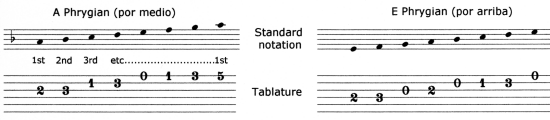
Flamenco guitarists normally use a capo to adjust the key of the music to the singer's preference. This makes it difficult to compare different recordings of a single style because the recordings are likely to be in different keys. For purposes of analysis, we can use the Phrygian mode to represent the sung melody of siguiriya styles in order to generically refer to each note of the melody as a degree, regardless of the corresponding key. The diagram below represents standard notation and guitar tablature for A and E Phrygian scales. The first note (also called tonic) would be the first degree, the second note would be the second degree, etc. The eighth note would be the first degree once again, because it is essentially the same as the first note, but in a higher register (this is why they are called octaves). Using this same system, Roman numerals are used in reference to chords. For example, playing por medio, in the key of A, a D minor chord would be written "iv" because D is the fourth scale tone (A-B-C-D) and in lower case because it's a minor chord (D major would be IV).
At least eight siguiriyas are based on a style attributed to Pedro Fernández Fernández, born in San Fernando in 1836 and known as Viejo de La Isla. The creators shared a relatively reduced period of time and space, as they were born in a 35-year span and lived within a distance of about as many kilometers, in Cádiz and Jerez: Viejo de La Isla and Francisco la Perla in Cádiz and Paco la Luz, el Marrurro and Joaquín Lacherna in Jerez. The styles tío José de Paula and Pastora Pavón are derivatives of Paco la Luz 1, the style Manuel Torre 2 is based on Francisco la Perla 2, and the style Antonio Mairena 1 is a version of Joaquín Lacherna. Ricardo Molina and Antonio Mairena were probably referring to this group of cantes (p. 194, Mundo y Formas del Cante Flamenco) in their description of the style el Marrurro: "Its music is a variation of what we could call the common melody of the modern siguiriya (the same substratum of the styles Joaquín la Serna, Francisco la Perla, Viejo de la Isla, Manuel Torre)..."
Manuel Torre 1929, Francisco la Perla 2
Ay ay ay
Qué desgracia yo tengo
madre en el andar
qué desgracia yo terelo
madre en el andar
como los pasos que para a(de)lante yo echo
se me vuelven atrás
qué desgracia yo terelo
madre en el andar
All the styles begin with characteristic vocalization followed by four lines of verse that are sung in pairs. After the first line, there is usually a brief pause, the second line is sung, both lines are repeated and there is another pause. The long line of verse can be fragmented, repeating the first half one or several times before singing the line completely, or left intact, with or without pauses in the middle. The conclusion is sung with the repetition of either the first or the last two lines. The result is a structure of eight sung lines when the long line remains intact.
The lines are articulated in the following ways:
Odd-numbered lines of verse: Each style has a characteristic melodic arc in the first line of verse and in the second half of the long line. With the repetition of the lines of verse, there is an arc in the first sung line, the third sung line, the second half of the long line and the next-to-last sung line. The arc is the most prominent characteristic of each style, as if it were the "face" of the cante. In most styles, when the arc is repeated (from the third sung line onward), it starts at the fourth degree. Depending on the style and the singer's intention, the same arc is repeated or different arcs are sung. The ascending legs of the arcs are arpeggiated (two or three notes) or diatonic (more notes, as in the Phrygian mode) and the descent takes place in different ways, as summarized below. Two audio samples are provided for each arc; see the description of each style for more information.
Even-numbered lines of verse: Although the even-numbered lines usually contain little of the essence of each cante (they serve as a reset point for cante and cantaor), they are articulated through a series of vocal techniques at the end of the odd-numbered line and/or the beginning of the even-numbered line:

Rushing of Viejo de La Isla: When the conclusion is sung with the long line of verse, the first words are characteristically rushed in order to make the syllables fit the singing and to provide melodic variation for the repetition of the line. This characteristic of Viejo de La Isla has been used by some singers to end derivative styles, although it does not appear in the commercial recordings of Agujetas el Viejo or in those of his son Manuel.
The interpretations of some of these cantes have varied among artists and over the course of time. Some of the first artists to record the cante of Pedro Fernández Fernández did so only on their first recordings (Chacón and Torre in 1909, Pastora between 1910 and 1915, etc.) and sang derivative styles on later recordings.
While most siguiriyas melodies can be considered to fall within the Phrygian mode, there are several ancient major-sounding styles known as siguiriyas cabales whose melodies are completely different. Their sweet sounds contrast with the intense drama of other styles, although they also require great effort of the singer as they are often sung at the end of a series of siguiriyas. All these styles correspond to the areas of Triana and Los Puertos: el Planeta, el Fillo 2, el Fillo 3, Manuel Molina 3, Silverio 3 and Loco Mateo 3. Apart from their archaic structure, the antiquity of these styles is indicated by the "fact" that all their creators are believed to have been born between 1790 and 1840. While the cabales of Silverio and Loco Mateo are entirely major-sounding, and the styles of el Planeta (as sung by Pepe Torre) and el Fillo 3 feature only brief and bitter incursions into Phrygian tones, el Fillo 2 is mostly Phrygian, with occasional bittersweet traces of the cabales air.
The styles are attributed to the artists with whom they are most closely associated, but this does not necessarily mean that they created these styles. In many cases, they either sang styles that were popular within their family or social group, or sang a personal version of another attributed song form. As opposed to the determination of authorship, the greatest value of this classification of cantes is the compilation of different versions of styles and the establishment of a series of names for their identification.
Cádiz styles are characterized by the frequent repetition and linking of lines of verse. Nearly all the styles presented here are clearly related to the cante of Viejo de La Isla.
Styles 2 and 3 attributed to this singer correspond to Triana. Silverio Franconetti was born in Seville in 1831 and died in 1889. The beginning of this style clearly resembles Viejo de La Isla and its derivatives, although from the fifth sung line onward, there are considerable differences. This seems to be a recreation of Silverio based on Triana and Cádiz styles.
Pepe el de la Matrona (1969). With Manolo el Sevillano. Without capo por medio (key of A).
Ayay
A la Virgen de Regla
yo se lo he rogado
yo se lo he rogado
yo se lo he rogado
que me liberara
que me liberara a un hermano mío
de salir soldado
y a la Virgen de Regla
yo se lo he rogado
Pedro Fernández Fernández was born in San Fernando in 1836. In Cádiz, he was known as Viejo de La Isla and in his hometown as Perico Piña. His sister was María Borrico, the creator of another popular style of siguiriya.
Main characteristics: The melodic arc rises in an abrupt arpeggio and falls gradually to the tonic. The repetitions of the arc start at the fourth degree. The conclusion is sung with the rushing and repetition of the long line of verse.
The style normally begins with two piercing and plaintive vocalizations ("aaayyy") drawn out at the fifth degree. This generally starts at the sixth degree ("a-"), is held at the fifth degree ("-aa-"), and falls away in an undetermined descending line ("-yyy"). Old-school guitarists frequently accompanied the end of the first vocalization with a iv chord (D minor without capo por medio), but this is rarely heard today. The second vocalization is linked to the first line of verse. The ascending leg of the melodic arc is an arpeggio that normally consists of the first, third and sixth degrees (also heard in the arc of Joaquín Lacherna). The remainder of the line of verse gradually falls to the tonic in what the Solers refer to as a mecío (rocking or lilting quality). After a brief pause, the third sung line starts with an "ay" at the fourth degree, although it seems that with the passing of time (and in the derivate styles) the "ay" has been dropped, and the first syllable is sung at the fourth degree (see the description of Francisco la Perla 2).
From the third sung line onward, Chacón and his followers sang a different arc. It starts at or rises to the third degree, goes up to the fifth, falls back to the third and descends to the tonic without sustain. This III-V-III arc is heard in the versions of Chacón, Niño de Cabra, Escacena, Bernardo el de los Lobitos, Fernando el Herrero and Marchena (last two not included in this study; click on the links to hear samples). This arc is also heard in some versions of Francisco la Perla 2 and other styles.
The long line of verse is normally fragmented, the first half of which is repeated once or twice. In the next-to-last sung line, the third and fourth lines of verse are repeated. This starts with a characteristic rushing of the words that accomodates the extra syllables and provides melodic variation in the repetition.
The Solers state that the cante of Viejo de La Isla was recorded far more often than any other style of siguiriya in the first two decades of the 20th century. Over half of the 30 or so recordings corresponding to this period were made by Pastora and el Mochuelo (12 and 9, respectively).
Manuel Cagancho (189?). With
Niño del Carmen. This sample was taken from an ancient cylinder recording, and the distorted sound makes it very hard to listen to. The sample has been slowed by two semitones, as the recording sounds unusually shrill and fast. The same verse was recorded by Manuel Torre, Pastora and Antonio Mairena. The repetition of the first line of verse ("compañerita mira que") is sung with the III-V-III arc. The last syllable is omitted in the first half of the cante, after which we hear shouts of "¡Manolo!" and "¡Vamos ya!"
Ay ay
Por tu causa me veo
herido de muerte
compañerita mira que
herido de muer(te)
y para más penas me veo aborrecido
de todita mi gente
y para más penas me veo aborrecido
de todita mi gente.
Antonio Chacón (1909). With Juan Gandulla. Capo at third fret por medio (key of C). From the third sung line onward, he sings the III-V-III arc, as heard in the next-to-last sung line of his version of el Marrurro. The last syllable is omitted in the second half of the cante.
Ay ay
Si yo supiera la lengua
que de mí murmura
ay si supiera la lengua
que de mí murmura
yo la cortara por el medio en medio
y la dejara muda
yo la cortara por el medio en medio
y la dejara mu(da)
Manuel Torre (1909). With Juan Gandulla. Capo at second fret por medio (key of B). In this version copied by Pastora and Antonio Mairena, Torre adds words to the end of the arc in order to repeat the flourish ("en la cama", "me veo", "madre mi alma" and "primito"). Nonetheless, all of the characteristics of the style are present in this recording: the drawn out initial vocalization, the second vocalization linked to the first line of verse, the ascending arpeggio in the first line ("Por tu causi-"), the extended melodic arc descending to the tonic ("-ita me estoy viendo ma-"), the brief fourth-degree "ay" that starts the repetition of the first two lines, the fragmentation and repetition of the long line of verse ("y para más penas"), the repetition of the arc in the second half of the long line of verse ("-tigas aborrecido me estoy viendo"), and the rushing used to conclude the cante with the repetition of the third and fourth lines of verse ("para más fatigas"). The last syllable is omitted in the first half of the cante.
Ay ay
Por tu causita me estoy viendo malito en la cama
malito de muerte
ay por tu causita muy malito me veo
malito de mue(rte)
y para más penas
y para más penas
para más fatigas aborrecido me estoy viendo madre mi alma
de toda mi gente
para más fatigas aborrecido me estoy viendo primito
de toda mi gente
El Niño de La Isla (1910). With Ramón Montoya. Capo at third fret por medio (key of C). The singer (José López Domínguez, 1871-1929) was born in San Fernando and was a follower of Pedro Fernández, which makes this recording of great historical interest. After repeating the introductory vocalization, he sings an arc that is very similar to the repetitions of the arc in the style el Marrurro, as they share the diatonic ascent (more notes than the arpeggio), the sustained fifth degree and the plummeting descent to the tonic. In the repetition of the first line, he foregoes the vocalization, singing instead the first syllable ("cuando") at the fourth degree, as heard in the last recordings of this style and in most of the derivatives. The first half of the long line is sung in the style Loco Mateo 1, as in the version of Escacena seen below and in other recordings, such as the versions of Talega and Perrate in the style Paco la Luz 1. This detail appears often enough to draw reasonable conclusiones as to the popularity and influence of Loco Mateo, although it must be pointed out that it is a fairly simple melodic variation that may not be indicative of anything. The last word is omitted in the first half of the cante.
Ay ayu ayu ayu
Cuándo querrá la Virgen
(de) Mayor Dolor
cuándo querrá la Virgen
de Mayor (Dolor)
que los cabellos
que los cabellos
que los cabellos de la madre mía
me los peinara yo
que los cabellos de la madre de mi alma
los peinara yo
Pastora Pavón (1910). With Ramón Montoya. Capo at fifth fret por medio (key of D). All of the arcs feature two descents from the sixth and fourth degrees. In the first line, this is heard in the word "supiera": the sixth degree in "-pie-" and the fourth degree in "-ra." The last syllable is omitted in the first half of the cante.
Ay ay
Si supiera la lengua
que de mí murmura
ay si la lengüita yo supiera
que de mí murmu(ra)
la cortaría
yo la cortara por el medio en medio
la dejara muda
la cortaría por el medio yo la lengua
la dejara muda
Pastora Pavón (1910). With Ramón Montoya. Capo at third fret por medio (key of C). In this version, inspired by her friend Manuel Torre, the arcs feature a gradual descent to the tonic. The last syllable is omitted in both halves of the cante.
Ay ay
Por tu causita me estoy viendo malita
malita de muerte
ay muy malita me estoy viendo en la cama
malita de muer(te)
y para más penas
para más fatigas aborrecida me estoy viendo primito
de todita mi gente
para más fatigas aborrecida me estoy viendo primito
de toda mi ge(nte)
Niño de Cabra (1913). With Ramón Montoya. Capo at fourth fret por medio (key of C sharp). The first line starts with a descent from the sixth degree. He repeats the III-V-III arc from the third sung line onward and ends with the rushing and long line of verse.
Ay ay
Siempre por los rincones
te encuentro llorando
ay siempre por los rincones
te encuentro llorando
a puñaladitas puñaladitas me den el santolio
si te doy mal pago
a puñaladitas me den el santolio
si te doy mal pago
Pastora Pavón (1913). With Luis Molina. Capo at sixth fret por medio (key of D sharp). In this and the next two versions, Pastora alternates two different arcs. In the first sung line, after the ascent and the gyration ("mío"), the arc is sustained at the fifth degree and plummets to the tonic ("mío"), as in the above version by Niño de La Isla. In the third sung line, she sings the arc heard in her 1910 version of this style. Similarly, in the second half of the long line of verse, she repeats the first arc and in the next-to-last line, after the rushing, she repeats the second arc. The upturn to the seventh degree in the first half of the long line also appears in all three versions.
Ay ay
Padre mío Jesús
el de Santa María
ay Padre mío Jesús
el de Santa María
que estos pesares
que estos tormentos que mi cuerpo terelas
sean alegrías
estos pesares que terelos en mi cuerpo
sean alegrías
Pastora Pavón (1913). With Luis Molina. Capo at fourth fret por medio (key of C sharp). Verse 5546 in the collection of Rodríguez Marín: "Yo sé que contigo / No m'he de lográ; / Así mis ducas - nunca ban á ménos; / Siempre ban á más."
Ay ay
Como sé que contigo
no me he de lograr
ay como sé que contigo
no me he de lograr
así mis penas
así mis penas nunca iban a menos
siempre van a más
porque mis penas nunca iban a menos
siempre van a más
Pastora Pavón (1914). With Luis Molina. Capo at sixth fret por medio (key of D sharp). The words added to the end of the next-to-last sung line are reminiscent of the version of Manuel Torre of this style. The last syllable is omitted in the first half of the cante. The verse (not the music) is attributed to Francisco la Perla.
Ay ay
Una cartita me mande
que me mande carta
ay dile a mi niño Currito
que me mande car(ta)
que con saber
que con saber que se encuentre muy bueno
me sobra y me basta
que con saber que muy bueno se encuentre mi niño Currito
me sobra, me basta
Manuel Escacena (1914). With Pepito Cilera. Capo at third fret por medio (key of C). In the first sung line, he sings two descents, as in Pastora's "Si supiera la lengua," although in this version the second descent is from the fifth degree. As in other versions, the III-V-III arc is repeated from the third sung line onward and the conclusion is sung with the carrerilla and long line of verse. The first half of the long line is sung in the style Loco Mateo 1, as in the version of Niño de La Isla.
Ay ay auay
Y están sintiendo las piedras
las fatigas mías
ay ya están sintiendo las piedras
las fatigas mías
porque las tengo
porque las tengo
porque las tengo madre mía
de noche y de día
porque las tengo madre mía
de noche y día
Bernardo el de los Lobitos (1923). With Montoya. Capo at second fret por medio (key of B). Two arcs are sung. He starts with the arpeggio, continues with brief gyrations at the fifth and sixth degrees, sustains the fifth degree and plummets to the tonic as in the version of Niño de La Isla. In the third sung line, he sings the III-V-III arc. In the second half of the long line, he sings the first arc again but with the microtonal descent of el Marrurro. In the conclusion, he sings the rushing and repetition of the long line of verse with the III-V-III arc.
Ay ay
Y como sé que contigo
no me voy a lograr
ay como sé que contigo
no me voy a lograr
así mis penas
así mis penas nunca iban a menos
siempre van a más
como mis penas nunca iban a menos
siempre van a más
Antonio Mairena (1951). With Paco Aguilera. Capo at second fret (key of B). The rushing is heard at the beginning of the third sung line ("yo por tu causa") and the next-to-last sung line ("para más duquelas").
Ay ay
Por tu causita yo me veo prima mi alma
yo malito de muerte
yo por tu causa me estoy viendo muy malito en la cama
yo malo de muerte
y para más penas
para más fatigas aborrecido me estoy viendo prima mi alma
de toda mi gente
para más duquelas me estoy viendo yo malito en la cama
yo malo de muerte
Manuel Vargas (1962). With Andrés Heredia. Capo at second fret por medio (key of B). He omits the initial vocalization and ends the cante with the repetition of the first two lines of verse. In the repetition of the first line, he starts at the fourth degree and sings the arc of Francisco la Perla 2. His singing alternates anger and pathos, violence and gentleness, light and shade.
Contemplarme por Dios a mi madre
que no llores más
corre contemplarle a mi madre
que no llores más
dile que vaya
dile que vaya a la Audiencia
de Cádiz
por mi libertad
contemplarme por Dios a mi madre
que no llores más
Antonio Mairena (1966). With Ricardo. Capo at sixth fret por arriba (key of A sharp). The repetition of the first line of verse starts at the fourth degree. The conclusion is sung with the repetition of the first two lines of verse.
Ay ay
Por Dios decirle a mi niño Currito
que me escriba carta
corre dile a mi niño Currito
que me escriba carta
que me he enterado
que con saber que mi Curro ya estaba muy bueno
me sobra y me basta
corre dile a mi niño Currito
que me mande carta
It has been suggested that his name was Francisco Moreno Camacho (1833-1891), and that he was born in Triana but lived most of his life in Cádiz. The only singer born up to 1920 to record this style was Pericón de Cádiz. The Solers' attribution is based on comments appearing in José Blas Vega's biography of Aurelio Sellés: When asked about the siguiriyas of Francisco la Perla, Aurelio responded that he knew of two different cantes and sang them with the same two letras that Pericón sings in the recording from which this sample is taken.
Pericón (1968?). With Melchor. Capo at second fret por medio (key of B). Pericón's recording bears characteristics of el Nitri 1 and Curro Durse 1.
Dejármelo ver
dejármelo ver
a los ojitos de mi niño Curro
por última vez
Main characteristics: The ascending leg of the arc is diatonic (more notes than the arpeggio of Viejo de La Isla) and reaches the fifth degree, with a characteristic descent to the fourth degree and sustaining of this note. The repetitions of the arc start at the fourth degree. The conclusion is sung with the repetition of the first two lines of verse.
The initial vocalization of this style is less piercing than that of Viejo de La Isla because it falls to the fourth degree, rather than being drawn out at the fifth degree. In all but one of Manuel Torre's versions, the arc rises to the fifth degree in four or five syllables and falls to the fourth degree, this note is held and, in the same syllable, falls to the lower register, and a flourish links the remainder of the first line to the beginning of the second line. The descent is more melodic and less abrupt than in Jerez-based styles.
Manuel Torre, in his last version, and other artists recorded this style with the arc heard in the versions of Viejo de La Isla as interpreted by Chacón and his followers. The arc starts at or rises to the third degree, goes up to the fifth, falls back to the third and descends to the tonic without sustain. In the style Francisco la Perla 2, this III-V-III arc is heard in the versions of Torre, Aurelio, Caracol, Mojama and Agujetas el Viejo (click on the links to hear samples).
In the rest of the cante, as in Viejo de La Isla, the even-numbered lines are linked with a flourish and the repetitions of the arc start at the fourth degree, although unlike said style, the conclusion is sung with the first two lines of verse.
Manuel Torre (1929). With Borrull hijo. Capo at first fret por medio (key of A sharp). The descent from the fifth degree to the fourth (and from there to the third and second degrees) is at the end of the word "desgracia." The way in which the lines of verse are linked deserves special attention: He ends the first sung line with a single flourish followed by silence ("tengo ma-") and, when he repeats the line of verse in the third sung line, he sings two flourishes instead of the silence ("terelo madre"). The pattern is repeated in the second half of the cante in the words "echo se" and "terelo madre". In the next-to-last sung line ("yo") there is another upturn to the fourth degree, as in Manuel Torre 2. In one of Torre's 1931 versions (see below), the melodic arc is sung differently. Verse 5429 Rodríguez Marín: "Soy desgrasiaíto / Jasta pâ 'landá; / Que los pasitos - que p' alante doy / Se güerben p' atrás."
Ay ay ay
Qué desgracia yo tengo
madre en el andar
qué desgracia yo terelo
madre en el andar
como los pasos que para a(de)lante yo echo
se me vuelven atrás
qué desgracia yo terelo
madre en el andar
Pastora (1929). With Manolo de Badajoz. Capo at fifth fret por medio (key of D). The descent from the fifth degree to the fourth is heard at the end of the word "dado."
Ay ayay
Me han dado las doce
las doce me dieron
me han dado las doce
las doce me dieron
en el compás
en el compás de Santo Domingo
con mi compañero
me han dadito a mí las doce
las doce me dieron
Mojama (1929). With Ramón Montoya. Capo at fourth fret por medio (key of C sharp). Mojama sings the III-V-III arc, as in the versions of Torre, Caracol, Aurelio and Agujetas el Viejo. The conclusion repeats the long line of verse.
Ay ayay
Me tienes apregonado
como a un mal ladrón
me tienes apregonado
como a un mal ladrón
cuantas más causas a mi cuerpo le eches
más te quiero yo
cuantas más causas a mi cuerpo le eches
más te quiero yo
Aurelio (1929). With Ramón Montoya. Capo at sixth fret por arriba (key of A sharp). Aurelio sings the III-V-III arc, as in the versions of Torre, Caracol, Mojama and Agujetas el Viejo. The conclusion repeats the long line of verse.
Ay ay ay
Puertecita no tengo
madre adónde llamar
puertecita yo no tengo
madre adónde llamar
llego a la tuya madre de mi alma
la encuentro cerrada
llego a la tuya madre de mi alma
y la encuentro cerrada
Manuel Torre (1931). With Javier Molina. Capo at second fret por medio (key of B). The descent is heard at the end of the word "grandes." In the third sung line ("yo") there is another upturn to the fourth degree, as in Manuel Torre 2.
Ay ay
Con qué grandes duquelas
yo le pido a Dios
por los rincones yo me meto
y le pido a Dios
que me aliviara y en estas dobles
duquelas de mi corazón
con fatigas yo le pido
le pido a Dios
Manuel Torre (1931). With Javier Molina. Capo at
second fret por medio (key of B). In his last recording of this style, Torre sings the III-V-III arc, as in the versions of Aurelio, Caracol, Mojama and Agujetas el Viejo. The first sung line bears an interesting similarity to that of Torre's taranto "Que ¿dónde andará mi muchacho?"
Ay
Dicen que duermes sola
mienten como hay Dios
dicen que sola duermes
mienten como hay Dios
porque de noche con el pensamiento
dormimos los dos
dicen que solita duermes
mienten como hay Dios
Antonio Mairena (1952?). With Melchor. Capo at fifth fret por medio (key of D). It is interesting to compare the initial vocalization of this version with that of other versions and styles, such as Chacón's version of Viejo de La Isla. The first sung line, despite the sustained notes, seems to be a variation of the III-V-III arc. The third sung line does not start at the fourth degree but features the descent from the fifth degree to the fourth at the end of the word "noche." Mairena's linking of the lines of verse seems to emulate Torre's 1929 recording of this style.
Ay ay
De noche no duermo
y de día no como
de noche no duermo
y de día no como
sólo pensando en mi compañera
yo me vuelvo loco
yo de noche no duermo
de día no como
Aurelio (1962). With Andrés Heredia. Capo at third fret por medio (key of C). As in his 1929 recording of this style, Aurelio sings the III-V-III arc heard in the recordings of Torre, Caracol, Mojama and Agujetas el Viejo. The last syllable is omitted in both halves of the cante.
Auay ay au ay
Te pido llorando
le he pedido llorando
hincadito de rodillas
le pido lloran(do)
que me dé limosna que a mí me quitara
lo que estoy pasando
a él de Santa María
le pido lloran(do)
Antonio Mairena (1963). With Melchor. Capo at third fret por medio (key of C). The descent is heard at the end of the word "siete." As in his 1959 version of this style, the linking of the lines of verse seems to emulate Torre's 1929 recording of this style.
Ay ay
Y por los siete dolores
que mi Dios pasó
por los grandes dolores
que mi Dios pasó
para recibirlo a la madre de mi alma
de mi corazón
por los siete dolores
que pasó mi Dios
Caracol (1968). With Melchor. Capo at first fret por medio (key of A sharp). He sings the III-V-III arc, as in the versions of Torre, Aurelio, Mojama and Agujetas el Viejo. In the second sung line, after the word "pena," he vocalizes an arc falling from the fourth degree, repeating the idea in "más grande" and ending with a smaller arc that rises to the third degree and falls to the tonic ("mío"). This interesting variation leaves the derivative structure intact but unexpectedly adds a compás to the see-sawing pattern. In the second half of the long line of verse, the upturns to the fifth degree (the second one at the end of "Chano") are reminiscent of the style attributed to Pastora.
Ay ay ay
Qué pena más grande
qué pena más grande Dios mío
qué pena más grande
qué pena más grande
que me se ha muerto
que se me ha muerto mi hermano Chano de mi alma
no lo veo más
compañerito hermano Chano
no te veo más
Pepe Pinto (1969). With Ricardo. Capo at second fret por medio (key of B). In the first sung line he howls ("dolorooaaaooo") the descent from the fifth degree to the fourth. In the next-to-last sung line, the upturns to the fifth degree are his supercharged version of the style attributed to his beloved Pastora, to whom the emotive verse is dedicated.
Ay ay
Qué dolor más grande
qué pena qué pena
qué dolor Dios mío
qué pena qué pena
que estar viviendo
que estar viviendo sin estar en el mundo
la mía compañera
qué dolor más grande
qué pena qué pena
Antonio Mairena (1969). With Melchor. Capo at third fret por medio (key of C). Rather than starting the repetitions of the arc at the fourth degree, he repeats the same arc throughout the cante. The first half of the arc is somewhat similar to that of the III-V-III arc heard in other versions of this style (Torre, Aurelio, Caracol, Mojama and Agujetas el Viejo).
Ay ay
A pasar fatigas
yo estaba tan hecho
a pasar fatigas
yo estaba tan hecho
que las alegrías se me vuelven penas
dentro de mi pecho
a pasar fatigas
yo estaba tan hecho
Agujetas el Viejo (1971). With Félix de Utrera. Without capo por medio (key of A). In this and the following version Agujetas sings the III-V-III arc, as heard in the versions of Torre, Aurelio, Caracol and Mojama, and he starts the repetitions of the first line with an "ay" at the fourth degree. In the next-to-last sung line, we can hear the guitarist Félix de Utrera react to the scorching delivery of Agujetas.
Ay ay
Por aquella ventana oscura
(que) al campo salía
ay por aquella ventanita oscura
(que) al campo salía
le daba voces a la madre (de) mi alma
no me respondía
ay por aquella ventanita oscura
que al campo salía
Agujetas el Viejo (1971). With Félix de Utrera. Without capo por medio (key of A). As in the preceding recording, Agujetas unleashes a considerable amount of energy in the next-to-last sung line. On this occasion, Félix de Utrera yelps as if he has been hit by an electrical discharge.
Ay
Por los siete dolores
que pasó mi Dios
ay por los siete dolores grandes
que pasó mi Dios
Dios se lo mande a la madre de mi alma
de consolación
ay por los siete dolores grandes
que pasó mi Dios
It is thought that Juan Feria was born around 1850. The versions of Pepe Pinto and Pepe el de la Matrona are very different. In both, the fourth degree is contained and released at the end of the melodic arc (similar to Joaquín Lacherna). Nonetheless, what Pepe Pinto sings is actually an interesting hybrid involving elements of the derivatives and of the non-derivative style Manuel Molina 1, and the versions recorded by Pepe Matrona are closer to the style Manuel Torre 2.
Pepe Pinto (1945). With Manolo de Badajoz. Capo at first fret por medio (key of A sharp).
Ay ay
Penas tiene mi madre
ay ayyy duquelas tiene mi madre
penas tengo yo
las que yo siento
las que yo siento son las de mi madre
que las mías no
penas tiene mi madre
penas tengo yo
Pepe el de la Matrona (1976). With Félix de Utrera. Capo at fourth fret por arriba (key of G sharp). The melodic arc has two upturns to the fourth degree, similar to the style Manuel Torre 2. He starts the second and fourth lines of verse with an upturn to the third degree, as in many versions of Paco la Luz 1 (although the origin of this detail may be the non-derivative style Manuel Torre 1).
Ayay
A mi hermano mataron
plaza de Guadix
mataron a mi hermano
plaza de Guadix
las fatiguitas
las fatiguitas madre que me dieron
me he visto morir
a mi hermano mataron
plaza de Guadix
Styles 1 and 3 attributed to this singer correspond to Jerez and Los Puertos, respectively. According to José Manuel Martín Barbadillo, Manuel Soto Loreto (Leyton, according to Barbadillo) was born in Jerez de la Frontera in 1880 and died in Seville in 1933.
Main characteristics: This variation of Francisco la Perla 2 involves a howling upturn to the fourth degree after the fall in the melodic arc. Listening to Torre's version, it is easy to understand why Rafael Alberti wrote that Manuel's singing was like an injured wild animal; a frightening pit of anguish.
Manuel Torre (1929). With Borrull hijo. Capo at third fret por medio (key of C). The upturn is in all the odd-numbered sung lines. In the first at the beginning of "camisita," in the third in "yo," in the fifth in "en" and in the seventh in "en."
Ay ayay ay
En mi cuerpo camisita
no me voy a poner
camisita yo en mi cuerpo
no me voy a poner
hasta no verme con mis niñas yo en mi casa
juntitos otra vez
las camisas yo en mi cuerpo
no me voy a poner
El Gloria (1929). With Manolo de Badajoz. Capo at fifth fret por medio (key of D). In the next-to-last sung line we hear the rushing of Viejo de La Isla ("porque me muero") and the characteristic upturn of this style ("de").
Ay ayay
Mi pena es muy grande
que no puede ser más
son mis duquelas tan grandes
que no pueden ser más
porque me muero sin la calor de mi madre
en el hospital
porque me muero sin la calor de mi madre
yo en el hospital
Pepe Pinto (1955) with Manolo Carmona. Without capo por medio (key of A). The initial vocalization corresponds to the style el Marrurro. The upturn appears in the first ("de"), third ("me"), sixth ("males") and eighth ("de") sung lines.
Ay auyauy
Y a las dos de la noche
y a mí me llamaron
y a mí me llamaron
y a mí me llamaron
para que curara
para que aliviara los males incurables
y a otro cirujano
llamo a las dos de la noche
y a mí me llamaron
Antonio Mairena (1966) with Ricardo. Capo at sixth fret por arriba (key of A sharp). As in Torre's version, the upturn appears in the odd-numbered sung lines: the first ("yo"), third ("en"), fifth ("yo") and seventh ("yo").
Ayay ay
Y la camisa yo en un año
no me voy a poner
camisita en mi cuerpo
no me voy a poner
y hasta no verme con mis niñas yo en mi casa
juntitos otra vez
la camisa yo en mi cuerpo
no me voy a poner
Niño Barbate (1971) with Paco de Lucía. Capo at first fret por medio (key of A sharp). The upturn appears in the first and sixth sung lines, at the end of the words "niños" and "madre."
Ayay ay
A mis niños (de) mi alma
yo los quiero ver
a mis niños míos míos de mi alma
yo los quiero ver
llamo
llamo a la madre (de) mi alma
y no la puedo ver
a mis niños míos míos de mi alma
yo los quiero ver
Agujetas el Viejo (197?) with unidentified guitarist. Without capo por medio (key of A). The upturn appears in the word "yo" in the first, third and seventh sung lines.
Ay
Y la camisa yo en mi cuerpo
no me voy a poner
la camisa yo en mi cuerpo
no me voy a poner
hasta no verme con mis niñas en mi casa
juntitos otra vez
la camisa yo en mi cuerpo
no me voy a poner
Jerez styles may be the most recently created, as the siguiriyas from this area seem to bear the influence of what are presumably older styles: The styles of Manuel Molina draw on Triana and Los Puertos, the cantes of el Loco Mateo bear characteristics of Los Puertos, and other styles are either derivatives of Viejo de La Isla (Paco la Luz 1, Joaquín Lacherna and el Marrurro) or variations of these derivatives (tío José de Paula and Pastora Pavón are based on Paco la Luz 1, and Antonio Mairena 1 is a version of Joaquín Lacherna). The style Manuel Torre 1 is a shortened version of Manuel Molina 1. Lines of verse are often repeated, as in Cádiz, and linked together, and the long line of verse is usually fragmented. Except for the oldest styles (as stated, Manuel Molina and el Loco Mateo seem to be influenced by Triana and Los Puertos), Jerez keeps the lines of verse short and concentrated. This concept reaches its summit in the siguiriya of tío José de Paula, which is sung in emotion-charged bursts, like electrical discharges. It may be said, then, that Jerez has developed its own approach to singing siguiriyas, given the great dissimilarity between its oldest styles (long and spectacular) and its most recent (shorter and more soulful).
It is thought that Molina was an artistic name used in the family of this singer and that his real name was Manuel Ortega Vargas, born in Jerez in 1822 and a friend of Frasco el Colorao and Curro Durse. The styles Manuel Molina 1 and Manuel Torre 1 (the latter is a shortened version of the former) are those most often sung, normally as the first of a series of siguiriyas. Manuel Molina 1, Manuel Molina 2 and Loco Mateo 1 are different from other Jerez styles as the lines of verse are lengthened and unlinked, which makes them more similar to siguiriyas of Triana (it is thought that style 1 of Manuel Molina derives from Frasco el Colorao). The recordings of Antonio Mairena and Rafael Romero, among others, include a variation of Manuel Molina 1 that has been attributed to Paco la Luz. In just a few versions, Torre, Pastora and Tomás sing a peculiar and soulful note, which is the major second degree (B natural por medio without capo), a tone that appears in other cantes such as the bulería corta (click here for more information on this tone).
Manuel Torre (1909). With Juan Gandulla. Capo at third fret por medio (key of C). At the end of the first sung line and subsequently, we can hear an early example of a guitarist using the II7 chord.
A clavito
a clavito y canelita madre
me hueles tú a mí
el que no huele
el que no huele a clavito y canelita madre
no sabe distinguir
Tomás Pavón (1927). With Ricardo. Capo at second
fret por medio (key of B). Major second degree at the end of the third line of verse at the beginning of the word "canela."
A clavito
a clavito y canelita
me hueles tú a mí
la que no huele a clavo y canela
no sabe distinguir
Manuel Torre (1929). With Borrull hijo. Capo at third fret por medio (key of C). His handling of the word "rodillas" at the end of the third line is interesting. Major second degree in the fourth line at the beginning of the word "pidiendo."
Te fuiste de
de mi vera te fuiste
sin apelación
ahora te veo
ahora te veo que te hincas de rodillas
pidiendo el perdón
Pastora Pavón (1933). With Antonio Moreno. Capo at first fret por medio (key of A sharp). Pastora uses the major second degree to great effect. She keeps her voice low and in tight control (the key is about five semitones lower than her other siguiriyas), creating an eerie atmosphere that becomes particularly unsettling with the major second degree in the second ("hazme") and fourth ("la") lines of verse. In his 1977 album Despegando, Enrique Morente recorded a version of this verse with some of the details heard in Pastora's singing.
Mírame
mírame a los ojos
hazme usted el favor
que mis ojitos
que mis ojitos camelan decirte
la verdad de todo
Antonio Mairena (1954). With Manuel Morao. Capo at third fret por medio (key of C). Mairena begins this version with a higher-pitched melody (Torre and others begin at the tonic). In reference to a similar version recorded in 1972, Mairena attributed this style to Paco la Luz. Manuel Soto "Sordera" also sang this variation and once stated that it had always been sung within his family. It was recorded in 1926 by José Cepero in a 78-r.p.m. recording titled "Seguidillas de Paco la Luz" which begins with this variation and ends with the style Paco la Luz 1. It seems very likely, then, that this is the way Paco la Luz sang the style Manuel Molina 1. The following cante of this track also starts in a higher register. It is interesting that Mairena recorded both versions with Morao (see his version of Paco la Luz 1)
De noche
de noche no duermo
de día no como
sólo pensando
sólo pensando en mi compañera
yo me vuelvo loco
Rafael Romero (1969). With Sabicas. Capo at fifth fret por medio (key of D). Another version of the variation attributed to Paco la Luz.
La carita
la carita morena
y los ojos negros
se parecía
se parecía a la Virgen
del Valle
la que está en San Telmo
This style was very popular throughout the "Opera Flamenca" period, and was recorded by many artists that did not specialize in siguiriyas. It may be based on Manuel Molina 3, and it also shares some characteristics found in Manuel Cagancho (strong rising melody heard in the first half of the long line of verse of the Triana style) and Loco Mateo 1 (emphasis on fourth and fifth scale degrees implying minor IV chord, and lines sung one after another, with very brief pauses). Due to the spectacular nature of this style, it is almost always used to conclude a series of siguiriyas.
Manuel Torre (1922). With el Hijo de Salvador. Capo at second fret por medio (key of B). In comparison with other recorded versions of this cante, Torre keeps the lines of verse shorter, he doesn't reach the sixth scale degree and he structures the verse differently.
(No) te hablo nunca
que la causita de que yo a ti te olvide
tú tienes la culpa
que la culpita de que yo a ti te olvide
tú tienes la culpa
Manuel Centeno (1929). With Manolo de Badajoz. Capo at fourth fret por medio (key of C sharp).
Y vivo yo con pena
que a quien yo quiero con mis cinco sentidos
no esté a mi vera
Manuel Vallejo (1933). With Ricardo. Capo at sixth fret por medio (key of D sharp). Notice the VI chord (F por medio). Although the VI chord can be heard in recordings of this style by Pastora Pavón with Currito el de la Jeroma or Manuel Vallejo with Ramón Montoya, it seems to be one of Ricardo's contributions to the development of accompaniment in the 20th century.
Me llamó mi madre
con grandes fatigas-
-as que le habían entrado
comenzó a llamarme
Styles 2 and 3 attributed to this singer correspond to Los Puertos. It is thought that his name was Mateo de las Heras Carrasco and that he was born in 1839. This style and Manuel Molina 1 and 2 do not use the typical Jerez approach described at the beginning of this section, and are more similar to styles from Triana and Los Puertos. The melody of the first sung line emphasizes the fourth, fifth and sixth scale degrees, implying the minor IV chord (A minor without capo por arriba), and is reminiscent of Curro Durse 1, and, to a lesser degree, of Manuel Molina 2. The melody of the first half of the long line of verse is similar to that of the first line, which creates a kind of symmetry. This also happens, but in a much more obvious manner, in the Los Puertos style Loco Mateo 2. The long line of verse is fragmented and repeated with characteristic vocalization at the midway point. It is interesting to observe that the melody of the first half of the long line of verse appears in some versions of Viejo de La Isla and Paco la Luz 1 (see comments on el Niño de La Isla's recording of Viejo de La Isla).
Manuel Torre (1909). With Juan Gandulla. Capo at fifth fret por arriba (?) (key of A).
Siem(pre)
siempre por los rinconcitos
te veo llorando
que yo no terela
que yo no tenga auy libertad en mi vida
si a ti te doy mal pago
que yo no tenga auy la libertad en mi vida
si a ti te doy mal pago
Aurelio (1929). With Ramón Montoya. Capo at sixth fret por arriba (key of A sharp).
Llamarme al medico
llamarme al doctor
que se me arrancan
se me arrancaran auay uay uay y las alas de mi cuerpo
de mi corazón
Manolo Caracol (1958). With Melchor. Capo at second fret por medio (key of B). As in almost all of Caracol's recordings, there are considerable differences between this version and those of other singers. Observe the ending of the first line and his handling of the second line.
Siempre por los rincones
te encuen(tro) lloran(do)
que no terele ay ay ay ay ay la libertad yo en mi vida
si te doy mal pago
Juan Talega (1959). With Manuel Morao. Capo at third fret por arriba (key of G). The first line is very long.
Y el corazón
y el corazón duro como una piedra
tiene esta mujer
como yo estaba ay ay ay uay malito en la cama
y no me vino a ver
Juan Talega (1966). With Ricardo. Capo at third fret por arriba (key of G).
Y el corazón
y el corazón duro como una piedra
tiene esta mujer
como yo estaba ay ay ay uay malito en la cama
y no me vino a ver
Style 2 attributed to this singer corresponds to Los Puertos. Francisco Valencia Soto was born in Jerez in 1839.
Main characteristics: Stepped arc repeated throughout the cante. Upturn to third degree in even-numbered lines of verse. The repetitions of the arc do not start at the fourth degree as the same arc is repeated.
The initial vocalization is similar to that of Francisco la Perla 2 but is kept shorter and is not normally linked to the first line of verse. The arc is more compact (characteristic of Jerez) and homogeneous, as it rises from the second degree to the fifth relatively quickly, passing from one note to the next in a measured and equal manner, without the constriction or the dramatic upturns and descents of other derivatives. It should be observed that the characteristic arc of this style of Paco la Luz is very similar to the III-V-III arc (see styles Viejo de La Isla and Francisco la Perla 2), especially when singers include the second degree in the latter arc. In a similarly calm manner, the even-numbered lines of verse are linked through an upturn to the third degree. When the lines are not linked, as heard in the versions of Talega and others, the upturn is vocalized before the first word of the next line. The upturn is heard in Cojo de Málaga's 1921 version of this style of Paco la Luz and subsequently in other versions recorded by Cepero, Carbonerillo and Luisa Requejo. It does not appear in the versions of Pastora, Pepe Pinto and Manolo Caracol but features prominently in the LP recordings of Antonio Mairena, Borrico, Perrate, Joselero, Juan Talega and others. It appears to be characteristic of the non-derivative style Manuel Torre 1 as it is heard in nearly all recordings of this style made since 1922, the year that Torre first recorded it. In their first recordings of Paco la Luz 1, Talega and Mairena start the arc in a higher register (Mairena in 1954 with an elegant #III-IV-V and Talega in 1962 at the fourth degree). Their subsequent versions, as well as those of Borrico, Perrate and others, seem to be based on the same pattern. In some versions, the lines of verse are repeated many times (Torre, Vallejo, Caracol, Perrate and Borrico).
Manuel Torre (1922). With el Hijo de Salvador. Capo at second fret por medio (key of B). The stepped arc is heard in the word "aquejitos." He sings the third sung line with the III-V-III arc (see styles Viejo de La Isla and Francisco la Perla 2; compare this third sung line to the arc heard in his version of Francisco la Perla 2 "Dicen que duermes sola"). The conclusion is sung with the rushing and the repetition of the long line of verse.
Ay
Qué aquejitos los golpes
aquejos por Dios
qué quejitos por Dios
qué quejos por Dios
porque las arrancan esos golpes
las alas de mi corazón
porque las arrancan esos golpes
las alas de mi corazón
José Cepero (1926). With Ramón Montoya. Capo at second fret por medio (key of B). The upturn to the third degree is heard at the end of each arc.
Ay ay
Qué dolor de mi madre
se la llevó Dios
qué dolor de mi madre
me la quitó Dios
ya le robaron la alegría a mi cuerpo
y a mi corazón
qué dolor de mi madre (de) mi alma
me la quitó Dios
El Carbonerillo (1932). With Ricardo. Capo at third fret por medio (key of C). The upturn to the third degree is heard at the end of the word "bocacalles." The next-to-last sung line starts at the fourth degree and is sung in the style of Francisco la Perla 2.
Ay ay
Por todas las bocacalles
vuelvo yo la cara
por todas las bocacalles
vuelvo yo la cara
por ver si veo
por ver si veo a la mía compañera
de las mías entrañas
por todas las bocacalles
vuelvo yo la cara
Manuel Vallejo (1933). With Ricardo. Capo at sixth fret por medio (key of D sharp). The third sung line starts at the fourth degree and is sung in the style of Francisco la Perla 2. At the midway point in the cante, a pioneering flamencólogo shouts out, "¡Viva el Durse!" The conclusion is sung with the rushing and the repetition of the long line of verse.
Ay ay
¿Qué te pasa prima?
¿Qué te está pasando?
¿Qué te pasa prima?
¿Qué te está pasando?
que las horitas que la noche tiene
siempre estás llorando
que las horitas que la noche tiene
siempre estás llorando
Manolo Caracol (1945). With Paco Aguilera. Capo at second fret por medio (key of B, actual pitch between B and C).
Ay ay
A las doce o la una
cuando viene el viento
cuando viene el viento
cuando viene el viento
siempre me encuentra borrachito de luna
sin conocimiento
a las doce o la una
cuando viene el viento
Pepe Pinto (1945). With Manolo de Badajoz. Capo at first fret por medio (key of A sharp). Verse 5348 Rodríguez Marín and 149 Demófilo: "Si esto que me pasa / Le pasara á otro, / Era cosita - de prebelicarse / Y gorberse loco."
Ay ay
Si lo que a mí me pasa
le pasara a otro
si lo que a mí me pasa
le pasara a otro
era casito
era casito de prevaricar
y volverse loco
si lo que a mí me pasa
le pasara a otro
Pastora (1946). With Melchor. Capo at sixth fret por medio (key of D sharp).
Ay ay
El corazón de pena
tengo traspasado
el corazón de pena
tengo traspasado
que hasta el hablar
que hasta el hablar madre con la gente
me sirve de enfado
el corazón de pena
tengo traspasado
Antonio Mairena (1954). With Manuel Morao. Capo at third fret por medio (key of C). In his first recording of this style, Mairena starts in a higher register (#III-IV-V). The preceding cante of this track also starts in a higher register. It is interesting that Mairena recorded both versions with Morao (see his version of Manuel Molina 1). In this version of the style Paco la Luz 1, he sings the upturn to the third degree between the odd- and even-numbered lines of verse: From the third sung line onward, the upturn links the first and second lines (at the end of "mía") and is vocalized after a pause at the beginning of the fourth line (before "ya").
Ay ay
Como si fueras mía
te miraba yo
como si fueras mía
te he miradito yo
pero quererte como yo te quería
ya eso se acabó
como si fueras mía
te he miradito yo
Juan Talega (1962). With Eduardo el de la Malena. Capo at fourth fret por arriba (key of G sharp). In his first recording of this style, Talega starts the first sung line at the fourth degree. The first half of the long line of verse is sung in the style Loco Mateo 1. The last syllable is omitted in both halves of the cante.
Ay ay
Sintiendo estaban ya las piedras
las fatigas mías
están sintiendo las piedras
las fatigas mí(as)
yo las terelo de día y de noche
de noche y de día
sintiendo estaban las piedras
las fatigas mí(as)
Juan Talega (1966). With Ricardo. Capo at third fret por arriba (key of G, actual pitch between G and G sharp). The first half of the long line of verse is sung in the style Loco Mateo 1. As in the preceding version, the last syllable is omitted in both halves of the cante.
Ay
Yo no soy de esta tierra
ni conozco a nadie
de esta tierra yo no soy
y ni conozco a nai(die)
él que hiciera algo por mis niños
que Dios se lo pague
yo no soy de esta tierra
ni conozco a nai(die)
El Perrate (1968). With Juan Carmona. Capo at first fret por medio (key of A sharp). The first half of the long line of verse is sung in the style of Loco Mateo 1.
Ay ay
Ya llegó la hora
la horita llegó
ya llegó la hora
la horita ya llegó
que te apartaras
que te apartaras de la vera mía
sin apelación
ya llegó la horita
la horita ya llegó
Tío Borrico (1971). With Pedro Peña. Without capo por medio (key of A). The second half of the long line of verse is sung in the style Francisco la Perla 2. In the next-to-last sung line, he sings the arc of Viejo de La Isla.
Ay ay
Delante de mi madre
no me digas na
compañerita mía
no me digas nada
que me naquera muy malitamente
cuando tú te vas
delante de mi momaíta amigo no
no me digas nada
Antonio Mairena (1976). With Enrique de Melchor.
Capo at second fret por medio (key of B). Sung with the dynamics of the style tío José de Paula, as observed in "un momentito al día."
Ay ay
Madre de mi alma
dígaselo usted
madre de mi alma
dígaselo usted
que tan siquiera
que tan siquiera un momentito al día
que me venga a ver
madre de mis entrañas
dígaselo usted
Joselero (1978). With Diego de Morón. Capo at fifth fret por arriba (key of A).
Ay ay
Qué desgracia es la mía
con quien vine a dar
qué desgracia es la mía
con quien vine a dar
con una hija
con una hija de tan mala madre
harta de rodar
qué desgracia es la mía
hasta en el andar
Tío Borrico (1980?). With Cepero. Capo at first fret por medio (key of A sharp). At the beginning of the second sung line, he vocalizes the upturn to the third degree. The next-to-last sung line starts at the fourth degree.
Ay
Dos hermanitos somos
fui el más desgraciado
de dos hermanos que somos
yo el más desgraciado
porque metí mi manita y qué suerte
yo salí soldado
de dos hermanos que semos
yo el más desgraciado
Tío Borrico (1980?). With Cepero. Capo at first fret por medio (key of A sharp).
Ay ay
No me hables en tu vida
no me hables más
no me hables en tu vida
no me hables más
que yo he perdido la calor de mis niños
para la eternidad
por favor yo te pido
no me hables más
Joaquín Loreto Vargas was born in Jerez in 1843 and was the uncle of Manuel Torre. Some researchers attribute to him a cante that is denominated Manuel Torre 1 in this study.
Main characteristics: The ascending leg of the arc is the abrupt arpeggio of Viejo de La Isla. It reaches the sixth degree and, characteristically, there is a kind of constriction and release at the fifth degree.
The arc begins with the arpeggio of Viejo de La Isla. After reaching the sixth degree, the melody falls to the fifth degree (or fourth in some versions), which is held, characteristically with a kind of constriction (swallowing and projecting a word) before falling to the tonic. As in the style el Marrurro, the repetitions of the arc can start at the fourth degree, although unlike said style they start with the arpeggio of Viejo de La Isla. The descent in Torre's version is from the fourth degree (the fifth degree is not sustained in any of his recordings of these styles), as in the recordings of Tomás and Aurelio in the first sung line and of Cepero from the third sung line onward. In some versions (Agujetas, Mairena), the arc in the last sung line is sung in the style of Viejo de La Isla.
Tomás Pavón (1927). With Ricardo. Capo at second fret por medio (key of B). The arc is heard in the word "apregonado," starting with the arpeggio ("A-pre-go-"), falling from the seventh degree (see Chacón's version of el Marrurro) to the fourth ("-na-") and to the tonic ("-do"). This arc falls from the fourth degree in the first sung line and from the fifth degree subsequently. In the fifth sung line, it sounds as if Ricardo accompanies with a seventh chord in the word "causas." In the next-to-last sung line, in the word "tienes," we can hear the constriction and descent from the fifth degree.
Ay ay
Apregonado me tienes
como a un mal ladrón
tú me tienes apregonadito
como a un mal ladrón
mientras más causas
contra más causas tú le echas a mi cuerpo
más te quiero yo
tú me tienes apregonado
como a un mal ladrón
Manuel Torre (1929). With Borrull hijo. Capo at third fret por medio (key of C). In the first sung line, the fourth degree is sustained in the word "Contemplarme." In the long line of verse, we can hear the typical pathos of Torre's singing. After a long pause, he repeats the entire second half of the cante.
Ay ay
Contemplarme a mí madre
que no llores más
tú me contemplas a mí madre
que no llores más
porque me dejas
que a mí me dejas que me muera rabiando
y en el hospital
tú me contemplas mi madre
que no llores más
que me dejabas que me muera rabiando
y en el hospital
tú me contemplas a mí madre
que no llores más
Manuel Torre (1929). With Borrull hijo. Capo at first fret por medio (key of A sharp, actual pitch between A sharp and B). In the first sung line, the fourth degree is sustained in the word "había." The third sung line is sung with the stepped arc of the style Paco la Luz 1. In the conclusion he sings the rushing and repetition of the long line of verse with the III-V-III arc (see styles Viejo de La Isla and Francisco la Perla 2).
Auy ay
El alma se me había arrancado
me se arrancó el alma
primito de mi cuerpo
me se arrancó el alma
cuando la vi que con pena lloraba
la madre (de) mi alma
cuando la vi que con pena lloraba
la madre (de) mi alma
Aurelio (1929). With Ramón Montoya. Capo at third
fret por medio (key of C). The first sung line and the second half of the long line of verse are sung in the style Francisco la Perla 2, with the descent from the fourth degree. In the third and next-to-last sung lines, we can hear the constriction and descent from the fifth degree in "encuen-tro."
Ay ayay
Qué solito me encuentro
qué solo me hallo
yo me encuentro solito
qué solo me hallo
con la calor de mi niña de mi alma
me voy consolando
yo me encuentro solito
qué solo me hallo
José Cepero (1930). With Ramón Montoya. Capo at first fret por medio (key of A sharp). In the first sung line, we can hear the constriction and descent from the fifth degree in the word "Rabian-do." Although the third sung line features some constriction, it is closer to the arc of the style Francisco la Perla 2, as is the second half of the long line of verse.
Ay ayay
Rabiando te mueres
sin apelación
has de morirte rabiando
sin apelación
has de buscarme
tú vas a buscarme por los suelos y en rodillas
pidiendo el perdón
tú te mueres rabiando
sin apelación
Manolo Caracol (1958). With Melchor. Capo at
second fret por medio (key of B). The arcs fall from the fifth degree without constriction or sustain, although in the next-to-last sung line he swallows and projects the word "yo."
Ay ay ay
Contemplarme a mi madre
que no llores más
tú me contemplas yo a mi madre
que no llores más
qué loco muero
yo muero loco sin el calor de mis niños
y en el hospital
contemplarme yo mi madre
que no llores más
Agujetas el Viejo (1971). With Félix de Utrera. Without capo por medio (key of A). The first half of the cante is very similar to his version of the style Antonio Mairena 1. The second half of the long line of verse is sung with the III-V-III arc (see styles Viejo de La Isla and Francisco la Perla 2). In the next-to-last sung line, he starts at the fourth degree and sings the descent of Viejo de La Isla.
Ay ay
Ahora sí que yo a ti te llamo
con duquelas grandes
ahora sí que yo a ti te llamo
con fatigas grandes
porque me encuentro
porque me veo en mi casa solo
sin calor de nadie
ahora sí que yo a ti te llamo
con fatigas grandes
Antonio Mairena (1973). With Melchor. Capo at third fret (key of C, actual pitch between B and C). The first sung line starts with the arpeggio ("A la") and falls from the sixth degree to the fifth in a word ("muer-") which Mairena swallows and projects ("-te"). The third sung line starts at the fourth degree and repeats the descent of the first arc ("llaman-do"), which is also heard in the second half of the long line of verse and in the next-to-last sung line.
Ay ay
A la muerte yo llamo
y no quiere venir
yo estoy llamando la muerte
y no quiere venir
que hasta la muerte
que hasta la muerte tiene compañera
lástima de mí
a la muerte yo estaba llamando
y no quiere venir
It is thought that he was the brother of another Jerez-born singer named Antonio Monge "el Marrurro" (in an interview conducted by Juan de La Plata, Javier Molina stated that he had accompanied the Marrurro brothers). His year of birth is thought to be approximately 1850.
Main characteristics: The ascending leg of the arc is diatonic. After reaching the sixth degree, the fifth degree is sustained and the melody plunges to the tonic.
The initial vocalization makes greater use of the sixth degree. In the first sung line, the ascent of the arc is a variable arrangement of the fourth, fifth and sixth degrees. The fifth degree is sustained (some singers descend to the fourth) and the melody falls to the tonic with considerable force. The repetition of the arc may start at the fourth degree (as in other derivatives) and usually features a diatonic ascent (I/II-III-IV-V-VI-V), which is the main difference between this style and Joaquín Lacherna. In the descent of the arc, some singers make less use of the fifth degree, as in the version below of Pepe Culata. In old recordings, the downturn from the fifth degree to the fourth is sung microtonically. The Solers point out that Mairena redefined this style.
Chacón (1913). With Ramón Montoya. Capo at fifth fret por medio (key of D). The initial vocalization is sung with the fifth degree. In the first sung line, he reaches the seventh degree in the word "supiera," perhaps inspiring Tomás' version of Joaquín Lacherna. In the third sung line, there is an upturn to the fourth degree ("si yo") and the microtonal descent is heard briefly in the "ay" that follows the word "supiera." The last syllable is omitted in the first half of the cante. A very similar conclusion is heard in the same singer's version of Viejo de La Isla, with the rushing and the repetition of the long line of verse with the III-V-III arc (see styles Viejo de La Isla and Francisco la Perla 2).
Ay ay
Si yo supiera ay la u la lengua
que de mí murmura
si yo supiera ay la u la lengua
que de mí murmu(ra)
yo la cortara
yo la cortara por el medio medio la o la lengua
y la dejara muda
y yo cortara la lengua por el medio medio
y la dejara muda
José Cepero (1926). With Ramón Montoya. Capo at second fret por medio (key of B). The initial vocalization is sung with the sixth degree. The diatonic ascent is heard at the beginning of the third sung line ("con la Vir-"). In the long line of verse (sixth sung line), the diatonic ascent is heard in "la salud" and a brief microtonal descent is heard in "de." The conclusion is sung with the rushing and the repetition of the long line of verse, but in the style Francisco la Perla 2.
Ay ay
Con la Virgen
del Carmen
yo estoy enfadado
con la Virgen
del Carmen
yo estoy enfadado
que le he pedido
yo le he pedido la salud de mi madre
no me la ha otorgado
que le he pedido la salud de mi madre
no me la ha otorgado
Pastora Pavón (1928). With Ricardo. Capo at fifth fret por medio (key of D). In the initial vocalization, she pushes up from the fifth degree ("aaa") to the sixth ("yyy"). In the first sung line, there is a brief downturn from the fifth to the fourth degree at the end of the word "tienes." In the third sung line, she starts at the fourth degree ("tú") and astoundingly flattens the melody a quarter tone in the word "tienes." The last syllable is omitted in both halves of the cante. The mircotonal descent is heard in the long line of verse ("malas") and in the next-to-last sung line ("tienes").
Ay ay
Tú no tienes la culpa
ni yo a ti te culpo
tú no tienes la culpa
ni yo a ti te cul(po)
te lo alevantan
tienen la culpa estas malas lenguas
que andan por el mundo
tú no tienes la culpa
ni yo a ti te cul(po)
El Gloria (1929). With Manolo de Badajoz. Capo at sixth fret por medio (key of D sharp). As in Pastora's version, in the initial vocalization, he pushes the fifth degree ("aa") up to the sixth ("y"). The microtonal descent is heard in the first ("a") and third sung lines ("de"), which end with the sobbing vocalization of this style. The diatonic ascent is heard in the words "hermano" and "hermana." The conclusion is sung with the rushing and repetition of the long line of verse.
Ay
Siéntate tú a mi vera ay
siéntate a mi vera
hermano de mi alma ay
siéntate tú a mi vera
que con tu aliento hermana de mi alma
y quizás yo no muera
que con tu aliento hermana de mi alma
y quizás yo no muera
Manuel Vallejo (1932). With Niño Pérez. Capo at sixth fret por medio (key of D sharp). The microtonal descent is heard in the first sung line ("llamarme") and in the second half of the long line of verse ("casita.") In the third sung line, the descent is from the fifth degree although in other versions Vallejo makes greater use of the fourth degree and/or the extended ending heard in the next-to-last line of this version.
Ay ay ay
No llamarme al médico
llámame al doctor
no llamarme al médico
llámame al doctor
cada vez que veo en mi casita al médico
me pongo peor
no llamarme al médico
llámame al doctor
Pepe el Culata (1958). With Perico del Lunar padre. Capo at fifth fret por medio (key of D). The first sung line features a downturn from the fifth to the fourth degree in the word "yo" and ends with the vocalization of this style. In the third and next-to-last sung lines, he starts at the fourth degree with the first syllable of the word "compañera" and, with the last syllable, he descends from the fifth to the fourth degree in a manner that very closely resembles the downturn heard in Francisco la Perla 2 (although this is followed by another ascent to the fifth degree, as in the style attributed to Pastora). In the second half of the long line of verse, he sings the high notes heard in the first sung line instead of the diatonic ascent, the melody falls from the sixth to the fifth ("desamparadita") and to the fourth degrees ("desamparadita"), and he ends with the sobbing vocalization.
Auy ay ay
Cuando yo me muera ay
¿qué va a ser de ti?
compañera de mi alma
¿qué va a ser de ti?
cuando te veas
cuando te veas tú desamparadita ay
sin calor de mí
compañera de mi alma
¿qué va a ser de ti?
Antonio Mairena (1959). With Melchor. Capo at second fret por medio (key of B). As in all of his versions of this style, the descent takes place from the fifth degree, with no involvement of the fourth degree. The diatonic ascent is heard in the third and next-to-last sung lines ("esta") and in the second half of the long line of verse ("hubiera").
Ayu ay
Si esta pena mía ay ay
mucho me durare
si esta pena mía ay ay
mucho me durare
muchas murallas
muchas murallas que hubiera en el mundo ay ay
yo las derribare
si esta pena mía ay ay
mucho me durare
Tía Anica (1962). With Parrilla de Jerez. Capo
at third fret por medio (key of C). In the first sung line, she briefly descends from the fifth to the fourth degree in the word "cosa" and repeats this more clearly in the third sung line ("cosita"). In the next-to-last sung line, she sings the rushing and repetition of the long line of verse, falling from the fifth to the fourth degree in the word "te."
Ay
Como una cosa mía ay
te he mirado yo
como cosita mía
te he mirado yo
pero quererte como yo te quería ay
ya eso se acabó
pero quererte como yo te quería
se me acabó
Tía Anica (1971). With Pedro Peña. Without capo por medio (key of A). The conclusion is sung with the rushing and repetition of the long line of verse.
Ay ay
Dios mío librarme ay ay
Dios mío librarme
Dios mío librarme
Dios mío librarme
como me libra de una malita lengua ay
y de un mal incurable
como me libra de una malita lengua ay
de un mal incurable
Antonio Mairena (1972). With Melchor. Capo at second fret por medio (key of B, actual pitch between B and C). The diatonic ascent is heard in the third and next-to-last sung lines ("hijo de") and in the second half of the long line of verse ("te acuestas.") As in his 1959 version, the repetitions of the arc do not start at the fourth degree, unlike another version he recorded in 1966.
Ay
Hijo de mis entrañas ay ay
y de mi corazón
hijo de mis entrañas ay ay ay
y de mi corazón
como te acuestas
como te acuestas te acuestas llorando ay ay ay
me acostaba yo
hijo de mis entrañas ay ay
de mi corazón
Ramón Medrano (1971). With Félix de Utrera. Capo at first fret por medio (key of A sharp).
Santolio le den
Santolio le den
y a este mal escribano
hastaíto papel, pluma y tintero
ayayu yu para sentenciar mi hermano
santolio le den
y a este mal escribano
Ramón Medrano (1971). With Félix de Utrera. Capo at first fret por medio (key of A sharp).
Ay la familia la llora
Valencia no calle
Valencia no calle
Valencia no calle
que los ojitos de tu hermanita
aoyaoy ya no ven a nadie
los ojitos de tu hermanita
auy no ayay ya no ven a nadie
José María Sebastián Soto Vega was born in Jerez in 1871 and died in 1955. This may be one of the most recently created styles.
Main characteristics: This cante can be described as a distillation of Paco la Luz 1 that may undergo melodic and structural variations due to its fast-paced and dynamic nature. The melodic arc is so short and compact that this style has often been described as a "spoken" cante (cante hablado).
The long line of verse is not usually fragmented. It starts at the sixth degree and falls gradually to the tonic, similar to the descent of Viejo de La Isla. In their recordings, tía Anica la Periñaca, Agujetas el Viejo and Manuel Agujetas sing in the conclusion the repetition of the long line of verse with the same melody (no rushing). As seen below, tía Anica, who has the most recordings of this style in the Solers' book, sang it in several different ways.
Juan Mojama (1929). With Ramón Montoya. Capo at fifth fret por medio (key of D). The stepped arc is repeated throughout the cante.
Ay ay
No terelo una puerta
adonde llamar
yo no terelo una puerta
adonde llamar
yo no tenía nada más que la tuya
la encuentro cerrada
no terelo yo una puerta
adonde llamar
Tía Anica (1959). With Juan Moreno. Capo at fourth fret por medio (key of C sharp). In the second half of the cante, the third and fourth lines are repeated and the conclusion is sung with the repetition of the first two lines.
Ay ay
Como una cosa mía
te he (mirado) yo
te he mirado yo
te he mirado yo
pero quererte como yo a ti te quería
ya eso se acabó
pero quererte como yo te quería
ya eso se acabó
como cosita mía
te he mirado yo
Tomás Torre (1962). With Eduardo el de la Malena. Capo at fourth fret por arriba (key of G sharp). The upturn to the third degree is heard at the end of the third ("grande") and the next-to-last sung lines ("vino").
Ay ay
Dónde vino a dar
dónde vino a dar
mi desgracia es muy grande
dónde vino a dar
en una hija
en una hija con tan mala madre
harta de rodar
desgracia es muy grande (dón)de vino
dónde vino a dar
Tía Anica (1962). With Parrilla de Jerez. Capo at third fret por medio (key of C, actual pitch between C and C sharp). She sings the opening line separately and starts over from the initial vocalization. As in her 1959 version, in the second half of the cante, she repeats the third and fourth lines of verse and sings the conclusion with the repetition of the first lines of verse.
Ay
Como sé que contigo
ay
y como sé que contigo ay
no me voy a lograr
no me voy a lograr
no me voy a lograr
así mis penas quieren venir para menos ay
siempre van a más
así mis fatigas siempre van a menos
nunca van a más
como yo sé que contigo ay
no me voy a lograr
Tía Anica (1962). With Parrilla de Jerez. Capo at third fret por medio (key of C, actual pitch between C and C sharp). As in the preceding version, she sings the opening line separately and starts over from the beginning with the initial vocalization. However, the second half of the cante is different, as the long line of verse is fragmented and the conclusion is sung directly afterward.
Ay
Y siente tú mi fatiga
ay
y siente tú mi fatiga
siente tú mis penas
tú sientes mi fatiga
siente tú mis penas
que yo también
que yo también voy a sentir las tuyas ay
cuando tú las tengas
tú siente mis fatigas ay
tú siente mis penas
Tía Anica (1971). With Pedro Peña. Without capo por medio (key of A). As in the preceding version, she sings the opening line separately and starts over from the beginning with the initial vocalization. The second half of the cante is sung with features of the style el Marrurro. She starts the next-to-last sung line with the rushing and repeats the long line of verse.
Ay
¿Por qué me pregonabas?
ay
apregonado me tienes
como a un mal ladrón
¿por qué me pregonabas
como a un mal ladrón?
contra más causas tú a mi cuerpo le echaras ay
más te quiero yo
contra más causas tú le eches a mi cuerpo
más te quiero yo
Tía Anica (1971). With Pedro Peña. Without capo por medio (key of A). In the next-to-last sung line, she starts with the rushing and repeats the long line of verse.
Ay
Qué desgracia esta mía
hasta en el andar
qué desgracia es la mía ay
y hasta en el andar
que estos los pasos que yo daba para (ade)lante ay
me se vienen atrás
los pasitos que yo para adelante doy ay
me se vienen atrás
Agujetas el Viejo (1975?). With Rafael Alarcón. Capo at first fret por medio (key of A sharp). In this version and others seen below, the conclusion is sung with the repetition of the third and fourth lines of verse with the same melody.
Ay
Yo bien sé que muero
yo bien sé que muero
compañera mía
yo bien sé que muero
pero el consuelo que llevo a la tierra
que tú mueres primero
pero el consuelo que llevo a la tierra
que tú mueres primero
Agujetas el Viejo (1975?). With Rafael Alarcón. Capo at first fret por medio (key of A sharp).
Ay
Dios mío ¿qué es esto
que me está pasando?
Dios mío ¿qué es esto
que me está pasando?
se me ha liado una cuerda al cuello
que me está ahogando
se me ha liado una cuerda al cuello
que me está ahogando
Agujetas el Viejo (1975). With Rafael Alarcón. Capo at first fret por medio (key of A sharp).
Ay
Como cosa mía
te he mirado yo
como cosa mía
te he mirado yo
pero quererte como te quería
eso se acabó
pero quererte como te quería
eso se acabó
Tía Anica (1977). With Diego Carrasco. Capo at third fret por medio (key of C).
Ay
Que no caben más
que no caben más
qué pena era la mía
que no caben más
me muero solo solito rabiando
en un hospital
qué fatigas más grandes aayu
y que no caben más
Styles 2 and 3 attributed to this singer correspond to Cádiz and Los Puertos, respectively. This cante and Manuel Molina 1 (the former is based on the latter) have been recorded more than any other siguiriya. According to Luis and Ramón Soler, Torre developed a shortened version of Manuel Molina 1 that was sung by his uncle Joaquín Loreto Vargas (some researchers have attributed this style to Torre's uncle). It is often sung as the first of a series of siguiriyas and, like Manuel Molina 1, the lines of verse are not linked. In the eight recordings that Torre made of this style between 1922 and 1931, we can see that the lines of verse are not normally repeated nor is the long line of verse normally fragmented. However, several of these recordings include variations, such as the repetition of the first line (one version in 1929), the fragmentation of the long line of verse (two versions in 1929; all of Antonio Mairena's versions include this feature), and the repetition of the third and fourth line to conclude the cante (one version in 1922). All of these features have been recorded by many artists, especially the repetition of the third and fourth lines of verse to conclude the cante.
Manuel Torre (1922). With el Hijo de Salvador. Capo at seventh fret por arriba (key of B).
(Siem)pre por los rincones
te veo llorando
que yo no tenga libertad en mi vida
si te doy mal pago
Manuel Torre (1922). With el Hijo de Salvador. Capo at seventh fret por arriba (key of B). In this version, Torre lengthens the lines of verse and repeats the third and fourth lines to conclude the cante.
Grandes eran mis penas
que no caben más
y yo me muero sin calor de nadie
y en el hospital
estoy muriendo sin calor de nadie
que en el hospital
Tomás Pavón (1927). With Ricardo. Capo at first fret por medio (key of A sharp, actual pitch between A sharp and B). The first line is repeated and Tomás repeats the third and fourth lines to conclude the cante. He pushes down to the major second degree in the long line of verse (corazón).
Te se logró a ti el gusto
te se logró el gusto
yo voy a vestir
yo voy a vestir a mi corazón
de un negrito luto
yo voy a vestir a mi corazón
de un negrito luto
Juan Mojama (1929). With Ramón Montoya. Capo at fifth fret por medio (key of D). The three-line verse (see Pastora's version below) results in the repetition of the first line. As Mojama isolates the first line, he ends up singing it three times.
Tanto he dormido
que tanto he dormido
que tanto he dormido
se han llevado a mi madre de mi alma
yo no la he sentido
Manuel Torre (1929). With Borrull hijo. Capo at second fret por medio (key of B). Torre fragments the long line of verse.
Siempre por los rincones
te veo llorando
que yo no tenga
que yo no tenga libertad en mi vida
si te doy mal pago
Manuel Torre (1929). With Borrull hijo. Capo at third fret por medio (key of C).
Manuela de mi alma
yo no tengo carta
ya me he enterado que mi niño estaba bueno
me sobra y me basta
Manuel Torre (1929). With Borrull hijo. Capo at third fret por medio (key of C).
Con qué dobles fatigas
yo le pido a Dios
que le aliviara las que tiene mi madre
en su corazón
Manuel Torre (1929). With Borrull hijo. Capo at second fret por medio (key of B). First line is isolated and repeated.
Qué grandes son
qué grandes son mis penitas
que no caben más
que me dejaste
que me dejaste morirme solito
en el hospital
Manuel Torre (1931). With Javier Molina. Capo at third fret por medio (key of C). In this and the following version, Javier strums into the long beats of the siguiriyas rhythm at the end of both halves of the cante.
A clavito y canelita
me hueles tú a mí
el que no huele a clavito y canelita
no sabe distinguir
Manuel Torre (1931). With Javier Molina. Capo at third fret por medio (key of C).
Por los rincones madre
te veo llorando
que yo no tenga libertad en mi vida
si te doy mal pago
Pastora Pavón (1947). With Melchor. Capo at sixth fret por medio (key of D sharp). Three-line verse.
Se te logró a ti el gusto
Se te logró el gusto
Yo voy a vestir a mi corazón
de un negrito luto
Francisco Mairena (1962). With Eduardo el de la Malena. Capo at second fret por medio (key of B). Mairena repeats the third and fourth lines.
Con qué dobles fatigas
yo le pido a Dios
que aliviara las que tiene mi madre
y en su corazón
que aliviara las que tiene mi madre
y en su corazón
Pastora Pavón Cruz was born in Seville in 1890 and died in 1969.
Main characteristics: Variation of Paco la Luz 1 in which the arc features two upturns to the fifth degree.
Pastora Pavón (1949). With Melchor. Capo at fifth fret por medio (key of D). The upturns to the fifth degree are heard throughout the cante. In the first sung line, they take place at the beginning of the word "llegó" and in the word "la."
Ay
Ya llegó la hora madre
la horita llegó
ya había llegado la hora primo
la horita llegó
que me apartara
que me apartara de la vera tuya madre
sin apelación
ya había llegado la horita madre
la horita llegó
Antonio Mairena (1969). With Melchor. Capo at third
fret por medio (key of C). From the LP "Honores a la Niña de los Peines." As in the preceding version, all the arcs feature the upturns to the fifth degree. In the first sung line, they take place at the end of the word "Madre" and in the word "mi."
Ay ay
Madre de mi alma madre
la vida yo diera
madre de mi alma madre
la vida yo diera
por yo pasar
por yo pasar una noche al ladito madre
de mi compañera
madre de mi alma madre
la vida yo diera
Styles 2, 3 and 4 attributed to this singer correspond to Los Puertos. Antonio Cruz García was born in Mairena del Alcor in 1909 and died in 1983.
Luis and Ramón Soler state that this style which they attribute to Mairena is a recreation based on Joaquín Lacherna. According to the authors, the accompanying text of the LP "Festival de cante jondo" indicates that Mairena's 1967 recording (seen below) is a version of Joaquín Lacherna that was sung by Manuel Torre and Tomás Pavón.
Main characteristics: In the odd-numbered lines of verse, after a descent from the sixth degree to the fourth, a series of flourishes leads into an ascent from the fourth degree and a descent from the major or minor fifth degree.
Antonio Mairena (1965). With Melchor. Capo at fourth fret por medio (key of C sharp). The melodic descents are heard in the words "ti" and "te."
Ay
Si algún día yo a ti te llamara y
y tú no vinieras
si algún día yo a ti te llamara
y tú no vinieras
la muerte amarga compañerita mía
yo la apeteciera
si algún día yo a ti te llamara
y tú no vinieras
Antonio Mairena (1967). With Ricardo. Capo at second fret por medio (key of B, actual pitch between B and C). The melodic descents are heard in the words "mío" and "de."
Ay
Ven acá hermano mío de mi alma y
siéntate a mi vera
ven acá hermano mío de mi alma y
siéntate a mi vera
que con tu aliento hermano mío de mi alma
quizás que no muera
ven acá hermano mío de mi alma y
siéntate a mi vera
Chocolate (1968). With Antonio Delgado. Capo at third fret por medio (key of C). In this interesting version, the third and fourth lines of verse are a little different and the long line of verse is sung as in the style el Marrurro but with a melodic descent in each half of the line.
Ay
Si algún día yo a ti te llamara
y tú no vinieras
si algún día yo a ti te llamara
y tú no vinieras
la muerte amarga a mí me diera
y no la sintiera
si algún día yo a ti te llamara
y tú no vinieras
Agujetas el Viejo (1975?). With Rafael Alarcón. Capo at first fret por medio (key of A sharp). The third sung line starts at the fourth degree and he sings the descending leg of the arc of Viejo de La Isla from the sixth degree. In the second half of the long line of verse, he repeats the first arc without the flourishes, and in the next-to-last sung line he repeats it completely.
Ay
Si algún día yo a ti te llamara
y tú no vinieras
si algún día yo a ti te llamara
y tú no vinieras
la muerte amarga compañerita de mi alma
yo la apeteciera
si algún día yo a ti te llamara
y tú no vinieras
Rancapino (1995). With Paco Cepero. Capo at first fret por medio (key of A sharp).
Ay ay
Si algún día yo a ti te llamara
y tú no vinieras
si algún día yo a ti te llamara
y tú no vinieras
la muerte amarga compañerita mía
yo la apeteciera
si algún día yo a ti te llamara
y tú no vinieras
Los Puertos is an area that includes the towns of San Fernando, Puerto Real, Puerto de Santa María and Sanlúcar de Barrameda. This group of styles is by far the most numerous (35 styles, followed by Jerez with 11) and features several peculiar characteristics. Along with the siguiriyas of Triana, they are perhaps the oldest and most archaic. The oldest siguiriyas from this area retain certain characteristics of tonás. The styles of several singers led to the creation of similar styles or exerted considerable influence on other siguiriyas. These seminal styles are attributed to el Planeta, el Fillo, Curro Durse and María Borrico. In general, the styles of Los Puertos are characterized by their lengthened and rarely repeated lines of verse. Some siguiriyas of Los Puertos end with a dramatic and characteristic ascending melodic line that reaches the fifth degree (Perico Frascola in the versions of Ramón Medrano, Diego el Lebrijano, el Nitri 3, Luis el del Cepillo and Juanichi el Manijero) or hits the fourth degree on the first syllable of the last sung line (el Planeta, el Fillo 1-2 and Paco la Luz 2). Many siguiriyas cabales can be traced back to this area, such as the styles of el Planeta, el Fillo 2-3, Manuel Molina 3 and Loco Mateo 3. Other styles feature characteristics of cabales (El Tuerto de La Peña, Miguel el de Pepa 2, Bochoque and some versions of Juanichi el Manijero) or the liviana (Juanelo, Diego el Lebrijano, el Nitri 3 and Los Puertos anonymous 1).
The Seville-based researcher Manuel Bohórquez, on the basis of documents he has located, claims that el Planeta's name was Antonio Monge Rivero (although it appears as Antonio Dionisio Alonso on the baptism record), that the singer was born in Cádiz on 8 April 1790 and that he died in Málaga in 1856. Pepe Torre's recording recovered this cante from certain oblivion. There are similarities between this style, el Fillo 2 and Silverio 3.
Pepe Torre (1959). With Melchor. Capo at fourth
fret por medio (key of C sharp). Notice his Phrygian incursion in the word
"alto."
Aa aa ay
A la luna aa
a la luna le pido
la del alto cielo
de que me ponga
que a mí me ponga mi padre en la calle
que me lo camel(o)
Rafael Romero (1968). With Antonio Arenas. Capo at fourth fret por medio (key of C sharp).
Ay
A la luna le pido
la del alto cielo
para que me ponga a mi padre en la calle
que bien lo camelo
Rafael Romero (1969). With Sabicas. Capo at fifth fret por medio (key of D).
Ay
Moritos
moritos a caballo
cristianos a pie
como ganaron la casita santa
de Jerusalén
According to Luis Javier Vázquez Morilla, Antonio Ortega Heredia (1806-1854) and his son Francisco de Paula Ortega Vargas (1829-1878) were known as el Fillo, which has led to some confusion among researchers (starting with Demófilo, who claimed that el Fillo's name was Francisco Ortega Vargas). Vázquez Morilla states that Antonio Ortega was born in San Fernando and died in Triana and that Francisco de Paula Ortega was born and died in Triana (although it appears that the younger el Fillo indicated in several documents that he was born in El Puerto de Santa María). The Morón-based researcher also confirms that Antonio Ortega's brother Curro Pabla was stabbed to death, which either contradicts or supplements previous reports that el Fillo's brother Juan Encueros met a similar fate (see el Fillo 2, below). Regarding this style of siguiriya, it is thought that Antonio Mairena reconstructed this cante from unknown sources ("una vieja gitana," according to Fernando Quiñones). It features some of the characteristics heard in the styles of Frasco el Colorao, Enrique el Mellizo 2 and Curro Durse 2. The fragmentation and repetition of the third line of verse (the long line of verse) is not a common feature of the styles of Los Puertos. In Mairena's first recording of this style, the verse portrays the alleged murder of el Fillo's brother. Demófilo wrote that the singer Juanelo had attributed to el Fillo a verse of a similar nature: "Mataron a mi hermano / de mi corazón / y los chorreles que le han quedaíto / los mantengo yo."
Antonio Mairena (1964). With Melchor. Capo at third fret por medio (key of C). This is the first recording to appear of this style.
Mataste a mi hermano
ay y y y no te he perdonado
tú lo has matado
tú lo mataste liadito en su capa
sin hacerte nada
Antonio Mairena (1976). With Enrique de Melchor. Capo at second fret por medio (key of B).
Prendieron a mi hermano
ay y y y una madrugada
como le pido
como le ruego a Undebel de los cielos
por su libertad
In the past, this style has been attributed to Paco la Luz, possibly because Juan Talega recorded it as the third of three siguiriyas in a 1962 recording titled "Siguiriyas de Paco la Luz y Manuel Cagancho." In said recording, the first two cantes correspond to Paco la Luz 1 and Manuel Cagancho, respectively, but the third resembles neither style. Although it is possible that Paco la Luz sang this style of siguiriya, Luis and Ramón Soler have set forth several reasons to suspect that it was created or redefined by el Fillo:
There are similarities between this cante and the siguiriyas cabales el Planeta and Silverio 3. It is thought that this style reached Juan Talega through the chain of transmission el Fillo-el Nitri-Agustín Talega-Juan Talega.
Antonio Mairena (1959). With Manuel Morao. Capo at second fret por medio (key of B).
Ay de las huertas de Murcia
yo vengo señores
y así le traigo a la madre de mi alma
ramitos de flores
Juan Talega (1962). With Eduardo el de la Malena. Capo at fourth fret por arriba (key of G sharp). The guitar does not include the "cabales" chording heard in the other versions.
Mi hermana la Alejandra
a la calle me echó
Dios se lo pague a mi primo el gallego
que me arrecogió
Tía Anica (1962). With Parrilla. Capo at third fret por medio (key of C, actual pitch between C and C sharp). This version does not seem to include the cabales air.
Ay
Dios mío librarme
Dios mío librarme
(co)mo me libra de una mala lengua
ay y de un mal incurable
Antonio Mairena (1983). With Pedro Peña. Capo at second fret por medio (key of B). This is the last siguiriya recorded by Antonio Mairena, at 74 years of age.
Pasen y lo verán
pasen y lo verán
que el oro fino no ha perdido su brillo
ni lo perderá
This style of siguiriya cabal has been recorded only a few times throughout history. It is similar in some aspects to Manuel Molina 3.
Rubia de las Perlas (1914). With (Luis Molina?). As explained in the text corresponding to this singer's version of Viejo de La Isla, the sample has been slowed down by three semitones. The bitter sound in the first syllable of the word "puerta" is achieved by flattening the sixth degree of the major scale.
Y salí por la puerta
y salí por la puerta
salí renegando cuantos santitos tiene
el cielo y la tierra
(salí renegando) cuantos santitos tiene
el cielo y la tierra
José Menese (1962). With Perico del Lunar. Capo at third fret por medio (key of C). Although this version does not sound exactly the same as that of Rubia de las Perlas (the guitar does not include the cabales chording), it is very likely that her recording is the source of Menese's recovery of this forgotten style. As in the preceding example, we hear a bitter Phrygian incursion in the form of the minor sixth degree in the first syllable of the word "puerta." Luis and Ramón Soler attribute this style to el Fillo based on Menese's attribution and the characteristic features of Los Puertos (air of cabal, breakneck approach and soaring melody).
Y salí por la puerta
y salí por la puerta
salí renegando de cuantos santitos tiene
el cielo y la tierra
Francisco Fernández was born in Cádiz around 1825. He was a friend of Frasco el Colorao and Manuel Molina and the great grandfather of Manolo Caracol. This cante has been recorded throughout history using several different structures (Manuel Vallejo even set it to bulerías). It is similar to the styles el Nitri 1 and, to a lesser degree, Loco Mateo 1 and Manuel Molina 2.
Juan Varea (1944). With Ricardo. Capo at third fret por medio (key of C).
Redoblaron las campanas señores
ay ay que de San Juan de Dios
habían redoblado por mi madre (de) mi alma ay ay
y que de mi corazón
Antonio Mairena (1954). With Manuel Morao. Capo at third fret por medio (key of C).
Dicen que duermes
ay dicen que duermes sola
ay y sola mienten como hay Dios
porque de noche
ay porque de noche con el pensamiento
aa yy con el pensamiento
dormimos los dos
Manolo Caracol (1962). With Arturo Pavón (piano). Key of A. This beautiful version features piano accompaniment.
Han redoblado
han redoblado campanas señores
aay aay ay ay ay ay que de San Juan de Dios
cómo han redoblado
han redobladito por mi madre de mi alma
de mi corazón
Notice the characteristic major-sounding III chord (C major without capo por medio). It is thought that this style was developed on the basis of Curro Durse's version of the style Frasco el Colorao. It retains several characteristics that closely associate it with the Triana style. These characteristics changed over time, eventually giving rise to the style Curro Durse 3. Style 2, then, seems to be an intermediate stage.
Isabelita de Jerez (1930). With Manolo de Badajoz. Capo at seventh fret por medio (key of E). The vocalization that begins this version is normally sung in style 3 of Curro Durse.
Ayayay
Salí de La Breña ayayay
me metí en San Pablo
y a rezarle
como le rezo y a mi madre de mi alma ayayay
a mi madre de mi alma
mi parte del Rosario
El Carbonerillo (1932). With Ricardo. Capo at third fret por medio (key of C).
Ay
Esos dientes blancos
esos ojos negros
se parecía a la Virgen del Valle
la que está en San Telmo
This style apparently influenced Manuel Torre's famous siguiriya "Santiago y Santa Ana" (Manuel Torre 3). Like Curro Durse 2, it also makes use of the major-sounding III chord. Luis and Ramón Soler state that this style may have been a further development of Curro Durse 2, which, in turn, is based on Frasco el Colorao. The vocalization heard before and during the cante is one of its characteristics. The melody of the third line is similar to other styles from Los Puertos, like el Fillo 2, Enrique el Mellizo 2 and Miguel el de Pepa 1.
Chacón (1928). With Ramón Montoya. Capo at sixth fret por medio (key of D sharp).
Ayay
Y era una madrugada
de Santiago y Santa Ana ay
santa Ana ayay yy yy
a eso de la una
las fatiguitas grandes diñaron ay
a mi madre Curra
Chacón (1928). With Perico del Lunar padre. Capo at eighth fret por medio (key of C).
Ayay
Y a las dos de la noche ayay yy yy
los campanilleros
con el ruido de las campanitas ay
me quitan el sueño
Manolo Caracol (1945). With Paco Aguilera. Capo at first fret por medio (key of A sharp). He starts the last line (de) with the fourth degree, characteristic of styles from Los Puertos. The third line is unusually short.
Ay ayay
Y a la medianoche ay ay ay
y se la llevó Dios
y a la niña de mi alma ay
de mi corazón
Although it is not apparent in either sample, this is a major-sounding cabal style that may have been the origin of Manuel Molina 2. It is normally interpreted with three lines of verse linked together, without fragmenting the longer second line. There are some similarities between this cante and Loco Mateo 3, which it may have influenced.
Manuel Cagancho (189?). With el Niño de Carmen.
Aa
Ay qué remedio habrá
para dos personas que se quieren mucho
y no se pueden hablar
para dos personas que se quieren mucho
y no se pueden hablar
Pepe Matrona (1969). With Manolo el Sevillano. Without capo por medio (key of A). The guitar does not include the cabales chording.
Ayayay
Ay (d)esperté y la ví
por si estaba soñando conmigo ay
la dejé dormir
Although this Jerez-born singer supplied much of the information in Demófilo's famous book, his name is not known. However, based on references in said book, it seems logical to calculate the date of his birth at around 1825. Luis and Ramón Soler have attributed this style to Juanelo, although they point out that we can not know the exact nature of his siguiriya. The first two sung lines of the style are very similar to the liviana and, to a lesser degree, to el Nitri 1. This similarity to the liviana is also heard in Pepe el de la Matrona's rendition of Los Puertos anonymous 1. As occurs in several other cases, Mairena was the only one to record this style, and it is difficult to determine how much he recovered and how much he recreated.
Antonio Mairena (1965). With Melchor. Capo at sixth fret por arriba (key of A sharp).
Cuando a ti te apartaron
de la verita mía
a mí me daban tacitas de caldo
y no las quería
Although practically nothing is known about this singer, it is thought that he might have been born around 1825. The researcher Luis Suárez Ávila attributes this style to el Porío. Although other researchers have attributed it to Perico Frascola, it seems that this singer frequently sang the style created by el Porío. As is the case with several cantes from Los Puertos, the only artist born up to 1920 to record this style was Ramón Medrano, who learned it from Félix Serrano Medrano, who, in this case, learned it from Perico Frascola. Luis and Ramón Soler point out that this cante shares characteristics of the tonás of Los Puertos and the oldest styles of siguiriyas.
Ramón Medrano (1971).
¿De quién son estas retamas?
son de los frailes no son
de los frailes no son madre
de la ley cristiana
María Fernández Fernández, the older sister of Pedro Fernández, "Viejo de La Isla," is thought to be the creator of this style, which has been described as a link between the older and more modern styles of siguiriyas. She was born in San Fernando in 1830, and was baptized with the lengthy first name of María de Montemayor de todos los Santos. The styles of Perico Frascola and Juan Junquera are closely associated with this cante. Traditionally, it has been used to finish off serranas and is interpreted with four lines of verse that are linked but not normally repeated. The melody soars up to the seventh degree or even to the tonic and features a series of ascents and descents between the high notes and the fourth degree. Notice the pause in the long line of verse.
Manuel Vallejo (1932). With Niño Pérez. Capo at fifth fret por medio (key of D). This is the first known recording of this style. Notice how the seventh degree is the predominant note in the beginning, pushing up to the tonic for only a moment in the second line of verse (que yo). The sustained sixth degree at the start of the last sung line is similar to a characteristic ending of siguiriyas of Los Puertos which starts at the fourth degree.
Ay ay
Dice mi compañera ay ay
que yo no la quiero
cuando la tengo la tengo delante
que el sentido pierdo
Rafael Romero (1967). With Antonio Arenas. Capo at fourth fret por arriba (key of G sharp). This version contains some of the features seen above but goes all the way to the tonic in the first line. Verse 5680 Rodríguez Marín: "Señó serujano, / 'Sengáñem' usté / Si mis chorreles se quean sin bata, / Sin bato tamié."
Señor cirujanito oo oo
desengáñeme usted
si estos tres niños se quedan sin su padre
lo quiero saber
Antonio Mairena (1972). With Melchor. Capo at fifth fret por arriba (key of A). Mairena pushes up to the tonic, as heard in the version of Rafael Romero, but drops to the seventh degree very briefly at the end of the first line (the "a" of "mía"). The long line of verse is similar to Mairena's versions of the style Juan Junquera. The last line is much shorter than in the versions of Vallejo and Romero.
Compañera mía ay yay
y yo no sé qué tiene
la hierbabuena de tu huertecito ay ay
que tan bien me huele
Pedro Serrano Carrasco was born in Sanlúcar de Barrameda in 1833 and died in 1915. This style is very closely associated with that of María Borrico. The only singers born up to 1920 to record this style were Ramón Medrano and Antonio Mairena, which limits any kind of analysis. This cante was transmitted by Pedro Serrano to a singer named Félix Serrano Medrano (born in 1879 and also known as Félix el Carnicero, Félix el de la Culqueja, Potajón, or Félix de Sanlúcar), and on to Ramón Medrano, who was the last surviving guardian of the ancient singing styles existing in Sanlúcar de Barrameda. In the versions of Ramón Medrano, notice the ascending melody at the beginning of the last sung line. This is very similar to a characteristic ending of other styles of Los Puertos, like Diego el Lebrijano, el Nitri 3, Luis el del Cepillo and Juanichi el Manijero.
Ramón Medrano (1971).
(Fran)quito
franquito y era libre ay
ay ay me cautivé
con una morita turca turquita y fea
cumpliendo con Undebel
Ramón Medrano (1971).
Los canastitos salgan
ay ay ayayauy
de San Juan de Dios
limosna a Riego el entierro cogerle
y va de por Dios
Antonio Mairena (1973). With Melchor de Marchena. Capo at second fret por medio (key of B). Notice the pause in the second line between "San Juan" and "de Dios," absent in Mairena's other recording of this style, seen below. Both of his versions are similar to those of the style attributed to Juan Junquera.
Salgan los santitos ay ay
y de San Juan de Dios
a pedir limosna para el entierro de Riego
que va de por Dios
Antonio Mairena (1976). With Enrique de Melchor. Capo at second fret por medio (key of B). This does not include the vocalization or pause observed in the above version.
Horas de alegría
son las que se van
que las de pena se quedan y duran
y una eternidad
Practically nothing is known about this singer. The Solers suggest that references to a singer known as Ciego de la Peña (Pedro Marín, de Arcos de la Frontera) are actually the result of misinterpretation, and that the creator of this style was from Sanlúcar de Barrameda. According to Luis Suárez Ávila, the singer's name is a reference to an area known as La Peña del Águila. Pastora Pavón saved this style from oblivion with an extraordinary and scantly reissued version recorded in 1949. At the fourth syllable of the third verse, the cante takes on the major-sounding cabales air.
Pastora (1949). With Melchor. Capo at fifth fret por medio (key of D).
Y de Sanlúcar a El Palmar
han hecho carril
que lo habían hecho la Mica
y el Mico
del ir y venir
Antonio Mairena (1966). With Ricardo. Capo at second fret por medio (key of B). This version is not an exact copy of Pastora's, as the first line is similar to that of the liviana.
Toditos los faluchos
entran en bahía
tan solamente dónde viene mi madre
entrar no podía
Antonio Mairena (1973). With Melchor. Capo at second fret por medio (key of B). This is much closer to Pastora's version. The guitar includes cabales chording from the start.
Soltaron los cabos
del muelle el vapor
y se han llevado a la madre (de) mi alma
de mi corazón
Style 1 attributed to this singer corresponds to Jerez. The soaring melody in the first line is very original, and the second line hovers around the tonic as heard in Loco Mateo 1. The third and fourth lines repeat this pattern, creating a kind of symmetry also observed in style 1 attributed to this singer although much more evident here.
Juan Talega (1959). With Manuel Morao. Capo at third fret por arriba (key of G).
Oleaditas madre de la mar
qué fuertes veneis
se os habéis llevado a la madre (de) mi alma
y no me la traéis
There are only five recordings of this style by singers born up to 1920. It shares some characteristics with the cabal Manuel Molina 3, from which it may have received some influence.
El Chaqueta (1954). With Perico del Lunar padre. Capo at fifth fret por medio (key of D).
Ay
Y desde la Porverita
y hasta Santiago
las fatiguitas de la muerte madre
me se han rodeado
El Sernita (1967). With Paco de Antequera. Capo at second fret por medio (key of B).
Desde la Porverita
hasta Santiago
las fatigas madre de la muerte
ay que las duquelas madre de la muerte ay
me se arrodearon
The only singers born up to 1920 to record this style were Antonio Mairena and Juan Talega, the former attributing it to Paco la Luz (the only known attribution for this style), and the latter heard in a recording made at El Espartero with Diego de El Gastor. Luis and Ramón Soler suspect that, if Mairena's attribution of this style is correct, Paco la Luz might have learned it from a singer from Los Puertos since it contains several features that are characteristic of the siguiriyas from this area, such as the scarce repetition of lines of verse, the long drawn-out melodic lines, the similarity of the first half of the long line of verse to that of el Fillo 2 and Enrique el Mellizo 2, and the typical strong high note (fourth scale degree) heard in the first syllable of the last sung line ("te"). This style is similar to that of Juanichi el Manijero, and some points in common can be heard in the ending of this style and that of Enrique el Mellizo 2, and in some versions of Curro Durse 3. Talega's version probably served as a model for Mairena and for Perrate's extraordinary recreation of this style.
Antonio Mairena (1952?). With Melchor. Capo at fifth fret por medio (key of D). In the first sung line he sings the second and third scale degrees, and in the second sung line the third, fourth, and fifth degrees. The two halves of the long line of verse also alternate between the upper and lower ranges of the scale.
Dolores
dolorosa mía
en un ladito de mi corazón
te llevo metida
Juan Talega (196?). With Diego de El Gastor. Capo at third fret por arriba (key of G). Notice how the melodic pattern detected in Mairena's version appears inverted here, with the third, fourth and fifth scale degrees in the first sung line, a rise to the sixth degree at the "ay" in the second sung line, and a drop to the second and third degrees for the third sung line. The beginning of this version bears a great similarity to Enrique El Mellizo 2.
Dolores
ay Dolores
dolorosa mía
en un ladito de mi corazón
te tengo meti(da)
For some time researchers have associated Juan Junquera with a café cantante of the same name in Jerez de la Frontera where many outstanding artists performed toward the end of the 19th century. The melody of this style clearly resembles that of María Borrico, an association that has given rise to an interesting theory. According to oral tradition, Silverio ended his serranas with the siguiriya of María Borrico, and there are supposedly several different references to a Juan Junquera who sang in Silverio's café cantante before opening his own establishment. In any case, references suggest that there were at least two singers with the same name living in Jerez in different decades. There are very few recordings of this cante.
The high notes reached in this style and that of María Borrico can create a stunning effect that is ideal for concluding a series of siguiriyas (since their spectacular nature makes it nearly impossible to follow them with anything meaningful). Both melodies start very high, at the seventh degree of the scale, and involve the fourth, fifth and sixth degrees, implying the minor IV chord (D minor without capo por medio). However, rather than projecting the verse in lengthy melodic arcs (Borrico), the singer pushes certain syllables up microtonally from the sixth to the seventh degrees of the scale, straining at the apparent limits of his or her voice (Junquera). Instead of projecting the melody in a floating and grandiose manner, sustaining notes until the point of exhaustion and stopping to breathe at just a few points (Borrico), the singer seems to be pushing against a heavy weight, almost reaching a breaking point, and wrestling with the melody in a series of attacks (Junquera). These two styles may very well represent two ways of approaching a similar musical idea, each best suited for a different kind of voice, although it must also be observed that this description is based on recordings of only three very different singers (Vallejo, Mairena and Romero).
Rafael Romero (1968). With Antonio Arenas. Capo at fourth fret por medio (key of C sharp).
No digas que no
no digas que no
que tú habías sido la causa grande ay ay
de mi perdición
Antonio Mairena (1972). With Melchor. Capo at second fret por medio (key of B). This "pushing" is heard in the words "estrella," "cielo," "siquiera" and "una." In the words "pido" and "alto," there is a similar downward pushing. Notice the perfect structure of Melchor's accompaniment and his enthusiastic and well-timed reactions to Mairena's inspired singing.
Se lo pido a la estrella
la del alto cielo
que me llevara siquiera una horita ay yay ay
con mi compañero
Diego Fernández Flores was born in Lebrija in 1847 and died in the first decade of the 20th century. This style uses six-line verse sung with references to the liviana at certain points. It is thought that el Lebrijano was a follower of el Nitri, and that he added to the style of el Nitri 3 the first two lines of verse of this style of siguiriya. Notice the ascending melody at the end of the next-to-last sung line. It is very similar to a characteristic ending of other styles of Los Puertos, as heard in Perico Frascola, el Nitri 3, Luis el del Cepillo and Juanichi el Manijero.
Antonio Mairena (1965). With Melchor. Capo at sixth fret por arriba (key of A sharp).
Si acaso no tuvieron
alivio mis males
yo me estoy muriendo
yo no quiero a nadie
mientras me viva mi hermanito Bocho ay ay ay ay ay
y tengo yo bastante
Juan Talega (196?). With Diego de El Gastor. Capo at third fret por arriba (key of G). Talega begins this cante with an ascending melodic line.
Supuesto que no tienen
alivio mis males
yo me estoy muriendo
yo no quiero a nadie
mientras viva mi hermanito Bocho ay y
tengo yo bastante
Francisco Antonio Enrique Jiménez Fernández was born in Cádiz in 1848 and died in 1906. It is thought that el Mellizo recreated this style based on certain cantes from Triana. Although this singer is closely associated with Cádiz, his siguiriyas correspond to the styles of Los Puertos, as is also the case of the styles of Curro Durse. Luis and Ramón Soler indicate that this cante bears similarities to Frasco el Colorao and Antonio Cagancho (air of Triana) and el Planeta and el Fillo 2 (air of Los Puertos).
Antonio Mairena (1965). With Melchor. Capo at third fret por medio (key of C, actual pitch between C and C sharp). Notice the fourth scale degree that starts the last sung line ("para").
Y qué vergüenza
y qué vergüenza más grande
y me has hecho pasar
pedir limosna
limosna mango de puertecita en puerta
para tu libertad
Pepe el de la Matrona (1976). With Félix de Utrera. Without capo por medio (key of A). This version does not make use of the fourth scale degree to start the last sung line.
Como la tortolita
que anda por los montes
así andaba mi compañerita
de día y de noche
así andaba mi compañerita
de día y de noche
The first lines of this style are sung with a very original melody. Luis and Ramón Soler note that the first half of the long line of verse resembles the music of other styles from Los Puertos, such as el Fillo 2, Curro Durse 3, Paco la Luz 2, el Lebrijano, el Nitri 1 and Miguel el de Pepa 1. Aurelio Sellés and Pepe el de la Matrona said that Enrique Morente sang this style very well.
Antonio Mairena (1958). With Juan Moreno. Capo at second fret por medio (key of B).
Dinero
ay dinero
ay dinero
ay dinero
Dios mío dinero
para yo pagarle y a esta gitana buena
aa ya y todo lo que yo le debo
Pepe el de la Matrona (1976). With Félix de Utrera. Without capo por medio (key of A). This last sung line starts with the fourth scale degree ("salen").
Ay en contra
ay en contra
ay en contra
ay en contra
ay todo me viene en contra
el tiempo y la marea yayayayay
y todo me viene en contra
y los pecitos de este mar salado
salen por la popa
According to Manuel Bohórquez, Tomás Ortega López was born in 1838 in Puerto de Santa María and died in 1877 in Jerez de La Frontera. The recently published data indicate that he was a nephew of el Fillo. Style 1 assigned to Tomás el Nitri features some characteristics of Curro Durse 1.
Antonio Mairena (1964). With Melchor. Capo at third fret por medio (key of C). The third sung line is similar to Curro Durse 1 ("le daba voces") in the use of the sixth scale degree.
Por aquella ventana
auay y que al campo salía
le daba voces a la madre (de) mi alma
ay que no me respondía
Antonio Mairena (1972). With Melchor. Capo at third fret por medio (key of C). This version is less similar to Curro Durse 1 as Mairena pushes the melody down to the fourth scale degree.
Al moro yo me voy
ay ay ay por no verte más
porque son dobles
porque son dobles las grandes duquelas
ay ay ay que me haces pasar
Tío Borrico (1980?). With Cepero. Capo at first fret por medio (key of A sharp). This version differs from Mairena's as the melody never ventures beyond the fifth scale degree.
Me voy
me voy uy ay uy al Carmen
yo me voy al Carmen
que me voy señores al Carmen
yo me voy para el Carmen
para rezarle ay ay a mi compañerita
siquiera una salve
This style is very similar to el Nitri 1. The slight differences observed here may have been added by different singers over time or perhaps by Antonio Mairena, as he was the only one to record this style.
Antonio Mairena (1973). With Melchor. Capo at second fret por medio (key of B).
Las manos a mí me duelen ay ay ay
y de tanto llamar
yo me he perdido
yo me he perdido y entre un sueño y otro ay ay ay
y por la madrugada
Antonio Mairena (1976). With Enrique de Melchor. Capo at second fret por medio (key of B).
Cuéntame tus penas ay ay ay
y te diré las mías
y verás cómo
y verás cómo el ratito de que estamos juntos ay ay ay
y todito te se olvida
This style differs from that of Diego el Lebrijano in that the latter has two more lines of verse. Luis and Ramón Soler make a distinction between the two based on the clear air of liviana and cabal, which were styles frequently sung by el Nitri, and on the idea that Diego el Lebrijano, a follower of the cantes of el Nitri, may have subsequently added two lines of verse to this style. Notice the ascending melody at the end of the next-to-last sung line. This is very similar to a characteristic ending of other styles of Los Puertos, like Perico Frascola, Diego el Lebrijano, Luis el del Cepillo and Juanichi el Manijero.
Antonio Mairena (1965). With Melchor. Capo at sixth fret por arriba (key of A sharp).
Camino de Bollullos
Venta del Noguero
allí mataron a Alonso de los Reyes ay ay ay
siete bandoleros
Juan Talega (196?). With Diego de El Gastor. Capo at third fret por arriba (key of G). As in his version of el Lebrijano, Talega begins with an ascending melodic line. In this version, he links the first and second lines of verse and repeats the beginning.
Camino de Bollullos
Venta de Noguero
Camino de Bollullos
Venta de Noguero
allí mataron a Alonso de los Reyes ay ay
cuatro bandoleros
It is thought that the name of this singer was José Vargas Serrano and that he was born around 1870. Some members of his extended family, known as the Bochoques or the Micos in Sanlúcar de Barrameda, were among the most important singers in this area. These artists were María la Mica, tío Frasco, la Mica, Pepa la Bochoca, as well as the brothers Bochoque and Miguel el de Pepa. The only singer born up to 1920 to record this style and many others of Los Puertos was Ramón Medrano, who learned it from Félix Serrano Medrano. This cante features many of the characteristics of the singing styles from Sanlúcar de Barrameda, with lengthy sung lines, the last two of which are linked. It is sung without extreme contrasts, as are the oldest styles from Los Puertos (el Planeta, el Fillo 2 or Enrique el Mellizo 1, among others) and Triana (Frasco el Colorao, la Josefa or Antonio Cagancho). It bears similarities to the cante attributed to el Tuerto de La Peña, which may have given rise to this style. However, in the cante of el Bochoque, the major-sounding cabal air is much more present than in el Tuerto de La Peña, at least in the handful of recordings that we can examine today. It is also similar to Miguel el de Pepa 2, perhaps because the two singers were brothers, or perhaps due to the personality of Ramón Medrano and the "primitive" manner in which he sang flamenco.
Ramón Medrano (1971). With Félix de Utrera. Capo at first fret por medio (key of A sharp).
Don Antonio González
el de la Huerta Grande
por Dios decirme si remedio tienen
mis males
It is thought that the name of this singer was Miguel Vargas Serrano and that he was born around 1875. Luis and Ramón Soler point out that the style involves very little linking or repetition of lines of verse and that echoes of tonás are heard in the melody, particularly in the version of Ramón Medrano. In this regard, it bears many similarities to the style Triana anonymous 2 recorded by Pepe el Culata.
Antonio Mairena (1966). With Ricardo. Capo at second fret por medio (key of B). Mairena reportedly learned this style from a son of the man to whom it is attributed. As observed in other cantes recorded by Antonio Mairena, this version includes some features of the liviana (first sung line).
Y qué dolor de moza
Dios le dé su gloria
mientras yo viva madre en este mundo
te llevo en mi memoria
Ramón Medrano (1971). With Félix de Utrera. Capo at first fret por medio (key of A sharp).
Ay ay bien sé que muero
yo bien sé que muero
pero consuelo
pero consuelo que a la tierra llevo ay yay yay
y que tú vas primero
Although this sounds very clearly like a siguiriya cabal, the conclusion is sung in the style of a "normal" siguiriya melody. It is thought that siguiriyas were developed from tonás, and Luis and Ramón Soler suggest that this style may represent a transitional stage in this development.
Ramón Medrano (1971). With Félix de Utrera. Capo at first fret por medio (key of A sharp).
Ay ay ay ay yaua
Ayatay fatigas grandes tengo
como sin sueño ni calenturita auy yau
me estoy durmiendo
Styles 1 and 2 attributed to this singer correspond to Jerez and Cádiz, respectively. This siguiriya is considered a recreation of Curro Durse 3, and is one of the cantes that is more closely associated with Manuel Torre. Many artists have recorded this style with the verse seen below. Most singers today conclude this style with the fourth scale degree at the first syllable of the last line of verse, which is a characteristic of some styles of Los Puertos. However, in his recording, Manuel Torre concludes this cante with a melody that remains close to the tonic, his version being similar to Curro Durse 3 in this regard. On the one hand, Torre may have sung a version that is more closely related to the cante of Curro Durse and, on the other, he may have preferred to avoid the final burst of energy needed to reach the fourth scale degree as he was not in good health toward the end of his life (he died of tuberculosis just four years after this recording). Niño de Cabra recorded this style in the same year as Torre and concluded the cante without the fourth degree.
Manuel Torre (1929). With Borrull hijo. Capo at third fret por medio (key of C).
Era un día señalado
de Santiago y Santa Ana ayayayayay
de Santiago y Santa Ana ayay
le rogué yo a Dios
que le aliviara a mi madre las ducas
de su corazón
Niño de Cabra (1929). With Ramón Montoya. Capo at fourth fret por medio (key of C sharp).
Ay ayay
Era un día señalado
de Santiago y Santa Ana ayayay
de Santiago y Santa Ana
y yo le rogaba
que le aliviara las penitas
a la madre (de) mi alma
It is thought that Luis Suárez de la O was born in 1880 in El Puerto de Santa María and died in the 1920s or 1930s. His siguiriya and that attributed to Juan Junquera are based on the style María Borrico. The ascending melody at the end of the next-to-last sung line is very similar to a characteristic ending of other styles of Los Puertos, as heard in the styles Perico Frascola, Diego el Lebrijano, el Nitri 3, and Juanichi el Manijero.
El Chaqueta (1959). With Perico del Lunar padre. Capo at fifth fret por medio (key of D). This version starts with the major-sounding cabales style of guitar playing because it is preceded by the cabales style Loco Mateo 3.
No digas que no
no digas que no
que tú habías sido la causa más grande ayayay
de mi perdición
Alonso el del Cepillo (1971). With Félix de Utrera. Capo at fifth fret por medio (key of D). Alonso was Luis' brother. The melody in these two versions is reminiscent of today's romance. Verse 5501 Rodríguez Marín: "Pare mió Jesús, / Darbos por contento; / Que no le quean - á este cuerpo mío / Nâ más que los güesos."
Dados por contentos
dados por contentos
que no le quedan a este cuerpo mío auyauy
nada más que los huesos
Alonso el del Cepillo (1971). With Félix de Utrera. Capo at fifth fret por medio (key of D).
(No) lo permitáis
no lo permitáis
que los moritos que están en la Isla auyauy
se pasen a Cádiz
Juan Fernández Carrasco was born in Jerez in 1879. His son tio Parrilla was the father of the tocaor Manuel Parrilla. His brother el Tati was the father of tío Borrico, who stated in his biography that his uncle Juanichi sang this siguiriya, although Borrico attributed it to Frijones. The three examples below were recorded by tía Anica, who stated that she had learned this cante from tío Parrilla. The style is similar to Paco la Luz 2. The ascending melody at the end of the second line of verse is very similar to a characteristic ending of other styles of Los Puertos, such as Perico Frascola, Diego el Lebrijano, el Nitri 3, and Luis el del Cepillo.
Tía Anica (1962). With Parrilla de Jerez. Capo at third fret por medio (key of C).
Hermanito mío Cuco
tú dile a mi madre
que yo me muero y en esta casapuerta ay
y arrevolcado en sangre
Tía Anica (197?). With Manuel Morao. Capo at third fret por medio (key of C). Notice the cabales chording heard at the end of the fourth sung line.
Comparito mío Cuco
comparito Cuco
llámame a mi madre
que yo me muero y en esta casapuerta ay ay ay
y revolcado en sangre
Tía Anica (1977). With Diego Carrasco. Capo at third fret por medio (key of C).
Comparito mío Cuco
comparito mío Cuco
tú llama a mi madre
que yo me muero y en esta casapuerta ay ay ay ayay
y revolcado en sangre
Style 1 attributed to this singer corresponds to Jerez. In the liner notes that accompany Mairena's 1966 anthology, Ricardo Molina attributes this cante to Juanelo. The first two sung lines are similar to Enrique el Mellizo 2, and the rest resembles María Borrico.
Antonio Mairena (1966). With Ricardo. Capo at seventh fret por arriba (key of B).
Ya vienen las requisas
ya suenan las llaves
y así me llora mi corazoncito
gotitas de sangre
This style is similar in several ways to Juan Junquera. One difference is that the melody remains in the high register in which it begins. Mairena may have based this recreation on Manuel Molina 3.
Antonio Mairena (1973). With Melchor. Capo at second fret por medio (key of B). In the same year, Alonso el del Cepillo recorded this verse in the style of Luis el del Cepillo. Notice that Mairena sings "los franceses," which makes more sense from a historical point of view.
No lo permitáis
y no lo permitáis
que los franceses que están en La Isla
se metan en Cádiz
Antonio Mairena (1976). With Enrique de Melchor.
Capo at second fret por medio (key of B). Mairena adds several interesting
features to this version, such as the repetition of the first line, the
fragmentation of the third line and the repetition of "adonde."
Huye usted para allá
huye usted para allá
que me has quitado
que me has quitado la sillita
de adonde adonde adonde adonde
yo me iba a sentar
Very similar to style 3 attributed to Mairena but the ascending melody in the first lines is a bit different.
Antonio Mairena (1976). With Enrique de Melchor. Capo at second fret por medio (key of B).
Sin verte de día
serrana no vivo
luego de noche me quitas el sueño
y sueño contigo
José Fernández Granados was born in Utrera in 1915 and died in 1992. It is said that this cante is Perrate's recreation of Paco la Luz 2, although the melody is quite different.
El Perrate (1968). With Juan Carmona. Capo at first fret por medio (key of A sharp).
Dolores
dolorosa mía
en un cachito de mi corazón
ay te tengo metida
Pepe el de la Matrona was the only artist born up to 1920 to record this style. The melody is clearly similar to the liviana, as heard in Antonio Mairena's version of the style attributed to Juanelo.
Pepe el de la Matrona (1969). With Félix de Utrera. Capo at second fret por arriba (key of F sharp).
Camino Casariche
camino Casariche
venta El Bravadero
venta El Bravadero
ahí mataron a Bastián Bochoco
cuatro bandoleros
The only singer born up to 1920 to record this style was Niño de Barbate. The beginning is similar to Manuel Torre 1, as heard in the stress on the last syllable of "faluchitos" and in "tuyo" in the next sung line. The rest of the lines end with characteristics of Cádiz and, in particular, Los Puertos, in the form of elements of the styles Curro Durse 1 and el Nitri 1. Said styles are present in Francisco la Perla 1, which in turn is very similar to the siguiriya sung by Niño de Barbate.
El Niño de Barbate (1971). With Paco de Lucía. Capo at third fret por medio (key of C, actual pitch between B and C).
Faluchitos entraron en bahía
como el tuyo no lo veo
entrar no podía
como el tuyo no lo veo madre (de) mi alma
entrar no podía
It is thought that Triana styles, along with those of Los Puertos, are among the oldest siguiriyas. The contact and influence among singers from both areas seem to have been inevitable, as indicated by the similarity of the ancient siguiriyas of el Planeta and el Fillo to the cante of Frasco el Colorao. Echoes of tonás can be heard in Triana styles and in many cantes from Los Puertos, and the major-sounding cabales styles also correspond to these two areas. Triana styles often sound archaic and are sung without much repetition of the lines of verse. The melodies do not feature the spectacular changes in pitch heard in styles from other regions.
Frasco el Colorao may have been born in the late 1700s, and it is said that he was a friend of Manuel Molina and Curro Durse. This cante is considered to be one of the oldest of the ancient Triana styles and seems to have influenced the Los Puertos styles of Curro Durse 2 and Curro Durse 3, the Jerez style Manuel Molina 1, and the Triana styles of Antonio Cagancho and la Josefa. The four sung lines are normally linked in pairs with a brief pause at the midway point of the cante. In view of the recordings of Cepero, Borrico, Manuel Sordera and Manuel Agujetas, it seems that this style was cultivated in Jerez.
José Cepero (1930). With Borrull hijo. Capo at first fret por medio (key of A sharp). Notice that this verse is closely associated with the style Curro Durse 3, which is another indication of the relationship between these two styles. Cepero's versions are much more similar to the cantes of Curro Durse.
Ay
A las dos de la noche
los campanilleros
con el ruido de las campanillas y
me quitan el sueño
José Cepero (1930). With Ramón Montoya. Capo at first fret por medio (key of A sharp).
Y desde que Dios te apartó
de la vera mía
yo no comía ni bebía a gusto ay
porque no te quería
Tomás Pavón (1947). With Melchor. Capo at the second fret por medio (key of B). Tomás' monumental version of this cante influenced generations of singers. Compare this version and that of Rafael Romero to those of Cepero.
Y Dios mandó el remedio
Dios mandó el remedio
para este mal mío y el de mi compañera y
que no lo hay ni lo encuentro
Rafael Romero (1968). With Antonio Arenas. Capo at fourth fret por medio (key of C sharp).
Ay
Si esta pena mía
mucho me durare
por todas las murallas que en el mundo hubiera y
que yo las derribare
According to Manuel Bohórquez, Antonio Rodríguez Moreno was born in 1821 in Triana. He was the father of Manuel Cagancho, whose cylinder recordings can be heard in this study (Viejo de La Isla and Manuel Molina 3). This style seems to be based on the cante of Frasco el Colorao. There are important differences among the three versions presented below.
Manuel Vallejo (1932). With Niño Pérez. Capo at fifth fret por medio (key of D). Notice that the melody in the first half of the long line of verse is very similar to that heard in the corresponding part of the style Manuel Cagancho.
Reniego
y reniego de mi sino ay
yo reniego de mí
como reniego reniego
como reniego reniego de la horita ay
que yo te conocí
Tomás Pavón (1947). With Melchor. Capo at second fret por medio (key of B).
Reniego yo
reniego en mi sino ayu
reniego en mi sino
como reniego madre hasta en la horita ay
que te he conocido
Manolo Caracol (1958). With Melchor. Capo at third fret por medio (key of C). This is a highly personal version that differs from those of Tomás and Vallejo.
Como el reniego
como el reniego reniego
reniego de mi si(no)
como el reniego
como el reniego ayay la horita
que te conocí
Style 1 attributed to this singer corresponds to Cádiz. This appears to be Silverio's recreation of Curro Durse 3 (first half of cante) and Manuel Cagancho (second half). It is said that Silverio sang this verse in memory of his friend Enrique Ortega Díaz "el Viejo." In relation to the aforementioned bases of this cante, the Solers point out that Caracol was the only artist born up to 1920 to record this siguiriya and that he was a descendant of Curro Durse and Enrique Ortega and was related to the Cagancho family of Triana.
Manuel Caracol (1958). With Ricardo. Capo at second fret por medio (key of B).
Ayay
y por Puerta de Tierra
no quiero pasar
porque me acuerdo ay de mi amigo Enrique
me harto (de) llorar
Silverio may have recreated this style based on el Fillo 2 and the siguiriya cabal of el Planeta, although it should be pointed out that the considerable differences between this style and those of el Planeta and el Fillo demonstrate the originality of Silverio's recreation. While the initial vocalization and the repetition of lines of verse are characteristics of this style, there are several versions to take into account: El Tenazas, who was a disciple of Silverio, recorded what is probably the version that most closely resembles the original cante. However, the style was first recorded by el Mochuelo and Sebastián el Pena in 1907, the latter singing a sweetened recreation of the style which came to be known as the "cabal del Pena."
El Tenazas (1922). With el Hijo de Salvador. Capo at first fret por medio (key of A sharp). This is perhaps the closest version to the original.
Ay y yay
Aay yo he andadito la Francia
ay andadito la Francia
Sevilla y Portugal
y yo una carita
una carita como tú la tienes
no he podido encontrar
una carita como tú la tienes
no he podido encontrar
El Pena hijo (1929). With Pepe de Badajoz. Capo at third fret por medio (key of C). This is a version sometimes referred to as the "cabal del Pena," first recorded by the father of this singer. Notice the absence of the characteristic vocalization of this style.
Si el querer que yo te tengo
de plata fuera
el querer que yo te tengo
de plata fuera
otro mas rico, mas rico que yo
en España no lo hubiera
Antonio Mairena (1959). With Manuel Morao. Capo at second fret por medio (key of B).
Ay ábrase la tierra
que no quiero vivir
ábrase la tierra
que no quiero vivir
que para vivir
que para vivir cómo yo estaba viviendo ayay
y yo me quiero morir
El Sernita (1967). With Paco de Antequera. Capo at second fret por medio (key of B).
Ay que los moritos y van a caballo
los cristianos a pie
ay los cristianos a pie como ganaron la casita santa ay
ay y y yuyuy de Jerusalén
Rafael Romero (1968). With Antonio Arenas. Capo at fourth fret por medio (key of C sharp). Rafael reportedly learned this version through his friend Bernardo de los Lobitos.
Qué fatigas tengo
y ganas de llorar
cuando la vi en el vaporcito
la máquina andar
Bernardo de los Lobitos (1969). With Luis Maravilla. Capo at third fret por medio (key of C). As in Rafael Romero's version, the the characteristic vocalization of this style is omitted.
Qué fatigas
fatigas me dieron
con ganas de llorar
cuando la vi
cuando la vi en el vaporcito
y la máquina andar
It is thought that her name was Josefa Ríos and that she was born around 1840. According to Luis and Ramón Soler, echoes of tonás are heard in the versions of Joselero and the style is closely associated with that of Frasco el Colorao.
Joselero (1978). With Diego de Morón. Capo at fifth fret por arriba (key of A).
Ay ay
Y a un toro de plaza
ay no le temas tú tanto ay a una malina lengua
y a un testigo falso
Manuel Rodríguez García was born in Triana in 1846. Although there is a cylinder recording of Manuel Cagancho containing two cantes por siguiriyas, it seems that this singer did not record the style attributed to him. Two characteristics of his siguiriya are its peculiar initial vocalization and the melody in the first half of the long line of verse. The melody, which is similar to that of Manuel Molina 2, is also heard in a version of the style Antonio Cagancho recorded by Manuel Vallejo.
Juan Talega (1959). With Melchor. Capo at third fret por arriba (key of G).
Ay darle la limosna
ay dársela por Dios
porque yo vengo vengo yo herido
del mal del amor
Juan Talega (1959). With Melchor. Capo at third fret por arriba (key of G). The third line is unusually short. The omission of the last syllable is also a feature of several early versions of Viejo de La Isla and two of Juan's recordings of the style Paco la Luz 1. Verse 5133 Rodríguez Marín: "Mi corazón lo tengo, / Que si lo vieras, / Lástima te causara; / Dolor te diera. / De puro sentir, / Negro como la tinta / Fina de escribir". The author adds that the last line seems to have been taken from a street-sellers' cry (pregón).
Ay uay
El corazón lo tengo
que si tú lo vie(ras)
lástima te causara
y dolor te die(ra)
Antonio Mairena (1963). With Melchor. Capo at third fret por medio (key of C).
Ayu ayu
Quítate de la puerta
vete para el postigo
compañerita
compañerita dame tu pañuelo
que vengo herido
Antonio Mairena (1963). With Melchor. Capo at third fret por medio (key of C).
Darle la limosnita a un pobre
dársela por Dios
porque venía
que el chorrorito viene mal herido ayu
del mal del amor
Luis and Ramón Soler state that this style, of which there is only one recording in the corpus studied, combines several features of styles associated with Triana. The first line begins with a melody that is similar to that of Manuel Molina 2. Toward the end, we can hear the characteristic vocalization of Manuel Cagancho (a style related to Manuel Molina 2), and, finally, echoes of Curro Durse. The second sung line, which repeats the first line of verse, returns to the melody of Manuel Molina. In the third sung line, we can hear once again the echoes of ancient Triana styles, especially in the stretching of the word "tiene," which is linked to the fourth sung line and is very similar to Frasco el Colorao.
Pepe el Culata (1958). With Perico del Lunar padre. Capo at fifth fret por medio (key of D).
Yo tengo una gitana ay y ayu
yo tengo una gitana
que de lo poquito que la pobrecita tiene
que la mitad me daba
Pepe el Culata (1973). With Félix de Utrera. Capo at fourth fret por medio (key of C sharp). There is only one example of this style in the corpus studied and it was recorded by Pepe el Culata. There are similarities between this cante and Miguel el de Pepa 1.
Qué pena más grande
tengo en mi corazón
qué pena más grande
todo el mundo tiene puerta adonde llamar
y yo voy por las calles
y todas me las encuentro cerradas